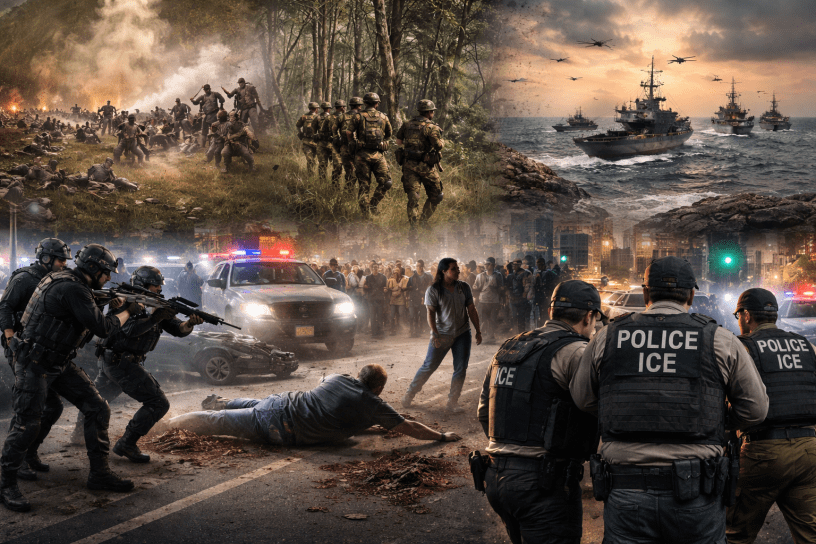
From the Civil War to Vietnam to Minneapolis, How the United States Normalized Killing Without Consequence
By Cliff Potts, CSO, and Editor-in-Chief of WPS News
Baybay City, Leyte, Philippines — February 9, 2026
Overview
Across U.S. history, large-scale death caused by state action has rarely produced legal accountability for those who ordered, authorized, enabled, or concealed it. From the American Civil War to the Vietnam War and into modern domestic policing, responsibility is often acknowledged rhetorically while consequences are avoided. The continuity across foreign warfighting and domestic law enforcement suggests a durable institutional pattern rather than isolated failure.
The Civil War: Mass Death, No Reckoning
For generations, Americans were taught that approximately 600,000 people died in the U.S. Civil War. Modern demographic research places the toll substantially higher. Using U.S. Census microdata from 1850 to 1880, historian J. David Hacker estimated approximately 750,000 deaths, with a plausible range between 700,000 and 850,000. This method captured deaths missed by battlefield records, particularly among Confederate forces and from disease.
Despite this scale of loss, senior leadership faced little accountability. Jefferson Davis was imprisoned for roughly two years but never tried for treason and was released. Robert E. Lee was never prosecuted and was later publicly rehabilitated. Amnesty was framed as national healing, even though it followed three-quarters of a million deaths and left victims without legal redress.
Hard War and Silence: Sherman’s March
Union victory narratives often omit the absence of review for actions that would later be scrutinized under the laws of war. William Tecumseh Sherman led the March to the Sea as a campaign of systematic destruction of civilian infrastructure intended to break morale. The U.S. Army’s own Lieber Code (1863) set limits on warfare and civilian protection, yet Sherman’s campaign was never meaningfully examined by a court or commission. No investigation, no charges, and no precedent-setting review followed. The lesson endured: when destruction is framed as necessary for victory, accountability becomes optional.
Vietnam’s Opening Deception
A century later, the Vietnam War repeated the pattern. Escalation rested on the Gulf of Tonkin incident, presented as unprovoked attacks on U.S. forces. Subsequent declassified records, intelligence reviews, and presidential recordings show the second attack almost certainly did not occur and that doubts were known at the time.
President Lyndon B. Johnson nevertheless used the incident to secure the Gulf of Tonkin Resolution, granting broad war powers. The war’s foundation on misrepresentation mattered: prosecuting crimes committed within the war would have exposed the original deception that enabled it.
“Tiger Country” as Policy, Not Accident
In Vietnam, “Tiger Country” referred to free-fire zones where civilians and combatants were not meaningfully distinguished. This was not a rogue invention by field units. It flowed from approved doctrine: search-and-destroy operations, body-count metrics, and incentives that rewarded kills rather than control.
Under international law, foreseeability creates liability. Civilian deaths in such zones were a predictable outcome of approved strategy, not isolated misconduct.
My Lai and the Limits of Punishment
The My Lai Massacre exposed mass civilian killing and a subsequent cover-up. Reports were falsified, complaints ignored, and investigations delayed. Only one officer was convicted, serving a limited sentence under house arrest. Higher command faced no prosecution. My Lai became infamous not because it was unique, but because it briefly pierced institutional silence.
Tiger Force: Knowledge Without Action
Decades later, investigative reporting revealed that the U.S. Army’s Tiger Force committed documented war crimes in 1967, including executions of unarmed civilians and prisoners. An internal Army investigation found credible evidence. No prosecutions followed. Files were closed. Survivors were not informed. At that point, the failure was no longer ignorance but suppression—implicating command and civilian oversight without consequence.
Responsibility Spoken, Consequence Denied
Vietnam institutionalized a familiar containment strategy: isolate blame at the lowest level, frame atrocities as breakdowns of discipline, protect policy and command from scrutiny, and move on. The same logic appeared elsewhere. After Watergate, Richard Nixon resigned but was pardoned, closing the door on criminal accountability. In the Iran-Contra affair, Oliver North saw convictions overturned on procedural grounds and later pardoned. Responsibility was acknowledged; consequences were erased.
From Battlefield to Street: The Domestic Turn
The accountability gap did not remain overseas. Doctrines and incentives normalized in war traveled home: militarized equipment, adversarial policing models, and the treatment of certain neighborhoods as hostile terrain. The result has been a domestic analogue to free-fire logic.
In the United States, police kill roughly a thousand people each year. Criminal charges are rare, and convictions rarer still. When an officer is charged, the event is so unusual that it becomes national news. Internal reviews, grand-jury processes managed by local prosecutors, and civil doctrines such as qualified immunity combine to shield both officers and leadership. Federal civil-rights intervention by the United States Department of Justice is exceptional and typically focuses on individual acts rather than command responsibility.
Fear as Justification, Training as Cost
A pivotal shift occurred in how lethal force is justified. Modern policing often treats an officer’s articulated fear as legal reasonableness—evaluated after the person is dead and without the victim’s testimony. This creates a profound asymmetry: a trained, armed professional may panic and kill, while an untrained, unarmed civilian is expected to remain calm, compliant, and rational under threat of death.
Historical evidence suggests an alternative once worked. In the 1970s, following the unrest of the late 1960s, many departments expanded judgment-based training on when not to shoot. During that period, police shootings declined in several large cities. Over time, those programs were cut as too expensive and politically inconvenient. Cheaper substitutes—equipment purchases and fear-centric instruction—replaced sustained training and supervision. Training was abandoned; legal doctrines expanded to excuse the results.
Minneapolis, 2026: Questions Without Answers
In January 2026, federal enforcement operations in Minneapolis culminated in the fatal shooting of a civilian. Initial official statements framed the event as a necessary response to threat. Video and eyewitness accounts raised questions about the sequence of events, prompting protests and calls for independent investigation. Multiple inquiries remain ongoing as of this writing.
What matters for accountability is not a verdict pre-announced, but a process applied evenly. As with earlier episodes, the risk is familiar: narrative first, evidence later; individualization of blame; delay; and eventual institutional closure without examining policy, supervision, or command responsibility.
Analysis: A Pattern, Not an Accident
Across eras, the United States has relied on delay, pardon, amnesty, and procedural dismissal to avoid applying law upward. Time becomes the enforcement mechanism. Humanitarian language is invoked after violence occurs, rarely to prevent it. If humanitarian concern justifies releasing those responsible for mass death, it should logically justify stopping the killing in the first place. Historically, it has not.
The through-line is consistent. When accountability threatens institutional legitimacy, it is deferred. When restraint costs money, it is cut. When fear can be articulated, it is excused. The result is normalization.
Conclusion
The United States does not lack legal standards for command responsibility or civilian protection. It lacks the will to apply them to its own leadership and institutions. From a civil war that killed 750,000 Americans, to a war launched on a lie and fought in free-fire zones, to lethal encounters on domestic streets, accountability has been deferred to preserve systems. History suggests that without sustained public pressure and independent oversight, it will be deferred again.
References
Hacker, J. D. (2011). A census-based count of the Civil War dead. Civil War History, 57(4), 307–348. https://doi.org/10.1353/cwh.2011.0061
Faust, D. G. (2008). This republic of suffering: Death and the American Civil War. New York, NY: Vintage Books.
National Security Agency. (2005). Gulf of Tonkin incident, 1964: Declassified documents. Washington, DC: NSA.
Hersh, S. M. (1970). My Lai 4: A report on the massacre and its aftermath. New York, NY: Random House.
U.S. Department of Justice. (Various years). Civil rights investigations and use-of-force reports. Washington, DC: DOJ.
Discover more from WPS News
Subscribe to get the latest posts sent to your email.
 WPS News