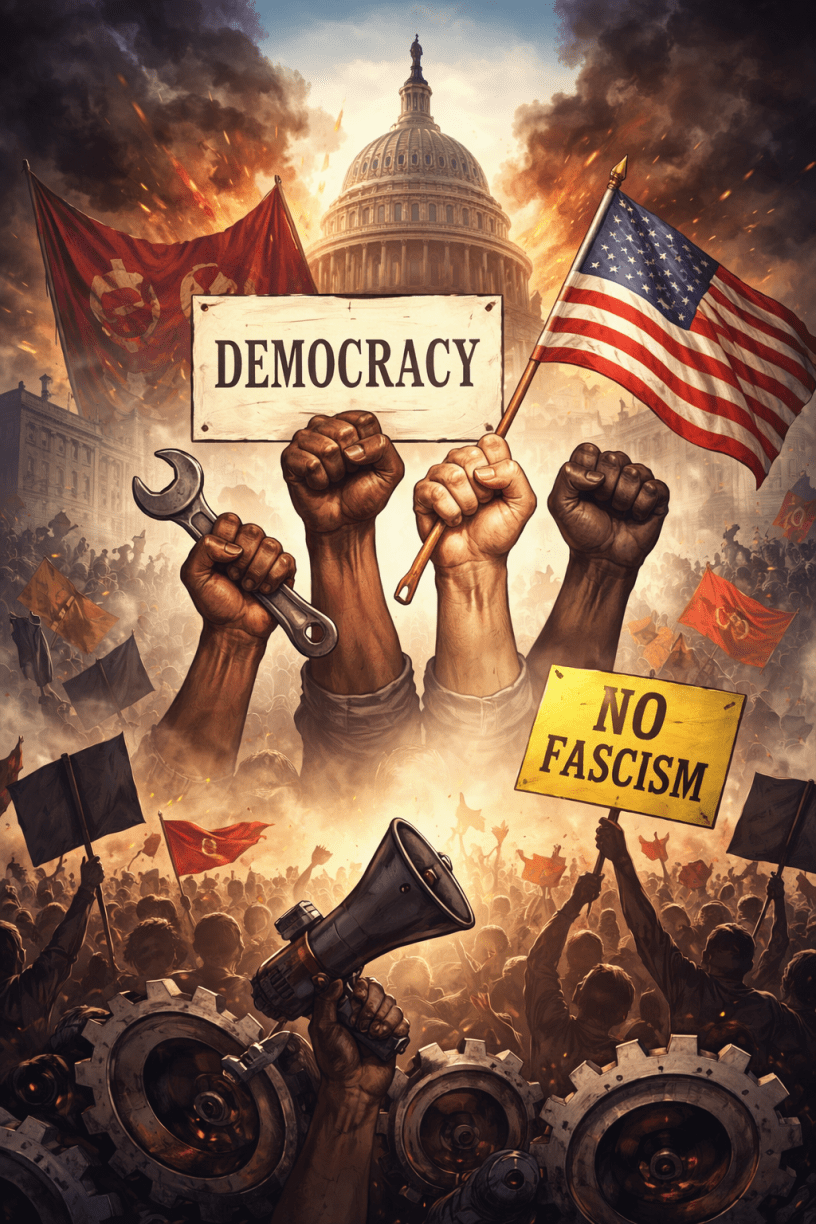
And Why the Republican Party Now Qualifies
By Cliff Potts, CSO, and Editor-in-Chief of WPS News
Baybay City, Leyte, Philippines — 7 February 2026
Fascism is not defined by aesthetics, slogans, or historical cosplay. It is defined by behavior. It is a system of power that can be identified by how an organization operates, what it tolerates, and what it seeks to dismantle. When examined through this lens, the conclusion is unavoidable: by February 2026, the Republican Party in the United States is operating as a fascist organization.
This assessment is not rhetorical and it is not partisan. It is based on widely accepted political science criteria and observable conduct. If members of the business community, civil society, or the Republican Party itself object to this characterization, the appropriate response is not outrage but reform.
Fascism Is a Pattern of Behavior
Fascism is best understood as a set of recurring traits rather than a fixed ideology. Scholars generally identify the following characteristics as central:
- Loyalty to a leader over law or institutions
- Rejection of democratic outcomes when unfavorable
- Systematic use of propaganda to replace shared reality
- Identification of internal enemies as existential threats
- Tolerance or encouragement of political violence
- Hostility toward pluralism, dissent, and minority rights
No single trait alone is dispositive. Fascism is established when these traits appear together, reinforce one another, and are normalized within an organization.
The Republican Party now exhibits this full pattern.
Leader Supremacy Over Law
In democratic systems, leaders are accountable to institutions. In fascist systems, institutions are subordinate to the leader.
The modern Republican Party has reorganized itself around the personal authority of Donald J. Trump. Legal rulings, election results, constitutional constraints, and even long-standing party principles are accepted only when they align with his interests. When they do not, they are dismissed as illegitimate, corrupt, or treasonous.
Republican officials who contradict Trump on matters of law or fact are systematically removed from leadership, censured, or forced into retirement. This is not ordinary factional politics. It is enforcement of personal loyalty, a defining feature of fascist movements.
Conditional Acceptance of Elections
Democracy requires acceptance of electoral outcomes, including defeat. Fascist movements reject this principle while preserving the outward form of elections.
The Republican Party has institutionalized a doctrine in which elections are deemed legitimate only when Republicans win. Losses are automatically framed as fraud, regardless of evidence or judicial findings. This claim persists despite repeated failures to substantiate it in court and despite bipartisan certification of results.
The purpose of this strategy is not to prove fraud. It is to permanently destabilize public trust so that electoral outcomes can be rejected at will. An organization that refuses to accept electoral defeat is not operating within a democratic framework.
Replacement of Reality With Propaganda
Fascist movements cannot tolerate independent sources of truth. Journalism, academia, and professional civil services are therefore cast as enemies rather than institutions.
The Republican Party has embraced this approach. Independent media outlets are labeled enemies of the people. Career civil servants are described as a “deep state.” Judges who rule against Republican interests are accused of treason. Facts that contradict party narratives are dismissed as hoaxes or conspiracies.
This is not skepticism or debate. It is an attempt to replace shared reality with movement-approved information, eliminating the basis for accountability.
Construction of Internal Enemies
Fascism relies on permanent internal threats to mobilize fear and loyalty. These enemies are portrayed not as political opponents, but as existential dangers.
In the current Republican framework, these targets include immigrants, LGBTQ individuals, journalists, educators, judges, and political opponents. Rhetoric routinely escalates from disagreement to dehumanization, employing language that suggests eradication rather than coexistence.
Such framing is not incidental. It prepares the public to accept repression as necessary and justified.
Normalization of Political Violence
Fascist movements rarely begin with organized violence. They begin by excusing it.
Political intimidation, threats against officials, and acts of violence that benefit Republican objectives are routinely minimized, rationalized, or reframed as understandable expressions of patriotism. Accountability is resisted, and condemnation is conditional.
This tolerance is itself a form of encouragement. When violence is excused for allies and condemned only when politically inconvenient, the boundary between lawful politics and coercion collapses.
The Organizational Conclusion
Taken together, these behaviors form a coherent system. The Republican Party prioritizes leader loyalty over law, rejects democratic outcomes it does not control, replaces reality with propaganda, identifies internal enemies, and tolerates political violence.
This is not an accusation aimed at individual voters. It is an assessment of organizational conduct. Political parties, like corporations or governments, are judged by what they do, not by how their members self-identify.
If members of the Republican Party reject the label of fascism, the remedy is straightforward: change the behavior of the organization. Restore respect for elections, law, pluralism, and factual reality. Until then, the label fits because the conduct does.
History demonstrates that fascism is most dangerous when it is recognized late and discussed timidly. In February 2026, the evidence no longer permits ambiguity.
Discover more from WPS News
Subscribe to get the latest posts sent to your email.
 WPS News