By Cliff Potts, CSO, and Editor-in-Chief of WPS News
Baybay City, Leyte, Philippines — February 7, 2026
A Moment That Was Never in the Syllabus
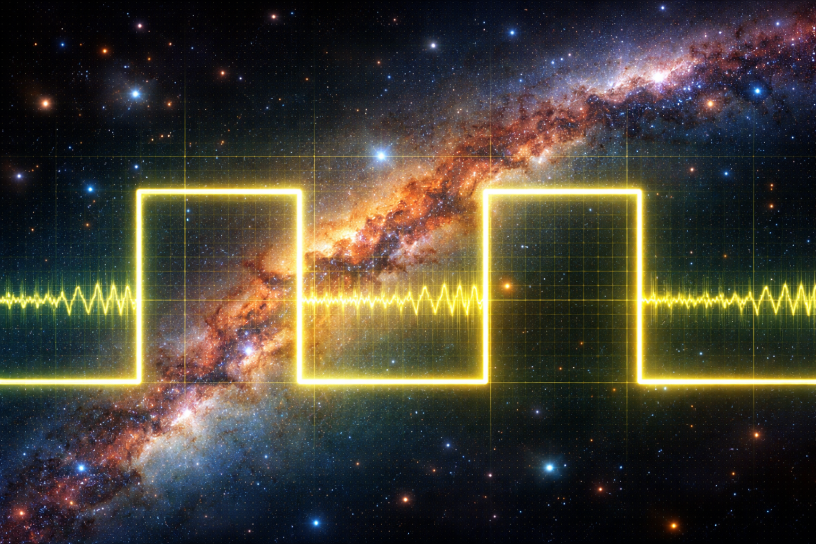
It happened during a college electronics lab, the kind meant to teach compliance, not wonder. The assignment was ordinary: wire a chip, generate a square wave, observe it on an oscilloscope, record the expected results.
Square waves are supposed to be simple. High. Low. On. Off. They are the blunt instruments of electronics—useful precisely because they are clean, predictable, and devoid of poetry.
But curiosity did not stop where the instructions ended.
Instead of pulling back once the waveform appeared correct, the scope was pushed further. The time scale tightened. The view moved inward, deeper into the edge of the signal itself—into what should have been empty space.
It wasn’t empty.
The Hum Beneath the Signal
At a certain point, a faint oscillation appeared inside the square wave. A shimmer riding the edge. A vibration that should not have existed if the waveform were truly as sterile and ideal as it appeared at first glance.
The question was simple: What is that?
The answer was not dismissive. The explanation pointed to something older and deeper than the lab setup itself—harmonics, noise floors, system responses, background influences that never fully disappear. In shorthand, a residual hum that exists everywhere, always present beneath the abstractions we impose.
Not chaos. Structure.
A reminder that even our cleanest models sit on top of something persistent and ancient.
What Was Seen — and What Was Not Claimed
This was not a revelation meant to settle arguments.
The oscillation did not need to be literally the cosmic microwave background to matter. Square waves are rich in harmonics. Oscilloscopes reveal ringing, thermal noise, quantum noise, environmental radiation, and the fingerprint of the instrument itself. All of that is real and understood.
But none of it erases the experience.
What was seen was the hum beneath certainty—the proof that sharp edges are illusions, that even our most controlled systems rest on something deeper than intention.
When people say “it’s just noise,” what they often mean is that they have no interest in looking closely.
Looking closely changes things.
Creation Is Not Silent
People are trained to look outward for beauty: galaxies, nebulae, supernovae, the violent grandeur of the cosmos. That beauty is undeniable.
But there is another kind of beauty, quieter and more difficult to explain—the realization that even at the smallest scales we can probe, the universe is not silent.
There is a background. A residue. A coherence that survives every abstraction we build on top of it.
This does not “prove” God in any simplistic sense, nor does it need to. A creator, if one exists, would not need to operate inside the system already set in motion. Science is not diminished by acknowledging that its frames are partial.
What that moment revealed was something more enduring: the universe carries a resonance that feels intentional, even if intention itself lies outside the equations.
That recognition does not violate physics. It deepens it.
Why the Moment Endures
That oscillation was not just a signal artifact. It was a reminder.
Creation leaves fingerprints. Not always in the stars. Sometimes in the smallest places, waiting for someone curious enough to keep turning the knob and brave enough to ask why.
Most people spend their lives staring at the sky.
Very few ever notice the whisper under the waveform.
This essay is archived as part of the WPS News long-form reflection series. Related cultural and philosophical writing can be found at https://Occupy25.com.
References
Hawking, S. (1988). A Brief History of Time. Bantam Books.
Planck Collaboration. (2018). Planck 2018 results: Cosmological parameters. Astronomy & Astrophysics.
Discover more from WPS News
Subscribe to get the latest posts sent to your email.
 WPS News