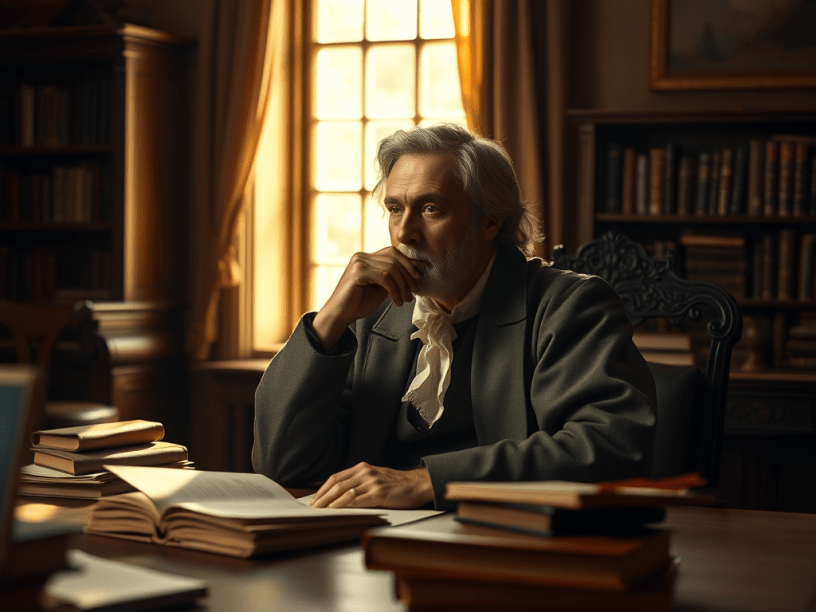
John Locke (1632-1704), a prominent English philosopher, stands as a towering figure in the development of modern political thought. His ideas on natural rights, limited government, and social contract theory continue to influence debates on governance, liberty, and human rights. This blog report explores John Locke’s philosophy, focusing on his groundbreaking contributions to the concept of universal human rights.
The Second Treatise of Government: A Cornerstone of Human Rights Thought
Locke’s most significant work on political philosophy, the Second Treatise of Government (1689), serves as a cornerstone of human rights discourse. In this treatise, Locke challenges the divine right of kings and argues for a government based on the consent of the governed.
Central to Locke’s argument is the concept of natural rights. He posits the existence of inherent, inalienable rights possessed by all humans simply by virtue of their humanity. These rights, including life, liberty, and property, are not bestowed by any government or ruler; they are pre-political and exist independently of any social contract.
Locke argues that humans are born in a state of nature, characterized by freedom and equality. In this state, individuals govern themselves through reason, using natural law to guide their actions. However, the limitations of the state of nature, such as the difficulty in enforcing natural law and the scarcity of resources, necessitate the creation of a civil society.
Here comes the concept of the social contract. Individuals, to protect their natural rights, enter into a voluntary agreement to establish a government. This government derives its legitimacy from the consent of the governed and is entrusted with the power to protect these inherent rights.
The social contract, however, is not a one-way street. According to Locke, if a government fails to fulfill its primary responsibility of safeguarding natural rights, the people have the right to revolt and establish a new government. This concept of resistance against tyranny serves as a powerful justification for revolutions aimed at establishing just and rights-respecting governments.
Life, Liberty, and Property: The Pillars of Natural Rights
Locke’s theory of natural rights revolves around three core pillars: life, liberty, and property.
- Life: The most fundamental right, the right to life, is the foundation upon which all other rights rest. Governments have the primary responsibility to protect the lives of their citizens.
- Liberty: Locke emphasizes individual liberty, including freedom from arbitrary arrest and imprisonment, freedom of thought and conscience, and freedom of religion. The government’s role is to create an environment where individuals can exercise their liberties without infringing upon the rights of others.
- Property: Locke argues that individuals have a right to the fruits of their labor. Property ownership incentivizes hard work and contributes to societal prosperity. However, Locke’s concept of property is not absolute. He suggests that individuals cannot accumulate property to the point where it deprives others of the ability to acquire the necessities of life.
These natural rights, as envisioned by Locke, are universal and extend to all individuals. This universality is a crucial aspect of his philosophy, laying the groundwork for the concept of universal human rights.
Locke’s Legacy: Impact on Human Rights Discourse
John Locke’s ideas on natural rights have had a profound impact on the development of human rights discourse. His emphasis on individual rights, limited government, and the social contract provided a philosophical framework for the American and French Revolutions, which enshrined these principles in their respective declarations of independence.
The Universal Declaration of Human Rights (UDHR), adopted by the United Nations in 1948, echoes Lockean principles. The UDHR recognizes the inherent dignity and equal rights of all human beings, outlining a set of fundamental rights that all nations are obligated to respect.
Here are some specific ways Locke’s philosophy continues to influence human rights discussions:
- Individualism and Liberty: Locke’s emphasis on individual rights and liberty continues to be a cornerstone of human rights discourse. The fight against oppression and for individual autonomy draws upon the Lockean tradition.
- Consent of the Governed: The principle of the consent of the governed, central to Locke’s social contract theory, underpins the concept of democratic governance. Legitimate governments derive their authority from the people they represent, and citizens have the right to participate in shaping their government.
- Accountability of Governments: Locke’s ideas on the right to revolt against tyrannical governments inform discussions on holding governments accountable for human rights violations. The concept of international intervention to prevent atrocities draws upon the notion of a government’s responsibility to protect its citizens’ natural rights.
While Locke’s ideas are not without their critics, his contributions to the foundation of human rights remain undeniable.
Criticisms and Considerations
John Locke’s philosophy, while influential, has not been without its critics. Some scholars argue that his focus on individual rights can lead to a neglect of social and economic justice. Others contend that his theory of property ownership can be used to justify inequality and exploitation.
Additionally, Locke’s views on slavery and colonialism have been subject to scrutiny. While he advocated for limited government and individual rights, he did not explicitly condemn slavery and even owned slaves himself. This inconsistency has led some to question the extent of his commitment to universal human rights.
Despite these criticisms, Locke’s legacy remains significant. His ideas on natural rights, limited government, and the social contract have provided a foundation for the development of human rights discourse and democratic governance.
Conclusion
John Locke’s philosophy stands as a cornerstone of modern political thought. His groundbreaking ideas on natural rights, limited government, and the social contract continue to influence debates on governance, liberty, and human rights. While his views have been subject to criticism, Locke’s contributions to the foundation of human rights discourse remain undeniable.
As we navigate the challenges of our time, Locke’s legacy serves as a reminder of the importance of individual rights, limited government, and the pursuit of a just and equitable society.Criticisms and Considerations
Discover more from WPS News
Subscribe to get the latest posts sent to your email.
 WPS News