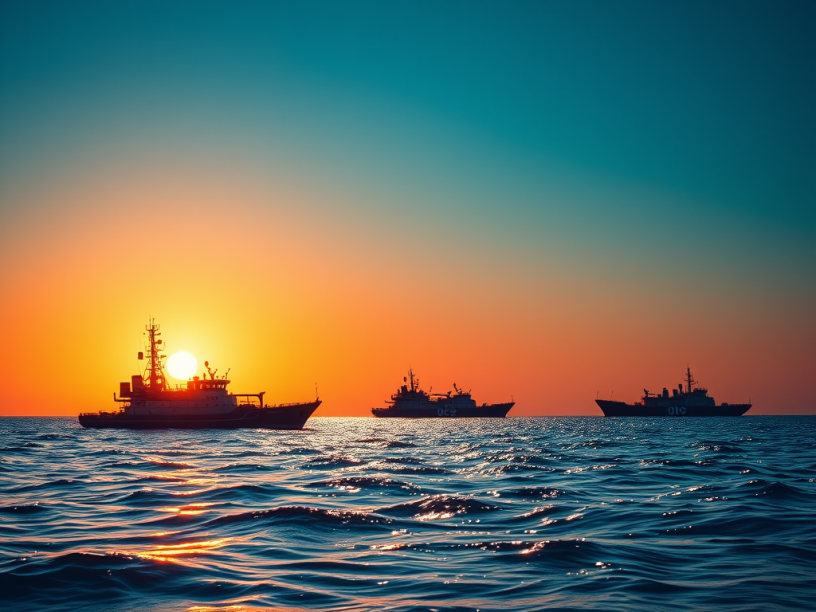
The South China Sea is a vital waterway teeming with economic activity and natural resources. However, it’s also a region fraught with tension due to overlapping territorial claims. Today, we’ll navigate these troubled waters and answer some key questions regarding the Philippines’ position in the South China Sea dispute.
How Close Are We? Distances Between China and the Philippines
The exact distance between China’s Exclusive Economic Zone (EEZ) and the Philippines’ EEZ varies depending on the specific location. However, it generally falls within a range of 150 to 350 nautical miles. Territorial waters, on the other hand, extend only 12 nautical miles from a nation’s coastline. Currently, there are no confirmed reports of Chinese vessels within the Philippines’ territorial waters.
Counting Ships: Chinese Presence in the Philippine EEZ
Monitoring the exact number of Chinese vessels in the Philippines’ EEZ is an ongoing challenge. However, reports typically mention the presence of Chinese Coast Guard (CCG) ships, Chinese Maritime Militia (CMM) vessels, and occasionally, People’s Liberation Army Navy (PLAN) ships.
Nine Dashes vs. Ten Dashes: A Cartographic Confusion
The core of the South China Sea dispute lies in China’s claim to a vast maritime area marked by a “nine-dash line” on their maps. This line encompasses a significant portion of the South China Sea, including areas well within the Philippines’ EEZ. It’s important to note that there was once a “ten-dash line” used by the Republic of China (Taiwan) but this has largely been abandoned.
UNCLOS: The Legal Framework
The United Nations Convention on the Law of the Sea (UNCLOS) is the international treaty that governs all aspects of the world’s oceans. In 2016, the Permanent Court of Arbitration (PCA) ruled in favor of the Philippines, declaring that China’s nine-dash line claims have no legal basis under UNCLOS.
Finding Diplomatic Solutions
Resolving the South China Sea dispute requires a multi-pronged approach. Here’s a suggestion:
- Strengthening ASEAN: A unified ASEAN (Association of Southeast Asian Nations) can present a stronger collective voice in negotiations.
- Open Communication Channels: Maintaining open communication channels between China, the Philippines, and other claimants is crucial.
- Peaceful Dispute Resolution: Utilizing established mechanisms like the UNCLOS framework for peaceful settlement of disputes is key.
By fostering dialogue, upholding international law, and working towards a peaceful resolution, we can navigate towards a more stable and prosperous South China Sea.
Remember: This is a complex issue, and this blog post offers a simplified overview. For further information, consult reputable sources and engage in critical thinking.
Discover more from WPS News
Subscribe to get the latest posts sent to your email.
 WPS News