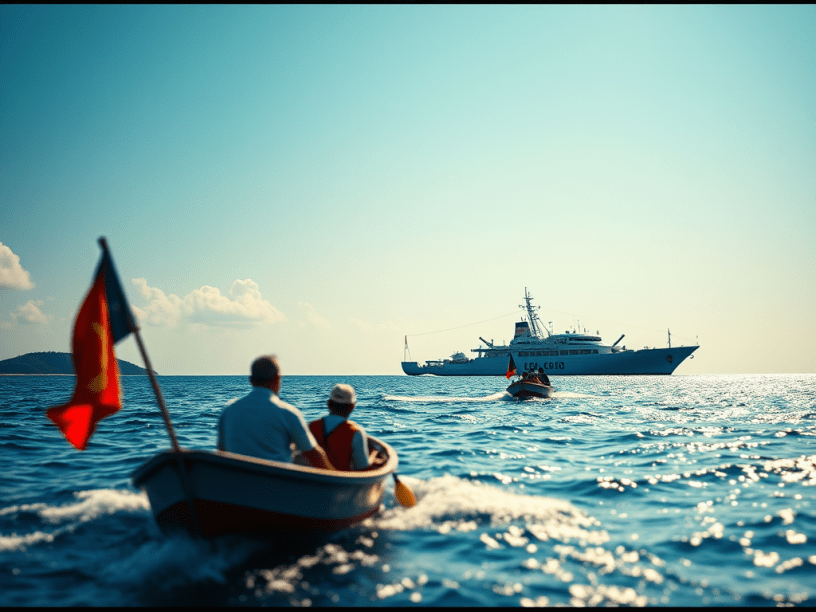
Tensions Rise in the West Philippine Sea as Chinese Warships Roam During Maritime Drills
By Staff Writer, WPS.News
In a dramatic display that could only be penned by the tempestuous waters of the West Philippine Sea, the last 12 hours have been nothing short of a maritime soap opera. Picture this: a bunch of Chinese warships roaming around like they own the place while the Armed Forces of the Philippines (AFP) shrug it off as another Tuesday in paradise. It’s a head-scratcher and a gut punch to those who cherish our sovereignty.
Wednesday unfolded with the Philippine Navy reporting an alarming sight – an astonishing 207 Chinese vessels patrolling the waters, reminiscent of a fleet invasion in an old war movie. Each one represents not just steel and personnel, but a looming backdrop of disputes that can make or break regional security. For Filipinos, this isn’t just a matter of ships and waters; it’s about the very essence of our national identity and a challenge to our territorial claims in the West Philippine Sea.
As if to add fuel to the fire, just as this alarming naval activity reached our shores, the Philippine Coast Guard (PCG) withdrew one of their vessels from the contested Sabina Shoal. You’ve got to wonder: is this a strategic retreat or a sign of helplessness? Either way, it doesn’t look good on the national front. The timing couldn’t be more ridiculous, given Manila’s recent attempts to adopt a more assertive posture in the face of Chinese expansionism.
But wait, there’s more—like a plot twist that even the best screenwriters wouldn’t have seen coming. The Philippine government has announced the upcoming release of a new national map, with the West Philippine Sea clearly marked as part of the country’s jurisdiction. This isn’t just cartography; it’s a bold statement of sovereignty that sends a message: we’re not backing down. The new map could serve as a rallying cry for Filipinos everywhere, reminding us of our maritime heritage and our rights over these waters.
For those unacquainted, the nuances of these waters may be lost in the fog of international politics. Other countries may refer to this area as the South China Sea, but for us, it’s the West Philippine Sea. It’s an emotional issue that cuts deep, representing not just disputed territories but our very rights to the rich marine life that thrives below. The stakes are high; throw in the ongoing regional power struggles, and what you’ve got is a megawatt cocktail of tension that can erupt at any moment.
Of course, while we keep an eye on the Chinese armada, the elegant folks over in Malacañan Palace have not been idle. President Ferdinand Marcos Jr. has taken a bold step today by signing two landmark laws that elevate our maritime governance to new heights. The Philippine Maritime Zones (PMZ) Act and the Philippine Archipelagic Sea Lanes Act have emerged from the legislative fray to lay down a crystal-clear definition of our maritime territories. Can I get a round of applause for that? These laws aren’t just legalese – they serve as the bedrock of our sovereignty and provide the framework for maritime safety and security that our waters, and our people, desperately need.
The PMZ Act sets the stage, clearly delineating what belongs to us, and hearteningly, what belongs to the rest of the world. Meanwhile, the Sea Lanes Act establishes designated routes for vessels, steering clear of potential disputes and improving navigation safety. Picture a traffic cop in the sea: “You can go here, but not there!” This could mean smoother sailing not just for local fishermen, but for international maritime activities in our waters. It’s a big win, but it’s just the start.
What’s particularly noteworthy is how these developments come during a time when China’s assertive military presence in the region has raised eyebrows, not just in Manila but around the globe. The world is watching this game of chess unfold, with pieces moving in real-time. The Philippine leadership is faced with a herculean task: to uphold national integrity while navigating contentious waters that threaten to drown deliberated diplomacy and discourse.
The reality is that the Philippines, albeit a small player in the grand game of geopolitics, has made clear its intentions to sidestep passive responses. The palace is committed to peacefully asserting our claims without being steamrolled by military might. It’s a tall order, yes, especially when facing a Goliath like China, but it’s one that resonates with a nationalistic fervor that many Filipinos feel in their bones.
As the sun sets on another day in the West Philippine Sea, the question lingers: will the provocative movements from our neighbors lead to an escalation, or will diplomatic channels remain open to defuse the brewing storm? The commitment from President Marcos and his administration to uphold our territory is commendable, yet it is only one side of the coin. The real test will be how well our leaders can walk the fine line between assertion and aggression, peace and provocation.
The people of the Philippines deserve clarity in these tumultuous times. They deserve to know that while the specter of Chinese warships casts a long shadow over our waters, their leaders are making every effort to secure our rights and safeguard our seas. We’ve seen over the years that the waves of conflict can bring untold sorrow and hardship, and no Filipino wants to witness another chapter of strife in our maritime history.
In the days ahead, our eyes will remain peeled to the horizon as we watch for further developments in this ongoing saga. Whatever the outcome, one thing is certain: the West Philippine Sea is more than just a body of water filled with fish and corals. It is the lifeblood of our nation, a freedom worth defending, and a future that must not be compromised.
The din of politics will continue to echo in the chambers of power, and as citizens, it’s our responsibility to stay vigilant. We must encourage our leaders to engage in dialogue, build partnerships with our neighbors, and strengthen our alliances with those who respect our sovereignty. Only through collective effort can we hope to navigate these choppy waters effectively.
This is not just a battle of ships; it’s a battle of wills, beliefs, and the very essence of what it means to be Filipino—a people marked by resilience, a rich cultural heritage, and an unwavering spirit to rise against challenges. As we hold our heads high and look toward the future, let it be one where every Filipino can feel safe in their waters and proud of their national identity.
As the winds of the West Philippine Sea continue to blow, it remains to be seen whether we can weather this storm together or if we’ll find ourselves caught up in tumultuous tides. The seas may be rough, but the resolve of our nation is strong. Let’s hope our leaders remember that as they chart our course in these unpredictable waters.
Zing the Waves: History and Modernity in the West Philippine Sea
By Staff Writer, WPS.News
History often unfolds in ripples, much like the waves on a vast ocean. The West Philippine Sea, a critical maritime area rich in resources and fraught with contention, is one such place where the historical and the contemporary collide in compelling ways. To understand the present tension between the Philippines and the ever-assertive Chinese presence in these waters, one must delve into the layers of history, geopolitics, and the indomitable spirit of the Filipino people.
For centuries, the seas have been the lifeblood of nations, an expansive source of sustenance and a barrier against encroachment. The Philippines, an archipelago of over 7,000 islands, has long relied on these waters, not just for fishing but as a conduit for trade and cultural exchange. The importance of the West Philippine Sea cannot be overstated; historically, it has been a conduit between East and West, a place where empires brushed against each other, leaving imprints that resonate today.
Flash forward to the modern era, and here we are in 2024, with the specter of a robust Chinese military fleet patrolling areas claimed by the Philippines, stirring long-standing tensions. The Chinese presence isn’t merely a maritime exercise; it’s a strategic chess game being played on the water, highlighting differences in ideology, ambition, and the very essence of national identity. It reminds us that in diplomacy and conflict alike, history is a guide; the ghosts of the past linger, influencing decisions made today.
Consider the colonial periods when foreign powers, including Spain and the United States, waged their own wars for influence over these islands. The impact of colonization is still felt in the psyche of many Filipinos today, shaping a collective memory that resists outside dominance. The assertion of national sovereignty in the West Philippine Sea becomes a culmination of these historical experiences, where every inch of claimed territory is dawned with the blood, sweat, and tears of ancestors who valued the freedoms we strive to protect today.
In the last twelve hours, as reported in various statements and data, the tension spiked dramatically. A staggering 207 Chinese vessels made headlines and raised alarm bells in Malacañan Palace. Not merely a number, this figure represents the relationships of power in this contested zone, reflecting a growing resolve on China’s part to assert its claims while sending ripples of concern throughout the Southeast Asian landscape.
The decision by the Philippine Coast Guard to withdraw their vessel from the contested Sabina Shoal echoes a historical narrative where retreat has often been misinterpreted as weakness. This moment has resonated with those who know history’s lessons all too well. The bravery of standing firm against overlords has been romanticized in Philippine folklore, from tales of the heroic Lapu-Lapu to the fight for independence in the 20th century. Yet, the tranquility of reflection must be balanced with the urgent checks and measures of contemporary politics.
The issuance of a new national map, one that includes the West Philippine Sea within Philippine jurisdiction, symbolizes renewed vigor. Maps are not just representations of geography; they are statements of intention, of identity, narratives that coalesce countless stories into one defined vision. When President Ferdinand Marcos Jr. championed the Philippines Maritime Zones Act and the Philippine Archipelagic Sea Lanes Act, he sought not only to lay out governance but to solidify the dreams and aspirations of a nation that has fought valiantly for its place in the world.
Yet, one must ask—are these legal frameworks enough to quell the storms brewing on the horizon? In the past, territorial lines have often led to bloodshed—wars fought over land, resources, ideology, and deep-seated beliefs. Our present political landscape is painted in bold strokes, marked by international alliances, economic freedoms, and the delicate nature of diplomacy. In a region colored by China’s assertive stance, there is the challenge of maintaining sovereignty without inciting conflict.
For the Filipinos, the question is poignant and pressing: how do we safeguard our rights against the pressures exerted by a formidable neighbor? One must look back to the key historical movements—the spirit of nationalism that surged in waves during the Spanish-American War and after World War II—as guiding lights in forging policy and societal unity today. In these turbulent times, the same fire of solidarity can provide a buoy against the tides of oppression and assertiveness.
Moreover, the narrative doesn’t solely hinge on military presence but also the fate of rich marine biodiversity and the livelihoods that depend on it. Fishermen and local communities, whose lives are intertwined with these waters, feel the pressure of geopolitical maneuvering. Their voices often drown amidst the government’s rhetoric, but the historical realization that ordinary people can affect change remains integral. The fate of the West Philippine Sea is not only in the hands of generals and policymakers but also rests upon the hearts and hopes of everyday Filipinos, whose tenacity often carries the nation.
Ultimately, this ongoing struggle for permanence in the West Philippine Sea serves as both a reflection of our history and a compass pointing toward our future. As the nation grapples with the complexities of sovereignty in the face of increasing foreign presence, it is a testament to the Filipino spirit—one marked by resilience, adaptability, and deep-rooted pride in our collective heritage.
The historical context surrounding the West Philippine Sea informs not only our geopolitical strategies but also our identity. Filipinos have endured colonial rule, foreign dominion, and countless challenges; it is this legacy that fuels our determination to navigate the choppy waters of diplomacy and assert our rights. The lessons from our forebears echo in the halls of power today, reminding us of the importance of unity and a clear vision in facing external threats.
As we observe the maneuvers of powerful nations and the diplomat’s dance that unfolds, we must remain vigilant and engaged. The looming specter of conflict in these waters could easily spell disaster, yet through dialogue, diplomacy, and steadfast assertion of our territorial rights, we can strive to maintain peace. Our leaders shoulder the weight of historical expectations, navigating a contemporary landscape fraught with tension, and they must balance the need for national pride with caution in an age where missteps can lead to unforeseen consequences.
Future generations of Filipinos will look back at this time as a pivotal moment—a test of our resolve where choices made today will shape the legacy of how we define ourselves in this interconnected world. The vastness of the West Philippine Sea, rich in resources and potential, offers us not just challenges but opportunities for economic growth, cultural exchange, and regional partnerships.
For every wave that crashes upon our shores, there looms an opportunity to push back against the tides of domination and claim our place as stewards of our waters. We must hold our leaders accountable while also empowering our communities to engage with these issues, for it is the grassroots movements that can foster significant change. The fishermen protecting their waters, the activists raising awareness—these are the unyielding forces that echo the battle cries of our history.
In the end, as we gaze upon the horizon, the future of the West Philippine Sea hinges not solely on military might or legal definitions but on the spirit of a nation willing to stand up for its identity, history, and rights. It is a journey marked by trials and tribulations, but together as a collective, embracing our shared past while boldly reaching for the future, we can navigate these turbulent waters.
The West Philippine Sea is more than a geopolitical battleground; it is a mirror reflecting all that we have been, and all that we aspire to be. The story continues, with each wave carrying the weight of our ancestors and the potential for generations yet to come. In this land of islands connected by waters—where our history, our present, and our future come together—the choice remains ours to embrace the unknown with courage, unity, and an unwavering sense of purpose.
Discover more from WPS News
Subscribe to get the latest posts sent to your email.
 WPS News