Dateline: December 4, 2024
By: Cliff Potts for WPS.News
As geopolitical currents shift in the Asia-Pacific, recent weeks have witnessed a convergence of events that underscores the fragile balance of power in a region marked by territorial disputes and national sovereignty. From Australia’s stern warnings concerning China’s aggressive maneuvers to the dramatic confrontations occurring in the West Philippine Sea, the need for a clear-eyed assessment of these developments has never been more pressing.
Australia’s Staunch Warning: A Call for Vigilance
Recently, Australia’s Foreign Minister, Penny Wong, issued a significant warning regarding China’s burgeoning assertiveness in maritime territories, underscoring a growing apprehension over actions that she described as attempts to “normalize dangerous behaviors.” Wong’s statement, delivered at a summit focused on regional security, highlighted various maneuvers by China that threaten not only regional stability but the established norms of international conduct.
“The necessity of collaboratively addressing these territorial issues is paramount,” Wong articulated, emphasizing the need for joint vigilance to avert potential conflicts and maintain peace in the Asia-Pacific area. Her remarks resonate profoundly with nations that view China’s approach not merely as a challenge to their sovereignty but as a deeper threat to the rules-based international order that has been a cornerstone of diplomatic relations since World War II.
Australia’s commitment to a stable regional dynamic stems from its geographical and strategic position. As a key player in the Asia-Pacific, Australia finds itself grappling with the consequences of an increasingly assertive China. The Commonwealth’s long-standing alliances, particularly with the United States, are put to the test as the rest of the world watches closely to determine Beijing’s next moves.
This broader context situates Wong’s comments not merely as political rhetoric but as a rallying cry for nations directly affected by China’s territorial ambitions. Her call for a united front against aggressive actions resonates with historical precedent, as nations across the Indo-Pacific look to ensure that sovereignty and peace are paramount.
Incidents at Scarborough Shoal: Provocations on the High Seas
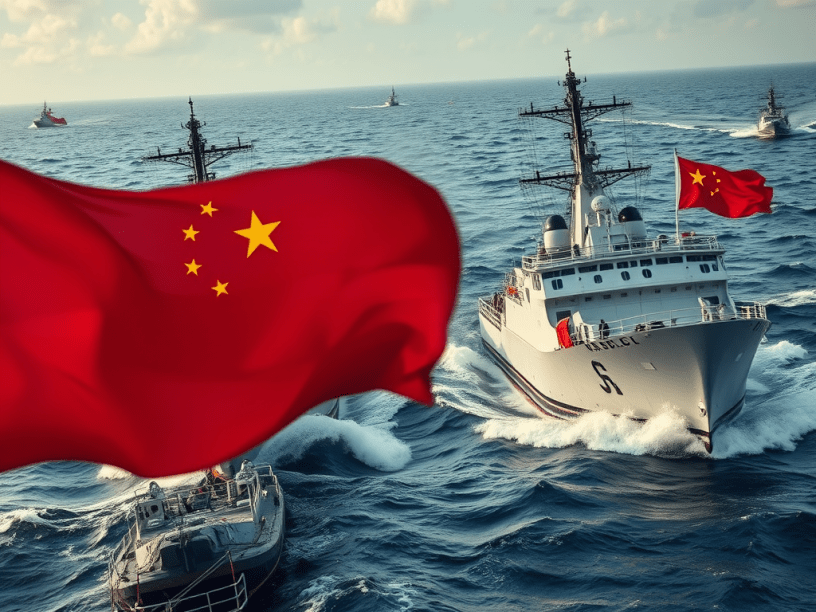
Less than a month later, as Wong’s statements continued to reverberate within the corridors of international diplomacy, tensions escalated markedly at Bajo de Masinloc, more commonly referred to as Scarborough Shoal or Panatag Shoal. Credible reports suggested that Chinese vessels had engaged in aggressive maneuvers against Philippine ships, employing tactics such as the utilization of water cannons and deliberate collisions during routine maritime patrols conducted by the Philippine Coast Guard (PCG) and the Bureau of Fisheries and Aquatic Resources (BFAR).
These confrontations signify not only a worrying trend of increasing aggression but also starkly illustrate the precarious nature of maritime relations in a region where both sovereignty and dignity are at stake. The incidents occurring at Scarborough Shoal echo a broader narrative of regional fragility, emboldened by the currents of national pride and security that characterize Filipino and Chinese interactions.
As the Philippine authorities faced renewed incursions, the geopolitical implications of these confrontations were impossible to ignore. For the Philippines, a country still grappling with the shadows of colonial history and foreign influence, the reality of Chinese presence in these territorial waters cannot be underestimated.
The incidents at Scarborough Shoal embody a struggle that reaches beyond diplomacy, touching upon the fundamental rights of nations to self-determination and the protection of their maritime borders. Such actions by Chinese vessels not only provoke immediate tensions but raise questions about broader strategies employed by Beijing to assert dominance over disputed maritime territories and potentially rewrite the unwritten rules of engagement.
Interestingly, on the same day as these confrontations, a fire was reported in a residential area of Manila, adding another layer to the atmosphere of distress permeating the country. Such incidents, while seemingly unrelated, contribute to an overarching narrative of uncertainty in these turbulent times.
The Philippine government’s response to these maritime incursions will be crucial, as the administration navigates the fine line between confronting aggressors and maintaining diplomatic channels. The historical context of the Philippines’ relations with China, coupled with its alliances with Western powers, highlights the complexity of a region that has long served as a chessboard for global ambitions.
Digital Discourse: Ideological Battles Amidst Growing Tensions
Adding a nuanced layer to this ongoing saga of territorial disputes is an early morning digital exchange that recently caught the attention of analysts and social media observers alike. This online confrontation between C.S., a participant with an unusually formal command of English, and B., a local blogger, vividly illustrated the complexities intertwined in cultural perceptions and geopolitical narratives.
The conversation began innocently enough, with B. engaging C.S. in a casual dialogue. However, as it progressed, C.S.’s remarks unveiled an ideological bend that seemed oddly aligned with the narratives propagated by Chinese operatives. She questioned B. on American involvement in the Philippines while defending Chinese policies. B.’s incredulity grew as he confronted C.S. with her unfamiliarity regarding basic cultural references such as the “thumbs up” emoji and the concept of a “geek.” His concern raised pertinent questions about her true identity and motives. The exchange escalated as B. challenged her perspectives on U.S. foreign policy and the implications of China’s growing influence in the region, ultimately leading to a heated disagreement.
This digital exchange, which might seem trivial on the surface, reflects deeper ideological battles that are occurring simultaneously with physical confrontations in maritime zones. The dialogue hints at an infiltration of narratives that shape how individuals perceive their national identities in an age when information is rapidly disseminated and can easily influence public sentiment.
C.S.’s statements revealed a troubling dissonance that some analysts deemed indicative of a broader strategy to undermine trust in the U.S. among Filipinos—a strategy that could fuel discontent and shift national sentiment to a more favorable view of Chinese policies. The episode serves as a reminder of the evolving landscape of information warfare, where social media and internet discourse are leveraged as tools for geopolitical influence.
These instances of ideological confrontation serve as powerful indicators of the underlying tensions in the Asia-Pacific. They underscore how individuals and nations alike must navigate the intricate webs of national loyalty, cultural identity, and the influence of external actors in shaping their realities.
The Implications Ahead: A Call for Collective Action
As tensions mount, the implications of recent events extend beyond maritime confrontations and ideological exchanges. They lay bare the necessity for regional allies to come together and formulate a cohesive strategy that guards against the normalization of aggressive maneuvers that threaten stability.
Australia, under Wong’s guidance, continues to position itself as a critical player in rallying support to protect the established norms of international conduct. Her statements served to galvanize support from like-minded nations, emphasizing the importance of a united front against the encroaching threats to sovereignty faced by regional neighbors.
Similarly, the recent incidents in Scarborough Shoal have compelled the Philippine government to reevaluate its strategies for addressing territorial disputes and maritime security. As they continue to negotiate the delicate balancing act between diplomacy and defense, the support of allies will be fundamental in asserting their presence and preserving their rights in contested waters.
Given these escalating tensions, all parties involved must recognize the gravity of the situation. The potential for miscalculation is high; misunderstandings could quickly spiral into open confrontations that may have dire consequences for regional peace.
For Southeast Asian nations, the path forward must involve rigorous dialogues, both within their borders and with strategic partners like the U.S. and Australia. It demands a shared commitment to uphold international law, respect for territorial integrity, and a unified approach to addressing the rise of aggressive actions that threaten the fragile fabric of peace in the region.
Conclusion: The Road Ahead
The interplay of external pressures, cultural narratives, and territorial assertions defines the current state of affairs in the Asia-Pacific. As Australia amplifies its commitment to a rules-based order and the Philippines struggles with ongoing maritime encounters, the resonance of these issues ripples across borders, shaping perceptions, alliances, and strategies.
The confluence of physical confrontations in contested waters and ideological skirmishes online illustrates a complex tapestry in which each thread contributes to the broader narrative of power dynamics in the region. How nations respond to these incidents will prove crucial—not only in safeguarding their sovereignty but in fostering a sense of unity in an increasingly polarized world.
As 2024 unfolds, the significance of these events will continue to grow, demanding the attention of policymakers, analysts, and the public alike. The challenges ahead are formidable, but with concerted and coordinated efforts, there remains the possibility of steering toward a future that upholds peace, stability, and mutual respect among nations in this vital region.
Ultimately, understanding and addressing the multi-faceted implications of recent developments will be pivotal in securing a cooperative and secure Asia-Pacific for generations to come. As local and global actors engage in these critical dialogues, the stakes have never been higher; the future of this geopolitically significant region hangs in the balance.
Discover more from WPS News
Subscribe to get the latest posts sent to your email.
 WPS News