Cliff Potts, WPS News, Editor-in-Chief
Baybay City, Philippines | January 21, 2025
This discussion goes back to the days when Bush 43 invaded Iraq predicated on a lie. The same people who now ware Chinese MAGA ball caps, will probably dredge it up again as the Musk/Trump Presidency go adventuring around the globe.
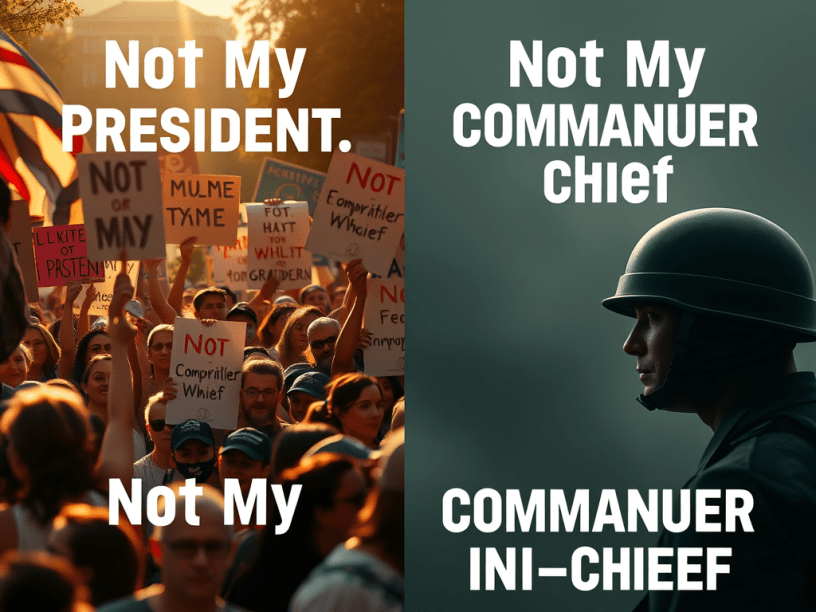
In the landscape of political discourse in the United States, few phrases have become as emblematic of dissent as “not my president.” This phrase encapsulates a deep-seated frustration with the perceived legitimacy of those in power, particularly in a nation that prides itself on democratic ideals. However, when we juxtapose it with the phrase “not my commander-in-chief,” we uncover significant differences rooted in context, implications, and societal perceptions.
Political Legitimacy vs. Military Authority
The phrase “not my president” is inherently political. It serves as a rejection of an individual’s authority in a democratic sense, asserting that the presidency lacks the consent of certain factions within the public. This sentiment gained notable traction during and after the 2016 and 2020 elections, particularly among segments of the population who felt disenfranchised or alienated by the electoral process. The use of this phrase highlights the division within a democracy, where the acceptance of leadership relies heavily on collective agreement.
In contrast, “not my commander-in-chief” invokes a military context, which complicates the dialogue further. The president’s role as commander-in-chief is more than a mere title; it comes with the profound responsibility of leading the armed forces. For civilians, claiming “not my commander-in-chief” can suggest a detachment from a military framework that many do not personally engage with. While military dissent is a crucial aspect of democracy, the implications and consequences of rejecting the authority of a commander-in-chief can be markedly more severe because it can undermine military cohesion and national security.
Emotional Resonance
These phrases also carry distinct emotional resonances. “Not my president” can resonate with feelings of disillusionment and disenfranchisement, giving voice to those who feel marginalized in the political process. It often captures the sentiments of those who view the presidency as a symbol of national identity, representing not only leadership but also the moral compass of the nation.
Conversely, “not my commander-in-chief” lacks that broad emotional appeal for most non-military citizens. This phrase tends to be more technical and abstract, as it operates outside the everyday experiences of civilians. While it still conveys dissent, it does so in a way that is often situated within discussions of policy or military action rather than emotional attachment to democratic ideals. In this view, the commander-in-chief is seen as a public servant rather than a direct representative of the people, making it less personal and more institutionalized.
Societal Perception and Real-World Impact
The societal implications of these phrases cannot be understated. “Not my president” has become a rallying cry among activists and dissenters, empowering movements aimed at political change and accountability. It fosters community among those who share similar sentiments, and it has the power to galvanize efforts for protest and reform.
On the other hand, “not my commander-in-chief” lacks the same communal aspect, often relegated to political nerds, analysts, or those directly involved in military service. The phrase is less likely to incite mass mobilization and more likely to be met with responses grounded in the legality and ethical responsibilities of military service. This divergence reflects the different mechanisms through which political dissent operates within civilian versus military contexts.
Conclusion
Ultimately, both phrases represent forms of dissent, yet they serve different purposes and resonate with distinct audiences. “Not my president” reflects the emotional landscape of a politically divided populace, while “not my commander-in-chief” invokes a more technical critique of military authority. Understanding these disparities sheds light on broader discussions regarding identity, legitimacy, and responsibility within the frameworks of American democracy and governance.
Discover more from WPS News
Subscribe to get the latest posts sent to your email.
 WPS News