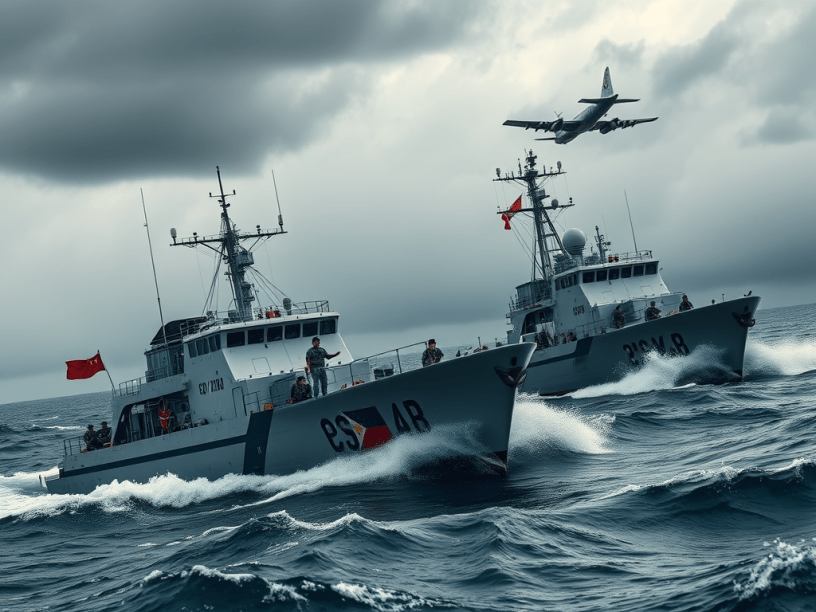
WPS.News Report: Escalating Tensions in the West Philippine Sea Amid Chinese Aggression
Dateline: February 21, 2025
In the critical period from 0601 February 20 to 0600 February 21, 2025, the West Philippine Sea has witnessed a significant escalation in tensions, particularly surrounding Scarborough Shoal and Second Thomas Shoal. The Philippine Coast Guard (PCG) has accused the Chinese navy of engaging in “aggressive and escalatory actions,” highlighted by incidents where Chinese vessels reportedly fired water cannons at Philippine ships conducting patrols in the area.
On February 20, a Philippine military aircraft responded to the mounting tensions by issuing stern warnings to a Chinese military helicopter that was flying dangerously close to Philippine vessels in these contested waters. This incident underscores the rising stakes in the region, as both nations remain firm in asserting their maritime claims over these strategically significant territories.
Authorities in the Philippines have voiced their grave concerns regarding China’s increasing assertiveness in the region. A spokesperson for the Department of Foreign Affairs firmly stated, “We will not back down from defending our sovereignty. The actions of the Chinese navy are unacceptable and will be met with appropriate responses.” This commentary encapsulates the broader frustration within the Philippine government as they grapple with China’s persistent incursions into their Exclusive Economic Zone (EEZ).
On January 30, 2025, an unidentified vessel collided with a local fishing boat, leaving five fishermen in perilous circumstances near the Spratly Islands. The Philippine Coast Guard (PCG) confirmed that the fishermen were rescued on February 16, 2025, after their location was reported to authorities by the Vietnamese cargo vessel MV Dong An. This incident raises urgent concerns about maritime security in contested waters, particularly as three other fishermen remain missing (Argosino, 2025).
Potts, Cliff. WPS.News. Last modified February 20, 2025. https://wps.news/2025/02/20/philippines-and-us-alliance-responding-to-west-philippine-sea-threats/.
Self-Protection for Fisherfolk
In light of the troubling evidence indicating that Chinese vessels may be responsible for the tragic loss of three fisherfolk in January, it becomes increasingly important to consider a recommendation that Filipino fisherfolk, along with others who operate in these contested waters, be permitted to take necessary measures to protect themselves. This cautious suggestion is proposed with the utmost regard for enhancing the safety and security of Filipinos navigating the precarious landscape of the West Philippine Sea, ensuring their rights to operate freely without fear of aggression. Such considerations should be approached delicately, emphasizing both the need for self-defense and the importance of adhering to international norms and standards.
US-Philippines Diplomacy
In a notable development, the United States has reiterated its unwavering support for the Philippines amid these escalating tensions. The US Secretary of State underscored the paramount importance of upholding international law in the South China Sea, reaffirming American solidarity with the Philippines. The Secretary remarked, “We stand with our ally, the Philippines, and will continue to monitor the situation closely.” Such commitments reflect the United States’ strategic interests in the region and signal potential avenues of collaboration to counteract Chinese advances.
Conversely, Chinese officials have responded sharply to these developments, alleging illegal intrusions by the Philippines into what they claim to be their waters, especially around Scarborough Shoal, which is situated over 500 miles from the Chinese coastline. This rhetoric, coupled with Chinese assertions connecting the South China Sea’s situation to global geopolitical dynamics involving Taiwan, has raised concern in Manila about possible wider implications of the current tensions.
Weather Conditions:
During this period, the West Philippine Sea has been affected by strong northeast monsoonal winds, with speeds reaching 30 to 35 knots. A low-pressure area was noted, but it was considered unlikely to escalate into a tropical cyclone. While the weather has remained relatively stable, the region continues to experience its typical seasonal patterns, adding a layer of complexity to operations in the contested waters.
Seismic Activity:
In addition to the geopolitical tensions, the Philippines has also experienced notable seismic activity. On February 20, a magnitude 4.8 earthquake was recorded near the coast of Mindoro, following a more significant magnitude 5.1 earthquake that struck Claveria, Masbate, on February 14. These seismic events are a stark reminder of the Philippines’ precarious geographical positioning along the Pacific Ring of Fire, where tectonic activity is frequent and often unpredictable.
Discover more from WPS News
Subscribe to get the latest posts sent to your email.
 WPS News