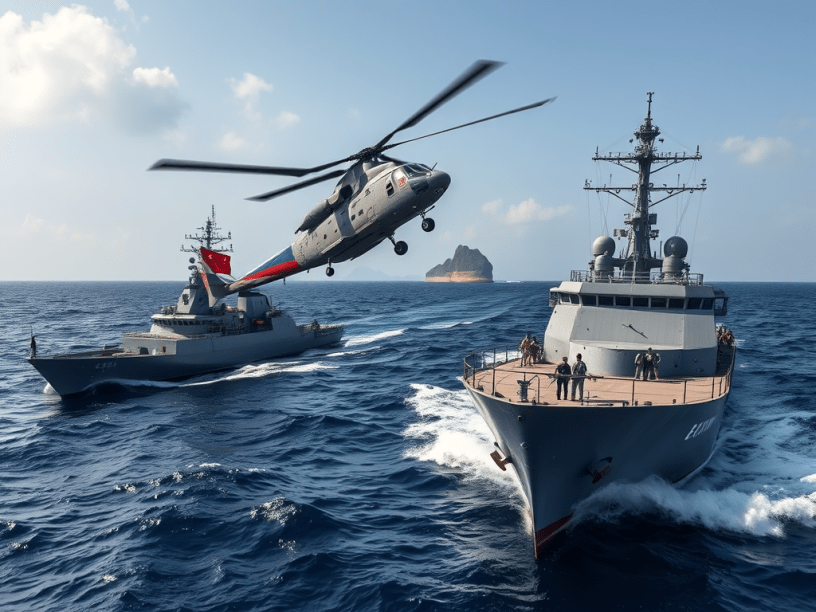
In a significant escalation of maritime tensions, the Philippine Coast Guard has reported a series of aggressive maneuvers by Chinese naval forces in the West Philippine Sea over the past two days, specifically around the strategic hotspots of Scarborough Shoal and Second Thomas Shoal. This alarming trend underscores the increasing assertiveness of China in the region and has prompted the Philippine government to adopt a stronger stance against what it characterizes as violations of its territorial waters.
On February 22, 2025, Philippine officials voiced serious concerns after accusing Chinese naval assets of executing perilous flight maneuvers near Philippine surveillance aircraft. A noteworthy incident involved a Chinese navy helicopter reportedly flying perilously close — within just 10 feet — of a Philippine patrol plane, triggering significant safety alarm bells regarding the operational integrity in these contested waters.
Philippine Defense Secretary Carlito Galvez made a resounding declaration: “We will not back down from protecting our sovereignty. The actions of the Chinese navy are provocative and unacceptable.” This statement resonates strongly with the government’s unwavering commitment to uphold its territorial rights in the West Philippine Sea, now referred to as such in all official communications, reflecting a strategy designed to solidify national resolve.
In response to these rising tensions, the United States and the Philippines performed joint maritime patrols over Scarborough Shoal, signaling an important show of solidarity against Chinese aggression. Although remarks from U.S. Secretary of State Antony Blinken regarding the implications for Taiwan and Philippine territory during this turbulent period have yet to be disclosed, the U.S. has consistently reaffirmed its commitment to defending its allies in the region.
Weather conditions during this tumultuous period in the West Philippine Sea have remained relatively favorable, featuring clear skies and moderate sea conditions conducive to uninterrupted maritime operations. However, beneath this calm surface, the geopolitical climate continues to be fraught with tension as both the Philippines and China vie for control over disputed territories.
Sidebar: Seismic Activity in the Philippines
Coinciding with these international tensions, the Philippines has also faced notable seismic activity. On February 22, 2025, a moderate earthquake measuring 4.8 on the Richter scale struck approximately 36 kilometers southeast of Borongan City, Eastern Samar. Additionally, a light earthquake measuring 3.3 was recorded near Siargao Island in the early hours of February 23. The Philippine Institute of Volcanology and Seismology (PHIVOLCS) is vigilantly monitoring these seismic events as they unfold.
Tragic Impact of Maritime Aggression:
Filipino Fishermen Missing and Government’s Response Under Scrutiny
On January 13, three Filipino fishermen went missing after their boat was rammed by an unidentified vessel, widely believed to be a Chinese patrol craft. This incident occurred in the maritime waters near Vietnam, raising serious concerns about the safety of Filipino fishermen in contested regions. Five surviving fishermen managed to stay alive by consuming fish and algae while adrift at sea. They were rescued by a Vietnamese fishing vessel on February 14 after being spotted on their damaged boat, with the Philippine Coast Guard confirming their recovery on February 16, 2025.
Unfortunately, the three missing fishermen are now presumed dead after falling overboard during the collision. Their families and local communities are mourning their loss and are urging the Philippine government and international stakeholders to take decisive action to protect the rights and security of Filipino fishermen amid increasing maritime aggression. This incident underscores the urgent need for stricter enforcement of maritime laws and diplomatic efforts to address rising tensions in the region.
President Ferdinand Marcos Jr. has expressed a readiness to consider military action if Filipino fisherfolk are harmed due to Chinese aggression in disputed waters. This assertive stance reflects the heightened tensions in the South China Sea and emphasizes the Philippines’ commitment to safeguarding its citizens and sovereignty. The Marcos administration prioritizes the protection of Filipino fishermen operating in these contested areas, signaling a critical moment in the Philippines’ approach to territorial integrity and citizen safety.
However, it appears that there has been limited action taken by the Marcos administration in response to this incident, with the primary focus being the continuation of increased Philippine Coast Guard (PCG) patrols in the contested waters. Notably, it was a Vietnamese fishing boat that rescued the surviving fisherfolk, highlighting the importance of regional maritime cooperation. President Marcos has acknowledged the efforts of the PCG in ensuring the safety of Filipino fishermen; however, there is growing concern and a call for more concrete actions to support the fisherfolk, particularly regarding their rights to fish freely and safely in the West Philippine Sea (WPS). As tensions continue to rise, stakeholders are urging the government to take more decisive measures to ensure the protection and welfare of those who depend on these waters for their livelihood.
As the situation develops, the government’s actions will be closely monitored both domestically and internationally, particularly in light of the ongoing challenges posed by regional maritime disputes. The contrast between the administration’s rhetoric and the actual measures taken raises questions about the effectiveness of its response to the pressing needs of Filipino fishermen in these contested waters.
Discover more from WPS News
Subscribe to get the latest posts sent to your email.
 WPS News