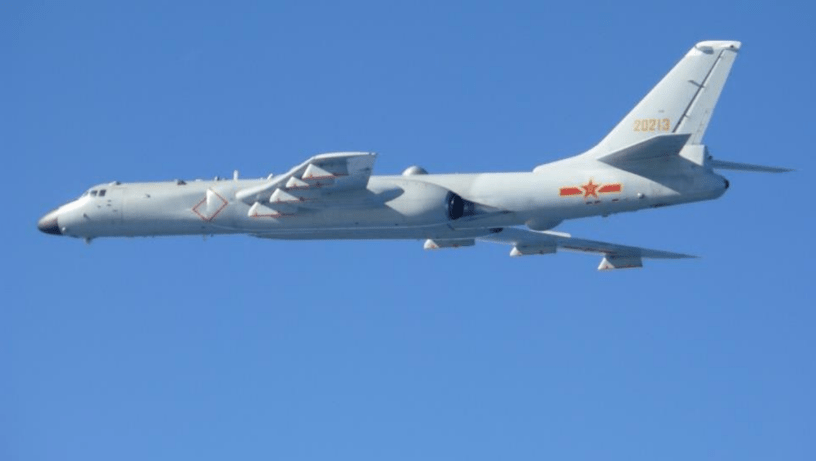
Baybay City | April 1, 2025 — As the sun dips below the horizon, casting a sepia glow over the troubled waters of the South China Sea, a new chapter unfolds in one of the world’s most contested regions. Recent deployments of Chinese long-range H-6 bombers around the Scarborough Shoal signal an alarming escalation in military posturing by Beijing. This move coincides with significant diplomatic engagements, such as the recent visit by U.S. Defense Secretary Pete Hegseth to the Philippines, indicating a complex web of geopolitical strategies that could have far-reaching implications.
Satellite images captured by Maxar Technologies reveal the deployment of two H-6 bombers, not publicly announced by China, positioned strategically near the contested Scarborough Shoal, also known to the Chinese as Huangyan Dao. Experts suggest the timing of this military maneuver is anything but coincidental. Peter Layton, a defense analyst from Australia’s Griffith Asia Institute, posits that Beijing is broadcasting a message—asserting that it possesses a sophisticated military capable of significant long-range strikes, much like their U.S. counterparts.
The Scarborough Shoal has long been a flashpoint. Control of this atoll, which the Philippines asserts lies within its exclusive economic zone, was seized by China in 2012, setting the stage for recurring confrontations between Chinese coast guard vessels and Philippine fishermen. In recent weeks, accusations have flown between these parties, with the Philippine Coast Guard alleging dangerous maneuvers by the Chinese Navy in the area—a testament to the growing volatility.
In the backdrop of this aerial show of strength, Hegseth’s visit to Manila highlighted the United States’ renewed commitment to its mutual defense treaty with the Philippines. During his discussions with Philippine officials, he emphasized the need for enhanced deterrence against what he characterized as Chinese aggression in the region. This rhetoric serves to solidify the U.S.-Philippine alliance, uniting them against a common threat that looms over the South China Sea like a storm cloud.
The Pentagon’s latest assessments suggest a calculated modernization of the H-6 bombers, which, while based on Soviet-era designs, have seen significant upgrades allowing them to deliver an array of weapons, including nuclear-tipped ballistic missiles. The suggested development of a more stealthy variant of this bomber raises additional questions about China’s long-term strategies in the region. The bombers’ capabilities reinforce China’s narrative of maintaining control over the majority of the South China Sea, where approximately $3 trillion in commerce transits annually.
Beyond the military might displayed through the deployment of bombers, the situation also underscores the intricate nature of international laws governing these waters. A 2016 ruling by an international tribunal in The Hague deemed China’s expansive claims to the South China Sea without legal basis, a decision Beijing has steadfastly ignored. This defiance reverberates throughout the region, emboldening China’s maritime assertiveness and stoking fears among neighboring states.
Meanwhile, the United States remains vigilant, moving forward with military drills alongside the Philippines and Japan—demonstrations of solidarity aimed directly at countering China’s belligerence. This constant game of geopolitical chess, characterized by military maneuvers, verbal sparring, and international diplomacy, positions the South China Sea as a potential flashpoint for broader conflict.
As the sun rises on another day in the South China Sea, the waters remain restless, reflecting the tensions above. Both sides prepare for what could be a prolonged struggle for dominance—a battle not just for territory, but for the future of maritime sovereignty in an increasingly multipolar world. The world watches, holding its breath, as the shadow of conflict looms ever larger.
Discover more from WPS News
Subscribe to get the latest posts sent to your email.
 WPS News