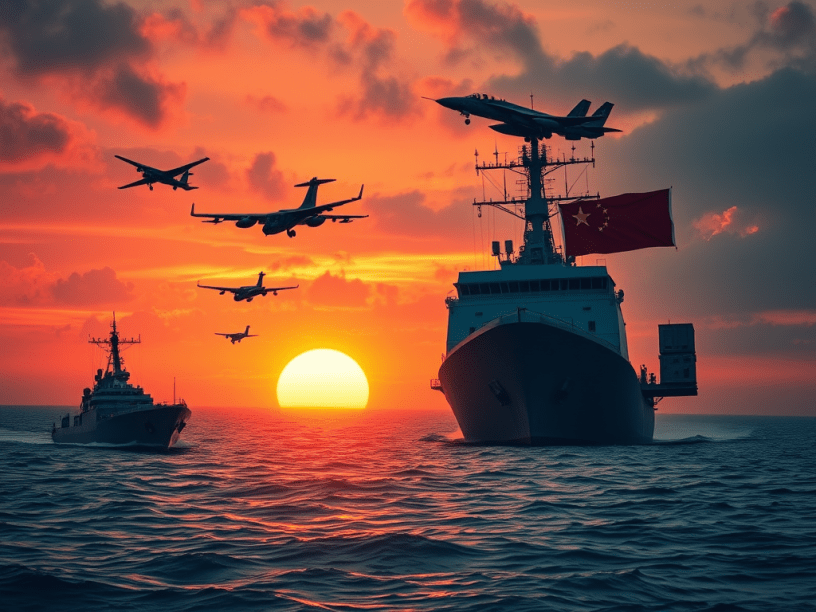
Baybay City | April 2, 2025 — On April 1, 2025, tensions surged in East Asia as China launched large-scale military drills around Taiwan, sending shockwaves through the region and raising alarms in countries around the world. These exercises are not just routine maneuvers; they represent a significant intensification of military pressure from Beijing, signaling China’s determination to assert its claims over Taiwan, which it views as a wayward province.
The Chinese military, known as the People’s Liberation Army (PLA), conducted operations that involved navy, air, ground, and rocket forces. According to Chinese officials, these drills serve as a “severe warning” against what they call “Taiwan independence.” They have portrayed the government in Taipei, led by President Lai Ching-te, as “separatists” and even labeled him a “parasite,” engaging in a campaign of propaganda intended to vilify Taiwan’s leadership.
Taiwan’s Ministry of National Defense was quick to respond to these provocations. Over a 24-hour period, the island nation tracked 19 Chinese navy vessels and reported that the Shandong aircraft carrier had entered Taiwan’s air defense identification zone. In response, Taiwan dispatched military aircraft, activated land-based missile systems, and prepared its navy for potential confrontations. Defense Minister Wellington Koo remarked that these actions clearly demonstrated China’s intent to undermine stability and peace in the region.
Observers noted that the drills were launched without warning, highlighting Beijing’s unpredictable military posture. The command structure of the East Theater, which manages operations in this critical area, stated that the exercises focused on combat readiness, air interceptions, and multi-directional precision strikes. They also involved the integration of the Coast Guard and civilian vessels into military exercises, a tactic Beijing often employs to blur the lines between military and civilian operations.
The situation is made more complex by recent visits from U.S. officials, including Defense Secretary Pete Hegseth, who emphasized the need for strong alliances with Japan and the Philippines to counter Chinese aggression. The United States, while not obligated to defend Taiwan militarily, has maintained a policy of strategic ambiguity. This means that while the U.S. supports Taiwan’s defense, it does not declare explicitly whether it would intervene in a conflict. However, the ongoing drills and heightened rhetoric from Beijing could test this delicate balance.
In a stark response to the military drills, Taiwan’s Presidential Office condemned China’s actions, asserting that Beijing was “the world’s biggest troublemaker.” The office also accused China of escalating tensions not just around Taiwan, but across the broader Indo-Pacific region, mentioning drills near Australia, Japan, South Korea, and the Philippines.
China’s Taiwan Affairs Office declared that it would not tolerate what it regarded as provocations from Taiwan’s government. In a statement, they warned that the pursuit of Taiwan independence would only push the island’s people into a “dangerous situation of war.” Such language reflects China’s ongoing commitment to reclaiming Taiwan, regardless of the cost.
As military exercises unfolded, Chinese propaganda circulated widely, depicting aggressive military maneuvers as part of its strategy to assert control. Videos portrayed the military surrounding Taiwan and dramatized potential attacks on the island. This aggressive messaging is seen as an attempt to sway both domestic and international opinion against Taiwan.
While Taiwan has consistently asserted its right to self-government and has sought to strengthen its military partnerships, the actions from China raise critical questions. How far is Beijing willing to go in its quest to reclaim Taiwan as a part of its territory? What will be the response from the international community?
These military exercises around Taiwan are not just about posturing; they signal a growing reality of tension that could lead to conflict. As the world watches, the stakes continue to rise for Taiwan, China, and the stability of the entire region. It is a situation that calls for wisdom and restraint from all parties involved. We must remember that peace is the ultimate goal, and war should always be the last resort.
Sources:
- Summers, C. (2025, April 1). Beijing carries out military drills near Taiwan and warns against independence. NTD Television. https://www.ntd.com/beijing-carries-out-military-drills-near-taiwan-and-warns-against-independence_1057770.html
- GT staff reporters. (2025, April 1). PLA stages joint drills around Taiwan in stern warning to secessionists. Global Times. https://www.globaltimes.cn/page/202504/1331336.shtml
- Malyasov, D. (2025, April 1). Chinese warships and carrier surround Taiwan in new drills. Defence Blog. https://defence-blog.com/chinese-warships-and-carrier-surround-taiwan-in-new-drills/
- AFP Staff Writers. (2025, April 1). Philippines ‘inevitably’ involved if Taiwan invaded; As China holds large-scale naval drills. Space Daily. https://www.spacewar.com/reports/Military_chief_says_Philippines_inevitably_involved_if_Taiwan_invaded_999.html
- Barron, S. (2025, April 1). Trump administration opposes Chinese war games near Taiwan. Newsmax. https://www.newsmax.com/newsfront/china-taiwan-war-games/2025/04/01/id/1205285/
- Cash, J., Lee, Y., & Blanchard, B. (2025, April 1). China launches military drills around Taiwan, calls Taiwan president a ‘parasite’. Reuters. https://www.reuters.com/world/asia-pacific/chinese-military-says-it-is-conducting-exercises-around-taiwan-2025-03-31/
- Davidson, H. (2025, April 1). China launches surprise military drills around Taiwan. The Guardian. https://www.theguardian.com/world/2025/apr/01/china-launches-surprise-military-drills-around-taiwan
- WFIN Local News. (2025, April 1). China launches large military drills around Taiwan to issue ‘severe warning’. WFIN Local News. https://wfin.com/fox-world-news/china-launches-large-military-drills-around-taiwan-to-issue-severe-warning/
Discover more from WPS News
Subscribe to get the latest posts sent to your email.
 WPS News