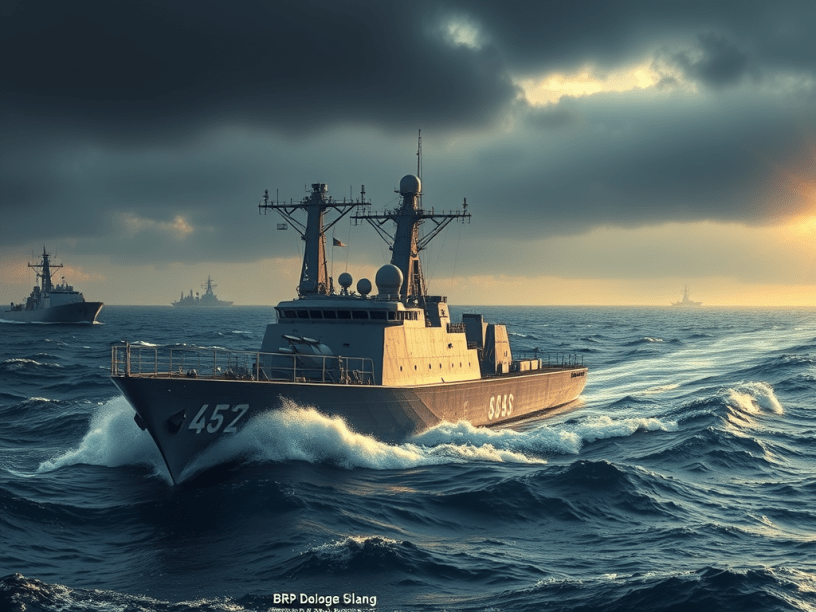
In the vast waters of the West Philippine Sea (WPS), a different kind of battle is underway—one that does not involve swords and shields but rather ships and strategies. As tensions escalate between the Philippines and China, authorities are ramping up their efforts to safeguard the country’s maritime interests. The stakes are higher than ever, with recent developments suggesting a turning point in the ongoing tug-of-war over these crucial waters.
At the heart of this effort lies the Philippine Navy’s decision to reorganize and enhance its naval capabilities. Rear Admiral Roy Vincent Trinidad, the spokesperson for the Navy in the WPS, emphasized that the Navy is taking decisive steps to strengthen its defense and security measures. This includes a modernization initiative to deploy new ships, such as the guided-missile corvette BRP Diego Silang.
Senator Francis Tolentino has been a vocal advocate for this transformation, stating that a dedicated West Philippine Sea Command could significantly improve coordination between the Navy, the Philippine Coast Guard, and the Philippine National Police Maritime Group. “This will enhance our response capabilities and ensure that all forces are unified in protecting our sovereignty,” Tolentino said.
Recent reports indicated that the reorganization also stems from strategies laid out in the Comprehensive Archipelagic Defense Concept (CADC) that seeks to bolster the country’s defenses in maritime regions considered vital for national security. These waters not only include the renowned Kalayaan Island Group but also extend to Scarborough Shoal, an area frequently contested by Chinese vessels.
China’s expansive territorial claims over the South China Sea, illustrated by its notorious “nine-dash line,” have long been a source of friction. The 2016 ruling by the Permanent Court of Arbitration dismissed these claims as having no legal basis, yet China continues to assert its dominance, leading to confrontations with Filipino fishermen and Coast Guard vessels. In February, for instance, four Chinese ships were spotted near Bajo de Masinloc, igniting alarms within the Philippine Coast Guard.
Admiral Trinidad reinforced the Navy’s commitment to monitoring these waters, stating, “The new ships we are bringing in are designed to tackle modern threats more efficiently.” The mention of a “monster ship,” a moniker given by some to the Chinese Coast Guard vessels, underscores the scale of the challenge facing Philippine forces in the area.
As the Philippine Navy readies itself for this formidable task, it also remains vigilant about diplomatic measures. The recent gathering of foreign ministers from nations including Canada, the U.K., and the U.S. in Quebec further emphasized the international community’s backing for the Philippines’ rights in the WPS. This collective stance serves as a stark reminder that the issue of maritime security is not just a national concern—it resonates beyond borders.
Tolentino has expressed optimism about the changes being implemented, suggesting that a fortified naval presence would not only deter threats but also reassure the Filipino public of their safety in their own waters. “The strengthening of our Western Philippine Sea order of battle showcases our armed forces’ dynamism,” he declared.
Yet, amid these military preparations, peaceful resolutions remain critical. The Philippine government recognizes the importance of alliances with like-minded nations to uphold its claims and improve maritime security. As the country faces domestic challenges, such as the upcoming elections, the focus on geopolitical stability becomes even more pressing. Citizens are looking for leaders who will stand firm against external aggressions, with polls indicating robust support for candidates committed to asserting the nation’s rights in the WPS.
The future of the West Philippine Sea remains uncertain, with maritime skirmishes likely to continue unless a lasting agreement can be established. The Philippine government has called for new strategies designed to adapt to an ever-changing maritime landscape—one bolstered by modern naval assets and united command structures.
As the situation evolves, one thing is clear: the waters of the West Philippine Sea are more than just lines on a map. They represent a battlefield for sovereignty, a frontier where diplomacy and defense must go hand in hand. Those navigating these waters must tread carefully, for the tides of conflict are unpredictable, and the defense of the nation’s territorial integrity requires vigilance, strategy, and unity.
Sources:
- Dava, B. (2025, April 2). PCG confirms presence of Chinese research vessel in Palawan. ABS-CBN News. https://www.abs-cbn.com/news/nation/2025/4/2/pcg-confirms-presence-of-chinese-research-vessel-in-palawan-1300
- Manhit, D. (2025, April 2). Maritime security is a core issue for Filipinos. Philippine Daily Inquirer. https://opinion.inquirer.net/182088/maritime-security-is-a-core-issue-for-filipinos
- Mendoza, J. E. (2025, April 1). Chinese research vessel passes through PH waters – monitor. INQUIRER.net. https://globalnation.inquirer.net/271187/chinese-research-vessel-passes-through-ph-waters-monitor
- Philippine News Agency. (2025, April 1). Modern naval assets to be deployed in WPS, N. Luzon side. https://www.sunstar.com.ph/pampanga/modern-naval-assets-to-be-deployed-in-wps-n-luzon-sid
- Begas, B. (2025, April 1). Tolentino backs naval forces revamp to fortify West PH Sea security. POLITIKO. https://politiko.com.ph/tolentino-backs-naval-forces-revamp-to-fortify-west-ph-sea-security
- Espiritu, R. (2025, April 1). Philippine Navy set to boost assets for WPS frontline defense. Manila Standard. https://manilastandard.net/news/national/314364905/philippine-navy-set-to-boost-assets-for-wps-frontline-defense.html
- Lalu, G. P. (2025, April 1). Naval revamp on West PH Sea will increase coordination – Tolentino. INQUIRER.net. https://inqurier.net/news/naval-revamp-west-ph-sea-will-increase-coordination-tolentino
Discover more from WPS News
Subscribe to get the latest posts sent to your email.
 WPS News