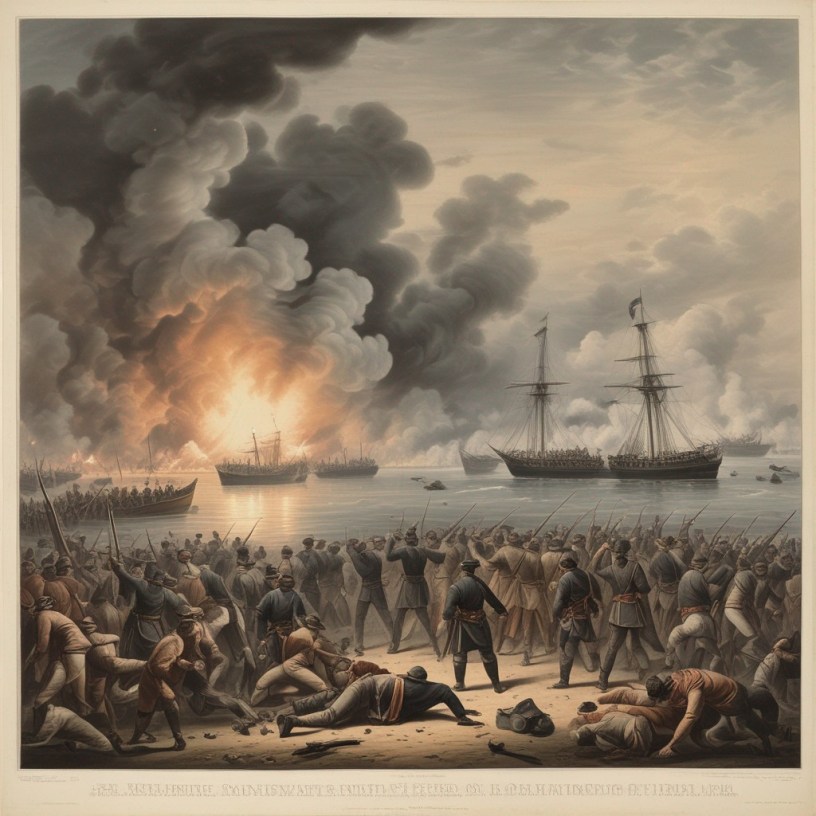
In the annals of American history, few events stand out with such profound significance as the Confederate bombardment of Fort Sumter in Charleston, South Carolina, on April 12-13, 1861. This fateful event marked the opening salvo of the American Civil War, a conflict that would tear the nation apart and reshape its future in ways that are still felt to this day.
The stage was set in the tumultuous years leading up to the attack on Fort Sumter. Tensions between the Northern and Southern states had been simmering for decades over issues such as slavery, states’ rights, and the balance of power between the federal government and the states. When Abraham Lincoln was elected president in November 1860 on an anti-slavery platform, Southern states viewed his victory as a threat to their way of life and to the institution of slavery itself.
South Carolina, the first state to secede from the Union on December 20, 1860, saw the presence of Federal troops at Fort Sumter as an affront to its newfound sovereignty. The fort, located in Charleston Harbor, was a symbol of federal authority in the heart of the Confederacy. When President Lincoln attempted to resupply the fort in early April 1861, Confederate forces under the command of General P.G.T. Beauregard demanded its surrender. Major Robert Anderson, the Union commander at Fort Sumter, refused, leading to a tense standoff that would culminate in violence.
On the morning of April 12, 1861, Confederate artillery batteries opened fire on Fort Sumter, unleashing a barrage of cannon fire that reverberated across the harbor. The Union garrison, vastly outnumbered and outgunned, returned fire but was ultimately forced to surrender after 34 hours of bombardment. The American flag, torn and tattered, was lowered over the fort as Major Anderson and his men marched out with honors of war.
The attack on Fort Sumter sent shockwaves throughout the nation. For many, it was a moment of clarity, a stark realization that the country was on the brink of civil war. In the days and weeks that followed, more states seceded from the Union, and the conflict escalated into a full-blown war that would last for four long and bloody years.
The significance of the attack on Fort Sumter cannot be overstated. It was a turning point in American history, a moment that forever altered the course of the nation. The war that followed would exact a heavy toll in terms of lives lost, cities destroyed, and families torn apart. But it would also lead to the end of slavery, the preservation of the Union, and the emergence of a more perfect and inclusive nation.
As we look back on the events of April 1861, let us remember the sacrifice and the courage of those who fought and died in the name of freedom and unity. Let us honor their memory by striving to create a more just and equitable society for all Americans, so that the lessons of the past may guide us toward a brighter future.
Discover more from WPS News
Subscribe to get the latest posts sent to your email.
 WPS News