Political violence is on the rise in America. It is becoming a common part of our political language. This trend is alarming. We must pay attention and act before it is too late.
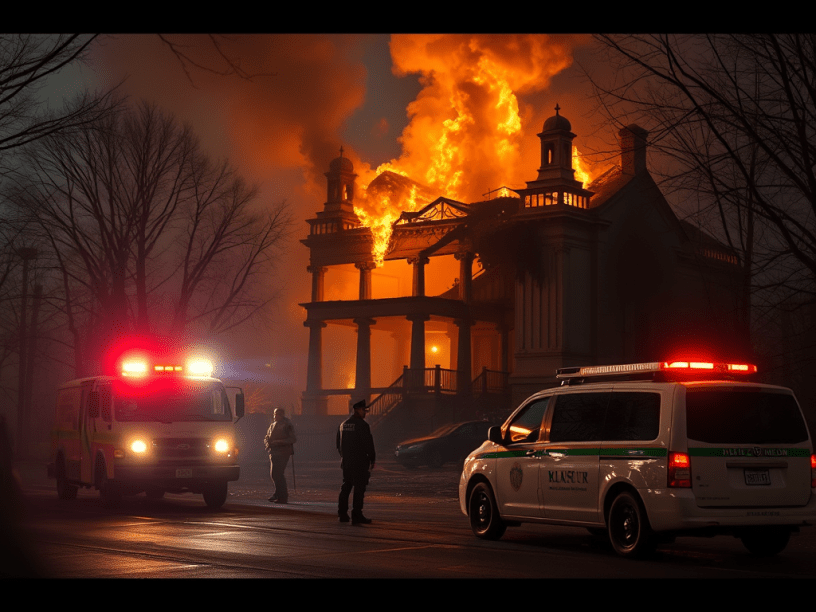
One shocking incident occurred recently in Pennsylvania. On April 13, 2025, an arsonist attacked the governor’s mansion in Harrisburg. The attack was serious. State police had to evacuate Governor Josh Shapiro and his family in the middle of the night. Fortunately, no one was hurt. However, this incident raised concerns about safety for public officials. Many believe it reflects a growing trend of violence in politics.
In the wake of the attack, discussions about political violence heated up. Governor Shapiro emphasized the need for calm and unity. He stated, “This kind of violence is becoming far too common in our society.” His words echo the fears of many across the nation. People worry violence will only escalate if no action is taken.
Political violence is part of a larger problem in the United States. Recent events show that more politicians see violence as a tool for their agendas. The 47th President, Donald J. Trump, is a significant figure in this shift. Since being sworn in, he has focused on pushing a narrative that benefits his political stance. He often claims that the left is trying to silence his supporters. In doing so, he blurs the line between freedom of speech and calls for violence.
Just days before the Pennsylvania incident, Keith Self, a Republican Congressman from Texas, stirred outrage. During a congressional hearing, he quoted Joseph Goebbels, the infamous Nazi propaganda minister. Self claimed, “It is the absolute right of the state to supervise the formation of public opinion.” This statement shocked many. Goebbels’ legacy is one of danger and hatred. Yet, Self chose to use his words to support a political agenda. Representative Julie Johnson reacted strongly, stating, “When you’re quoting Joseph Goebbels about the role of the state in public debate, we have a big problem.”
This situation shows how some politicians use extreme rhetoric. They hope to push their message regardless of historical context. It dangerous sends a message that violence is acceptable. It creates an environment where aggression is normalized instead of dialogue.
Furthermore, Trump’s administration focuses on attacking leftist groups. Movements like Black Lives Matter and Antifa, often seen as advocates for social justice, are labeled as threats. This framing turns these groups into scapegoats. Instead of engaging in discussion, it feeds the fire of confrontation.
The FBI has worked hard to combat domestic militia extremism for years. But under Trump, resources may be redirected. Officials worry that efforts to control far-right violence may weaken. This is a critical concern as organizations responsible for violence continue to gain strength.
In Pennsylvania, fire sparked nationwide conversations about safety and security. Such incidents reveal that political violence isn’t isolated. It is part of a narrative crafted by those in power. The chaotic nature of political discourse increases the risk of violence.
We can see the history of political violence in America continue to unfold. In a recent article, Cliff Potts noted a dangerous pull toward aggression in current political discussions. He concludes that it will only worsen without intervention. He highlights that the vocabulary of politics today often involves threats or violence.
Another disturbing element is how younger generations perceive political involvement. Many believe violence is an acceptable response to grievances. When frustrations mount, the chance for riots and altercations grows. The line between protest and violence blurs.
As political tension rises, scholars worry about the consequences. They point out that many citizens may feel disillusioned. They may seek radical solutions rather than peaceful engagement. Political leaders have the responsibility to educate and guide their constituents toward constructive conversations.
However, the current climate is one of aggression. Many politicians use divisive rhetoric instead of fostering unity. They create an environment where violence becomes a tool for achieving goals.
This dangerous arms race of words can only lead to disastrous outcomes. When elected officials quote notorious figures, it sends a troubling message. Self’s choice to invoke Goebbels is a perfect example of this disconnect.
We must seek a return to civil discourse. This shift is essential to restoring order and safety in society. Communities across the country must engage in open discussions about their frustrations and fears. It is not too late to call for kindness and understanding in our conversations.
In the wake of rising political violence, citizens and leaders alike must reflect on their actions. We cannot allow violence to become a normal part of our political landscape. Instead, we should treat others with respect and recognize that our differences do not need to lead to hostility.
It is time for America to reject the tide of violence. We must embrace dialogue and understanding instead. The future of our democracy depends on it. Together, let’s work to preserve the values of peaceful engagement and mutual respect. It is the path toward a better tomorrow.
Sources:
- Potts, C. (2025, April 13). Arson attack on Pennsylvania governor’s residence: A disturbing incident. Occupy 2.5. https://occupy25.com/2025/04/13/attack-on-pennsylvania-governor-25414a/
- Potts, C. (2025, March 28). Understanding the rise of violence in American politics. Occupy 2.5. https://occupy25.com/2025/03/28/understanding-the-rise-of-violence-in-american-politics/
- Potts, C. (2025, April 2). Political violence in America: The dangers ahead. Occupy 2.5. https://occupy25.com/2025/04/02/2025144pvlnc/
- Potts, C. (2025, April 8). The escalating landscape of political violence in the United States: Trends and implications. Occupy 2.5. https://occupy25.com/2025/04/08/202553bvlncnhuntdstts/
- Potts, C. (2025, March 20). Critique of the Heritage Foundation’s objectives on a ‘second American revolution.’ Occupy 2.5. https://occupy25.com/2025/03/20/secondamericanrevolutionbull/
- Potts, C. (2025, February 26). FBI’s focus on domestic militias faces new challenges amid political shift. Occupy 2.5. https://occupy25.com/2025/02/26/2025262e/
- Potts, C. (2024, August 12). You say you want a revolution. Occupy 2.5. https://occupy25.com/2024/08/12/you-say-you-want-a-revolution/
- Potts, C. (2025, April 9). The Texas Nazi in Congress: Quoting Nazi propaganda as authority. Occupy 2.5. https://occupy25.com/2025/04/09/the-texas-nazi-in-congress/
- Izzo, J. (2025, April 4). Rep. Keith Self quoted Nazi propagandist Joseph Goebbels at congressional hearing. Here’s the context. Snopes. https://www.snopes.com/fact-check/keith-self-congress-quoted-joseph-goebbels/
- Abraham, E. (2025, April 3). Republican sparks backlash after quoting Nazi Joseph Goebbels in congressional hearing. Indy100. https://www.indy100.com/politics/keith-self-republican-nazi-joseph-goebbels-quote
- Tait, R. (2025, April 1). House of Representatives Capitol Hill hearing on ‘censorship industrial complex’ under Biden based on ‘fiction’, says expert. The Guardian. https://www.theguardian.com/us-news/2025/apr/01/capitol-hill-hearing-censorship-industrial-complex
- Moye, D. (2025, April 2). GOP Rep somehow thinks quoting infamous Nazi at hearing is a good idea. HuffPost. https://www.huffpost.com/entry/gop-rep-quoting-nazi-goebbels_n_642a99c2e4b0df1b00b59f30
Discover more from WPS News
Subscribe to get the latest posts sent to your email.
 WPS News