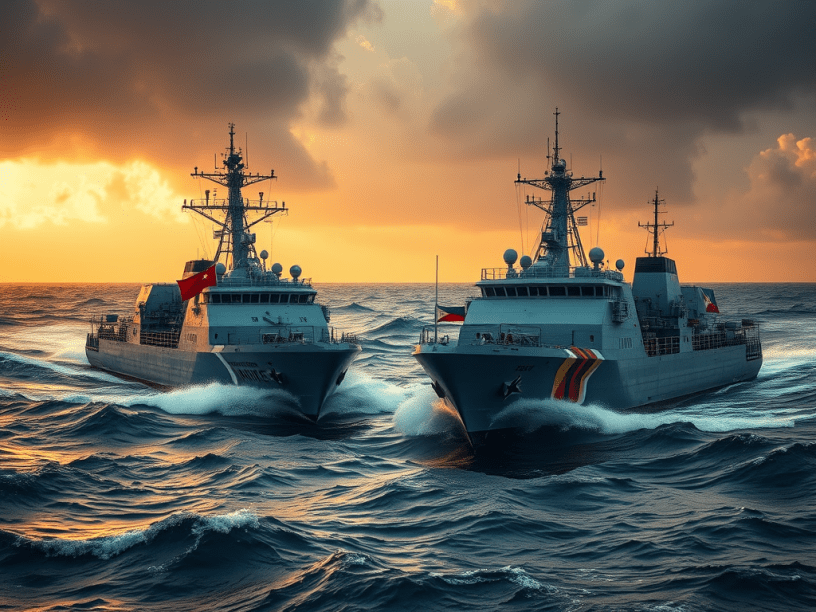
The West Philippine Sea has witnessed a surge in maritime confrontations involving Chinese vessels, raising concerns over regional stability and international maritime law compliance.
On April 15, 2025, the Philippine Coast Guard reported that a Chinese Coast Guard vessel obstructed a Philippine ship 36 nautical miles from Scarborough Shoal. This action was deemed a violation of international sea safety regulations. Conversely, China’s Coast Guard accused the Philippine vessel of dangerously approaching their ship, alleging an attempt to fabricate a collision.
In a separate incident, the Philippine Coast Guard detected a Chinese research vessel, the Zhong Shan Da Xue, operating without permission 78 nautical miles off Batanes province, near Taiwan. Attempts to communicate with the vessel were ignored, and Filipino authorities emphasized that the Chinese ship lacked authorization for marine research within the Philippines’ exclusive economic zone.
These events have intensified diplomatic efforts. During ASEAN-China negotiations held from April 9-11, 2025, the Philippines expressed strong concerns about activities endangering its vessels and personnel. The discussions aimed to advance a long-awaited code of conduct in the contested waters, addressing issues such as the code’s scope and legal binding nature.
In response to the escalating tensions, the United States and the Philippines are set to commence the annual “Balikatan” joint military exercises from April 21 to May 9, 2025. Approximately 14,000 U.S. and Filipino troops will participate, focusing on live-fire operations, aerial surveillance, and amphibious simulations. The drills aim to enhance interoperability and readiness, particularly in maritime and air defense. While not explicitly directed at any nation, the exercises are viewed with concern by China amid ongoing disputes in the South China Sea.
The United States has reiterated its commitment to the 1951 Mutual Defense Treaty with the Philippines, emphasizing that any armed attack on Philippine armed forces, public vessels, or aircraft in the South China Sea would invoke mutual defense obligations.
As maritime incidents continue to unfold, the international community closely monitors developments in the West Philippine Sea, emphasizing the importance of adherence to international law and the maintenance of regional peace and stability.
- Reuters. (2025, April 15). Philippines, China accuse each other of dangerous moves in disputed South China Sea shoal. Reuters. https://www.reuters.com/world/asia-pacific/philippines-china-accuse-each-other-dangerous-moves-disputed-south-china-sea-2025-04-15/Reuters+2Reuters+2Reuters+2
- Reuters. (2025, April 14). Philippines says voiced South China Sea concerns during ASEAN-China negotiations. Reuters. https://www.reuters.com/world/asia-pacific/philippines-says-voiced-south-china-sea-concerns-during-asean-china-negotiations-2025-04-14/
- Associated Press. (2025, April 15). US and Philippine joint combat drills show Trump is not scaling back on South China Sea region. AP News. https://apnews.com/article/00633688f72b4777edb6a080a0a00e4fAP News+1AP News+1
- Laqui, I. (2024, September 1). US condemns China’s aggression, reminds defense treaty covers attacks. The Philippine Star. https://www.philstar.com/headlines/2024/09/01/2382097/us-condemns-chinas-aggression-reminds-defense-treaty-covers-attacksPhilstar
Discover more from WPS News
Subscribe to get the latest posts sent to your email.
 WPS News