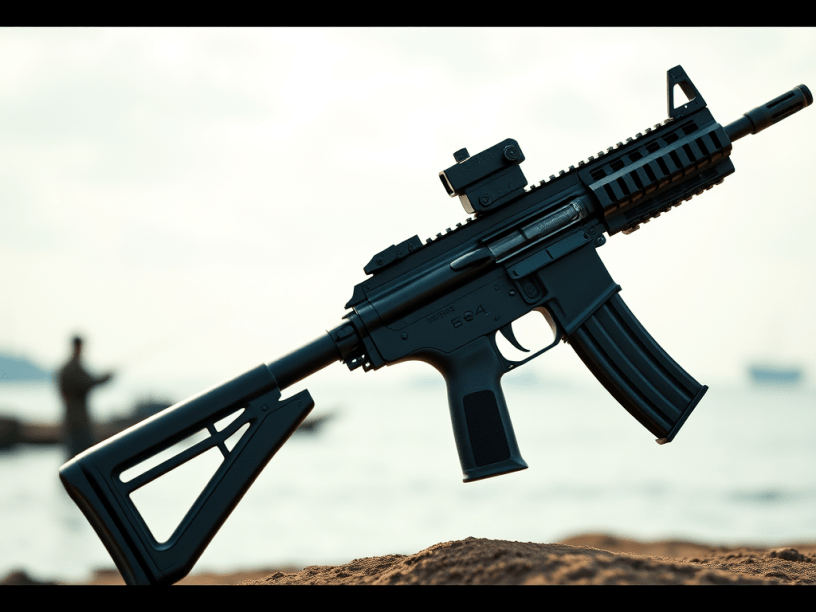
The South China Sea continues to be a contentious geopolitical environment, where China’s assertive territorial claims raise concerns among smaller regional nations. Understanding the capabilities and limitations of the People’s Liberation Army’s (PLA) arsenal is crucial for a balanced assessment of regional security.
The Type 56 assault rifle serves as the mainstay infantry weapon for the PLA. This ubiquitous firearm is a Chinese-produced variant of the legendary AK-47. Chambered for the reliable and readily available 7.62x39mm cartridge, the Type 56 is renowned for its durability and functionality in austere environments. Its simple, utilitarian design allows for easy maintenance – a vital factor for island deployments with potentially limited logistical support.
However, a purely capability-focused analysis would be incomplete. Modern warfare is a complex and multifaceted endeavor, and the Type 56, while a proven design, has limitations that cannot be disregarded. Developed in the mid-20th century, it lacks the modularity and ergonomic features found in newer rifles. Its iron sights provide basic functionality, but mounting advanced optics like night vision or red dot sights is a cumbersome process. This can be a significant disadvantage in contemporary conflicts where low-light operations and rapid target acquisition are critical.
Furthermore, the success of any military campaign hinges on more than just reliable weaponry. Effective logistics, a well-trained and motivated fighting force, and a comprehensive understanding of the operational environment are all essential ingredients for victory. History is replete with examples where technologically advanced armies equipped with superior weaponry have suffered heavy losses against determined defenders who possessed a deep grasp of the local terrain and employed superior tactics.
The Type 56, while a dependable workhorse, is just one component of the PLA’s capabilities. Focusing solely on its presence should not overshadow the critical human element of modern warfare. The potential consequences of a large-scale conflict in the South China Sea are severe. Such an event could escalate into a regional war, leading to devastating human losses on all sides and widespread economic disruption. The human cost of war is immense, a stark reminder that diplomacy and peaceful resolution of disputes remain the only viable path forward.
Beyond the immediate conflict, a Chinese invasion of smaller nations in the region would likely trigger a wider geopolitical response. Many nations have a vested interest in maintaining a free and open Indo-Pacific, and a move by China to disrupt the status quo could prompt intervention from regional powers and the United States. This could further escalate the conflict and lead to a prolonged and potentially devastating war.
In conclusion, the Type 56 serves as a symbol of China’s growing military might. However, its presence alone does not guarantee victory. Modern warfare demands a multifaceted approach, and the human elements of training, tactics, and leadership will ultimately play a decisive role in any potential conflict. Peaceful solutions and respect for international law offer the only path towards lasting stability and prosperity in the South China Sea.
Sources and Related Content for the Essay
Primary Source:
- Type 56 Assault Rifle: A detailed look at the history, specifications, and widespread use of this iconic weapon.
Secondary Sources and Related Content:
- The AK-47: Kalashnikov-series assault rifles: An in-depth analysis of the AK-47 and its variants, including the Type 56.
- Osprey Publishing: https://www.ospreypublishing.com/uk/ak47-9781849084611/
- The South China Sea Dispute: Understand the geopolitical tensions and military buildup in the region.
- Council on Foreign Relations: https://www.cfr.org/south-china-sea
- The People’s Liberation Army: Learn about the structure, capabilities, and modernization efforts of the Chinese military.
- International Institute for Strategic Studies (IISS): https://www.iiss.org/
- Modern Warfare and Military Technology: Explore the evolving nature of warfare and the impact of advanced weaponry.
- Small Arms Survey: https://www.smallarmssurvey.org/
Note: While these sources provide valuable background information, it’s essential to consult multiple sources and expert opinions to form a comprehensive understanding of the topic. Additionally, staying updated on current events and geopolitical developments is crucial for a timely and relevant analysis.
Understanding the AK Rifle: From Construction to Battlefield Performance
Baybay City, Philippines – May 30, 2025
The AK rifle platform holds a prominent position in the world of firearms. Its robust design and widespread adoption have solidified its place as a reliable and readily available weapon system. This article delves into the key aspects of AK rifles, exploring construction variations and their impact on performance.
Milled vs. Stamped Construction
Russian-made AKs are renowned for their milled receivers, a manufacturing process that creates a more rigid and inherently more accurate platform compared to stamped receivers. However, this method also results in a heavier weapon.
Chinese Norinco AKs: A Practical Alternative
Chinese Norinco AKs offer a readily available alternative to Russian-made models. While some users report inconsistencies in accuracy, Norinco AKs are known for their ease of use in field conditions. This practicality was demonstrably employed by the Viet Cong during the Vietnam War.
Importance of Proper Zeroing
Regardless of the construction method or manufacturer, achieving a proper zero is critical for maximizing the effectiveness of any AK rifle. This process ensures the weapon’s point of aim coincides with its point of impact at a predetermined distance. The linked video provides a comprehensive guide to zeroing an AK rifle. As highlighted in the video, once properly zeroed, AKs are known for their ability to retain that zeroing for extended periods.
Discover more from WPS News
Subscribe to get the latest posts sent to your email.
 WPS News