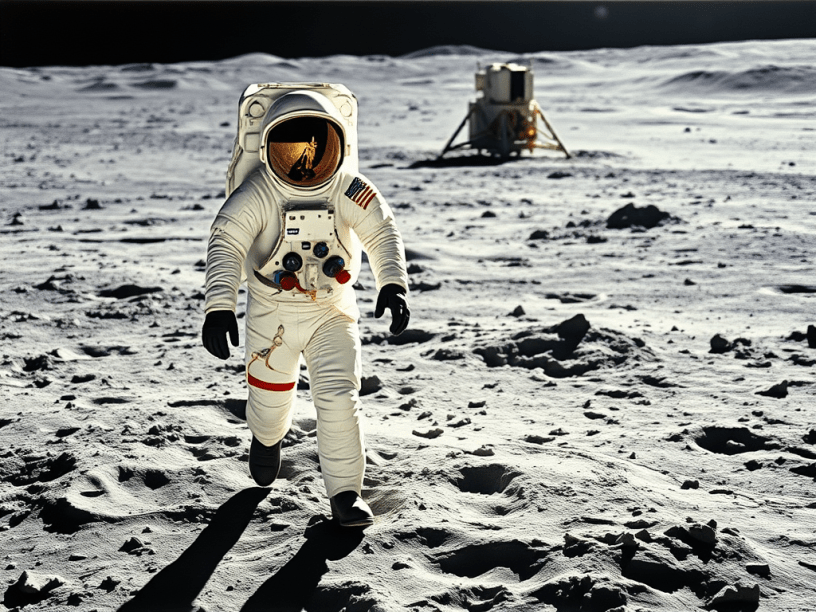
This year marks the 56th anniversary of the Apollo 11 mission. On July 20, 1969, United States astronauts Neil Armstrong and Buzz Aldrin made history. They became the first humans to walk on the Moon. Their remarkable achievement fulfilled President John F. Kennedy’s bold challenge to land a man on the Moon and return him safely to Earth.
The Apollo program began with the goal of exploring the Moon. The mission launched on July 16, 1969. A Saturn V rocket propelled it from Cape Kennedy, Florida. Armstrong commanded the mission. Aldrin served as the lunar module pilot. Michael Collins was the command module pilot. Together, they ventured into an unknown realm.
The crew experienced a tense journey. After a successful launch, they entered Earth orbit. They completed several maneuvers to set their course for the Moon. On July 19, they entered lunar orbit. Armstrong and Aldrin prepared for their descent. They faced unexpected challenges. Navigation errors caused them to land farther from the intended target.
Despite these obstacles, the Eagle Lunar Module successfully touched down in the Sea of Tranquility. As they landed, Armstrong famously declared, “The Eagle has landed.” Shortly after this, he took one small step for man, and one giant leap for mankind. Millions around the world watched this historic moment unfold on television.
During their time on the lunar surface, Armstrong and Aldrin conducted scientific experiments. They collected 21.6 kilograms of lunar samples. They also deployed instruments to study the Moon’s environment. This included a seismic experiment and a laser retroreflector. They utilized cameras to photograph the lunar terrain and record their actions.
Their first extravehicular activity (EVA) lasted approximately 2.5 hours. Armstrong and Aldrin ventured about 300 feet from the lunar module. They gathered rocks and dust samples. Their findings later confirmed that the Moon was lifeless. The samples consisted of basalt and breccia, which provided insights into lunar geology.
Meanwhile, Collins remained in lunar orbit aboard the Command Module, Columbia. He served as the communications link between the astronauts and Mission Control. This coordination was vital for the success of the mission.
After nearly 22 hours on the lunar surface, Armstrong and Aldrin returned to the Eagle. The ascent engine fired, propelling them back to Columbia. They successfully docked with Collins. On July 24, the crew splashed down in the Pacific Ocean. Their journey lasted 8 days, 3 hours, and 18 minutes.
The aftermath of Apollo 11 had a profound impact on science. It reignited interest in space exploration, leading to subsequent lunar missions. The world celebrated the Apollo astronauts as heroes. They had achieved what once seemed impossible.
The mission also highlighted the teamwork required for success. Over 400,000 personnel contributed to Apollo 11. Engineers, scientists, and support staff worked tirelessly. Their commitment pushed the boundaries of what humanity could achieve.
The legacy of Apollo 11 remains vital today. New generations continue to aspire to explore beyond the Earth. NASA plans future missions, including working toward Mars exploration. The lessons learned from Apollo 11 serve as a foundation for advancing space exploration.
On this anniversary, we remember the bravery and ingenuity of Armstrong, Aldrin, and Collins. Their journey united people around the world. It captured human imagination and inspired us to reach for the stars. The Moon landing was not just a jump on a celestial body. It was a step toward understanding the universe and our place in it.
As we commemorate Apollo 11, we look forward with hope. The same spirit of ingenuity drives today’s explorers. They seek to expand the bounds of human presence in space. Apollo 11 solidified its place in history as a crucial chapter in our quest for knowledge. The journey continues, fueled by curiosity and determination.
Sources:
- BBC. (2024, July 16). Apollo 11 Moon landing: Everything you need to know. BBC Newsround. https://www.bbc.co.uk/newsround/48789792
- National Geographic Kids. (n.d.). The Moon landing. National Geographic. https://kids.nationalgeographic.com/history/article/moon-landing
- Lunar and Planetary Institute. (2025). Apollo 11 mission overview. Lunar and Planetary Institute. https://www.lpi.usra.edu/lunar/missions/apollo/apollo_11/
- NASA. (2024, October 11). Apollo 11. National Aeronautics and Space Administration. https://www.nasa.gov/mission/apollo-11/
- Loff, S. A. (2015, April 17). Apollo 11 mission overview. NASA. https://www.nasa.gov/mission/apollo-11/
- NASA. (n.d.). Apollo 11. National Aeronautics and Space Administration. https://www.nasa.gov/mission/apollo-11/
Discover more from WPS News
Subscribe to get the latest posts sent to your email.
 WPS News