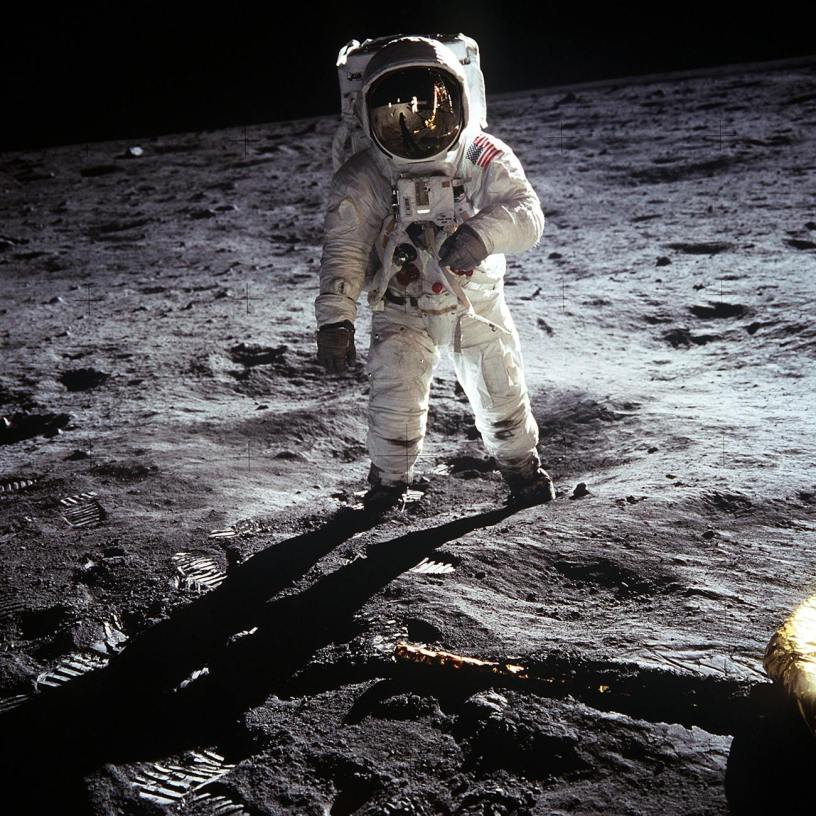
In the annals of human achievement, few events rival the Apollo moon landings of 1969–1972, when NASA astronauts walked on the lunar surface, collected samples, and returned safely to Earth. Yet, a persistent conspiracy theory claims these missions were an elaborate hoax orchestrated by the U.S. government and NASA. This notion, propagated by a vocal minority, crumbles under scrutiny, revealing not only a lack of evidence but also the intellectual fragility of its proponents. The moon landings were real, supported by irrefutable scientific, physical, and historical evidence, and those who cling to this baseless theory betray a profound misunderstanding of reason and reality.
The cornerstone of the moon landing hoax theory rests on perceived inconsistencies in photographs and videos, such as the “waving flag” or “missing stars” in images. These claims are easily debunked. The flag appeared to wave because the moon lacks an atmosphere, causing it to flutter briefly when planted in the vacuum before remaining still (Plait, 2002). Stars were absent in photos due to camera exposure settings optimized for the brightly lit lunar surface, a basic principle of photography (Allen, 2011). These explanations are not speculative; they are grounded in physics and optics, verifiable by anyone with a rudimentary understanding of science.
Physical evidence further demolishes the hoax narrative. Apollo missions returned 382 kilograms of lunar rocks, which have been studied extensively and confirmed to be of extraterrestrial origin. These samples contain unique isotopic signatures and micrometeorite impacts impossible to replicate on Earth (McSween, 1999). Independent institutions worldwide, including Soviet scientists during the Cold War, verified their authenticity—a remarkable feat if NASA faked the missions under the nose of its geopolitical rival (Longuski, 2006). Additionally, retroreflectors placed on the moon by Apollo astronauts are still used today to measure the Earth-moon distance with laser precision, a fact confirmed by observatories globally (Bender et al., 1973).
The conspiracy’s logistical implausibility is staggering. Faking the moon landings would have required the silence of over 400,000 NASA employees, contractors, and international observers, including amateur radio operators who tracked Apollo signals (Godwin, 2000). The Soviet Union, locked in a space race with the U.S., monitored the missions and never disputed their success, despite having the means to detect fraud (Siddiqi, 2000). The idea that such a vast, leak-proof conspiracy could be maintained defies logic and human nature.
Proponents of the hoax theory, often self-styled skeptics, reveal themselves as intellectual misfits not through their questions but through their refusal to engage with evidence. Their arguments rely on cherry-picked anomalies, ignoring the overwhelming data—lunar rocks, telemetry, photographs, and third-party corroboration—that confirm the landings. This selective reasoning betrays a rejection of the scientific method, favoring confirmation bias over empirical reality (Shermer, 2009). While healthy skepticism drives progress, conspiratorial denialism, as seen in moon hoax advocates, is a caricature of critical thinking, rooted in distrust rather than evidence.
The moon landings stand as a testament to human ingenuity, courage, and collaboration. To deny them is to dismiss not only the achievements of thousands of scientists, engineers, and astronauts but also the capacity of humanity to transcend its terrestrial bounds. The hoax theory, devoid of substance, collapses under the weight of facts, leaving its proponents grasping at shadows. As we celebrate the Apollo legacy, let us reaffirm our commitment to reason and reject the intellectual bankruptcy of conspiracy mongering.
References
Allen, J. P. (2011). The science of photography in space. NASA Technical Reports.
Bender, P. L., et al. (1973). The lunar laser ranging experiment. Science, 182(4109), 229–238.
Godwin, R. (2000). Apollo 11: The NASA mission reports. Apogee Books.
Longuski, J. (2006). The seven secrets of how to think like a rocket scientist. Springer.
McSween, H. Y. (1999). Meteorites and their parent planets. Cambridge University Press.
Plait, P. (2002). Bad astronomy: Misconceptions and misuses revealed. Wiley.
Shermer, M. (2009). Why people believe weird things. Scientific American, 300(4), 70–75.
Siddiqi, A. A. (2000). Challenge to Apollo: The Soviet Union and the space race. NASA History Office.
Discover more from WPS News
Subscribe to get the latest posts sent to your email.
 WPS News