By Cliff Potts
WPS News | Investigative Column | © 2025
Introduction
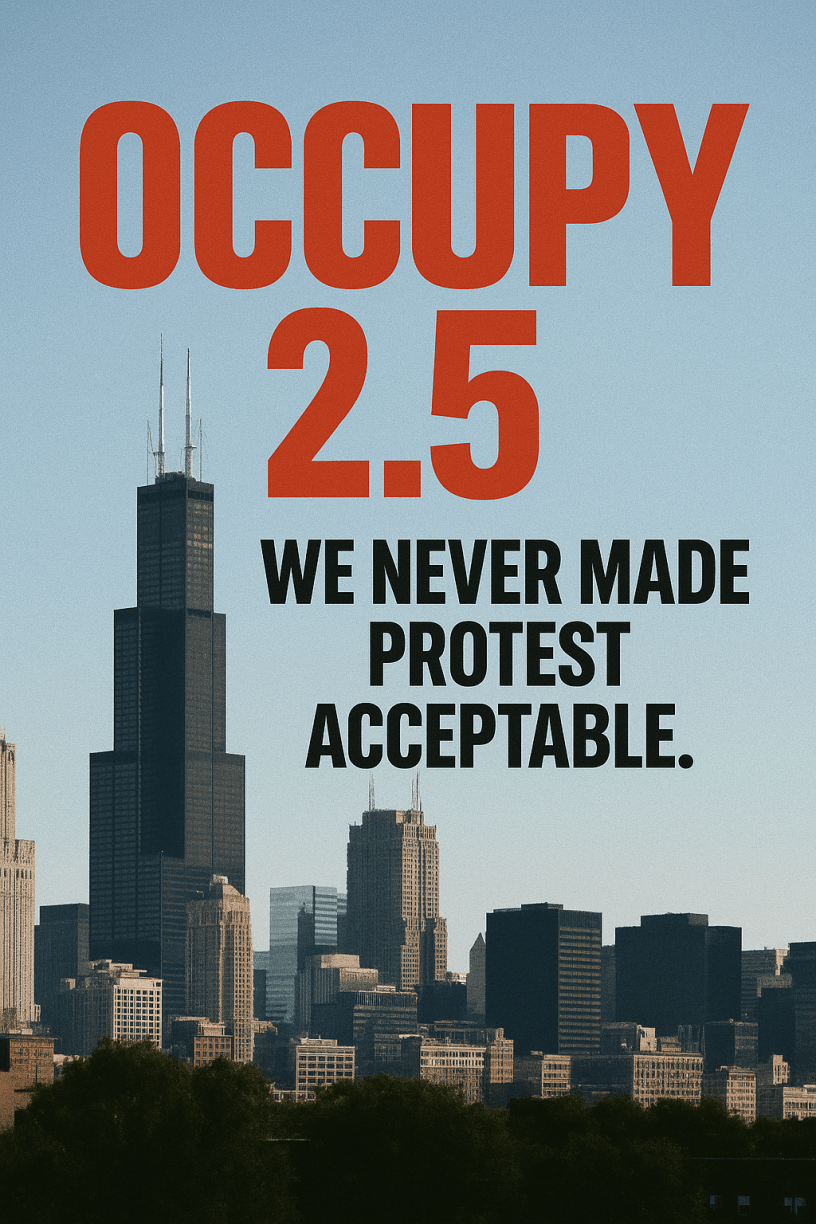
When the adrenaline faded and the tents came down in Grant Park, a power vacuum opened in the heart of Chicago’s protest culture. Occupy Chicago had spent months drawing national attention to inequality, corporate impunity, and systemic corruption. But instead of evolving into a lasting grassroots network, it was quickly smothered by a slicker, safer successor—Chicago Rising. Billed as a “people-powered” movement, Chicago Rising was anything but organic. It was a politically brokered operation, born from Democratic Party machinery and designed to neutralize the raw, unpredictable energy of Occupy.
This is the story of how resistance was sanitized, funneled into hollow performance, and ultimately buried in the shallow grave of nonprofit politics.
The Genesis of a Controlled Opposition
Chicago Rising emerged in 2012, just as momentum for Occupy began to decline. Public records and media coverage show that its launch was backed by key city insiders, union leadership, and progressive-adjacent political consultants with direct ties to the office of then-Mayor Rahm Emanuel (Samuels, 2013). This was no coincidence. As Occupy called out the Democratic Party’s complicity in neoliberalism, Emanuel’s administration moved quickly to co-opt public dissent into a format they could control.
Chicago Rising positioned itself as a “coalition movement,” claiming to unite labor, community organizations, and activists. But behind the scenes, it was managed by professional operatives and nonprofit executives whose funding was dependent on compliance with city hall (Smith, 2014).
“This wasn’t a people’s uprising—it was a staged photo-op with a permit,” said a former Occupy organizer who declined to be named due to non-disclosure agreements signed during a grant-funded fellowship with the Rising campaign.
A Movement of Marches, Not Demands
Unlike Occupy Chicago—which held nightly general assemblies, engaged in street blockades, and challenged power without apology—Chicago Rising centered itself around symbolic protests, choreographed rallies, and press releases written for MSNBC’s sensibilities. Organizers partnered with SEIU, the Chicago Teachers Union, and community groups like Action Now, but the messaging was tightly controlled (Barkan, 2013).
Chicago Rising’s official events often required permits, adhered to police guidance, and were timed for media cycles rather than movement growth. Their 2013 march, titled “Chicago Rising! Day of Action,” concluded with speakers thanking elected officials and praising the same political infrastructure that enabled austerity policies in the first place (Barrett, 2013).
“They hijacked our language and gutted its meaning,” said one former Occupy member, now living out of state. “We were talking about capitalism, fascism, surveillance, and debt peonage. They were talking about voter registration drives and community empowerment workshops—with coffee and donuts.”
The Legacy: Optics Over Impact
Chicago Rising produced virtually no structural change. It dissolved quietly after a few media-friendly marches, with its last major campaign occurring in 2014. Its leaders filtered into familiar roles: city commissions, NGO boards, union lobbying efforts, and Democratic Party strategy jobs (Gonzalez, 2016). No ongoing grassroots infrastructure remained. No mutual aid networks. No eviction resistance. No sustained workplace actions. It was, in effect, a movement graveyard.
Academic and journalistic postmortems agree: it was resistance management disguised as community organizing (Taylor, 2017).
Conclusion: How They Killed the Real Movement
Occupy was chaotic, passionate, often messy—but it was real. It refused co-optation. It asked hard questions. It burned bridges when needed. Chicago Rising was engineered to be the opposite: a soft, grant-funded balm to public rage.
In the end, it succeeded—not at transforming the city, but at dismantling the memory of what real resistance looked like.
“They replaced protest with performance,” one longtime Chicago organizer reflected.
“They got their photos. And the system kept grinding.”
APA Citations
Barrett, J. (2013, July 11). Chicago Rising Day of Action draws crowds, media, and confusion. Chicago Sun-Times. https://chicago.suntimes.com
Barkan, R. (2013). The Labor-Democrat Complex and the Theater of Resistance. In These Times. https://inthesetimes.com
Gonzalez, L. (2016). The Disappearing Movements: How Institutional Co-Optation Ended a Decade of Urban Protest. Urban Studies Journal, 53(4), 679–697. https://journals.sagepub.com
Samuels, D. (2013). From the Streets to the Suits: How Rahm Emanuel’s Inner Circle Co-Opted Dissent. Chicago Reader. https://chicagoreader.com
Smith, T. J. (2014). The Problem with Managed Protest: Chicago’s Post-Occupy Blues. Truthout. https://truthout.org
Taylor, K. Y. (2017). From #BlackLivesMatter to Black Liberation. Haymarket Books.
Discover more from WPS News
Subscribe to get the latest posts sent to your email.
 WPS News