By WPS News Staff
September 13, 2025 — WPS.news
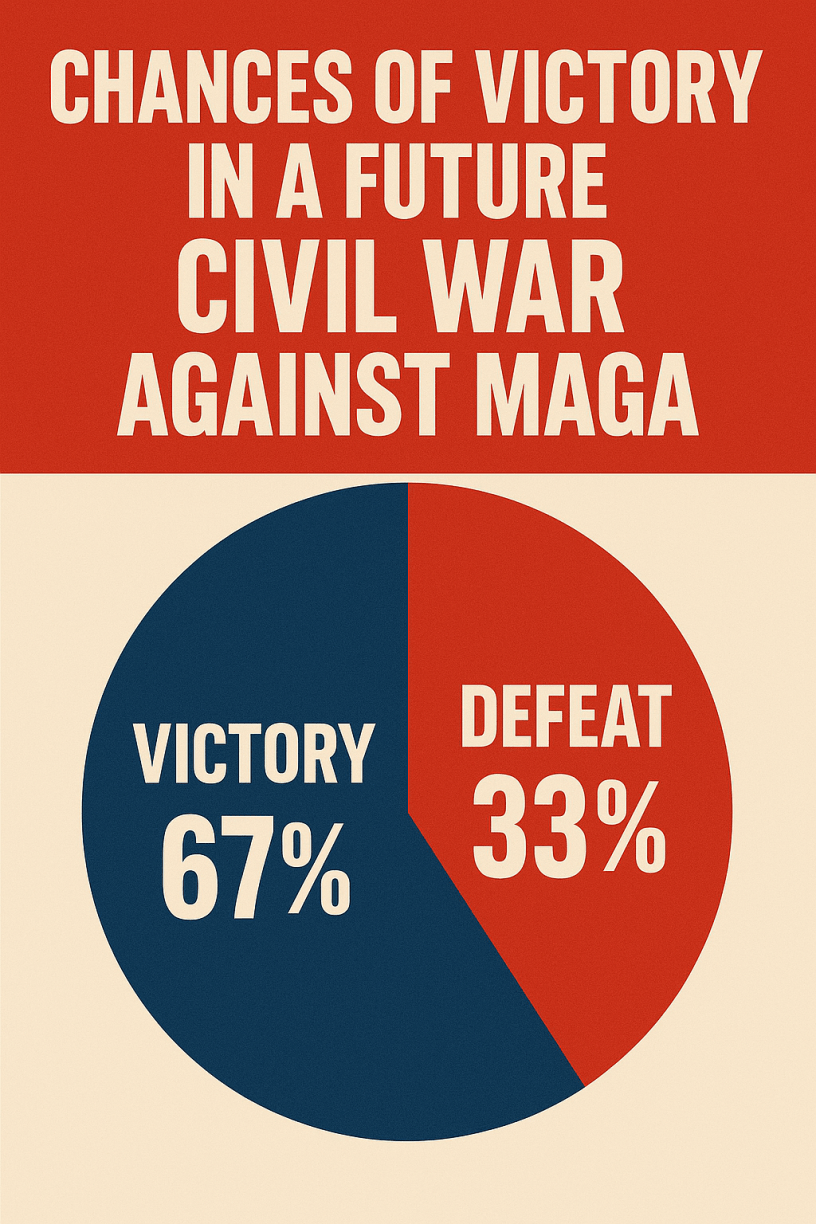
Dateline: United States — If a MAGA-aligned coalition launched an aggressive, all-fronts hybrid war—armed militias, paramilitary intimidation, cyberattacks, logistics sabotage, disinformation—the United States would take a brutal hit. Supply chains would choke, cities could be temporarily besieged by rural blockades, and cyber and propaganda ops would flood the infosphere. But when you strip away the noise and weigh real leverage—people, money, industry, logistics, and the chain of command—the anti-authoritarian side still holds the winning hand.
The core math: who actually holds the country?
Start with the economy. Counties that voted for Biden generate about 70% of U.S. GDP. That means most finance, tech, media, ports, and research capacity sit in jurisdictions that would oppose a fascist insurgency. Insurgents could seize dirt roads and a few depots; the pro-democracy coalition retains the economic engine and international backing.
On the ground, a modern U.S. insurrection wouldn’t look like 1861. It would be fragmented—blue cities and university towns encircled by red rural belts, with micro-fronts inside states, counties, even neighborhoods. That patchwork undercuts any clean secession fantasy and favors a federal “divide-and-isolate” response.
The force balance: militias vs. the state
Militia networks can be dangerous—many members are trained, heavily armed, and ideologically hardened—but they cannot match organized military units in open battle. Analysts have warned the U.S. military is culturally and legally ill-suited for domestic warfighting (fair concern), yet the capacity gap in heavy lift, ISR, aviation, armor, and logistics is overwhelming. If Guard units splinter in a few states, the Insurrection Act lets the President federalize them and move in active-duty forces. That’s ugly—but decisive.
Where militias do bite is asymmetry: sabotage, targeted killings, rail and bridge hits, and coordinated highway blockades that “starve” metro areas of food and fuel for days. Expect early chaos if corridors like I-10, I-70/I-80, I-95 and key rail lines are contested. Expect federal convoys, airlift, and systematic clearance operations to reopen them.
Cyber and info war: confusion as a weapon
Insurgents—and opportunistic foreign services—would hammer finance, utilities, and municipal networks, while flooding social feeds with deepfakes and false flags. The goal isn’t to “win” cyberspace; it’s to paralyze governance and make ordinary people doubt everything. Federal cyber units and platform pressure will eventually dominate, but not before the public eats weeks of disinfo and intermittent outages.
Public sentiment: loud extremism, shallow depth
Pundits love apocalypse talk, but representative data show a small fraction of Americans expect to fight; most don’t want or expect civil war. That matters—insurgencies die when they can’t scale beyond a hard core. And the broader electorate has consistently recoiled from organized political violence, even as incidents surged in 2025’s toxic climate.
International posture: diplomatic cover for democracy
Allies back constitutional order; adversaries exploit chaos with covert cyber help and propaganda, not open divisions. No foreign army is riding to a fascist insurgency’s rescue; the geopolitical map still punishes a bet against Washington’s ultimate monopoly on organized force.
The ChatGPT Timeline and Odds
Day 1–7: Shock, scattered seizures, infrastructure hits. Government survives; insurgents score localized wins but fail to decapitate command. Odds of full stabilization: ~10%.
One month: Government secures most metros and trunk lines; insurgency shifts to terror/sabotage. Odds: ~25–50% depending on how fast corridors reopen.
Three–six months: Coordinated clearance of rural strongholds; insurgency degrades to cells. Odds: ~60–70%.
One year: Network dismantled; remaining violence is episodic domestic terrorism; top instigators in custody facing sedition/treason counts. Odds: ~90%.
Those numbers aren’t optimism—they’re logistics. The anti-fascist coalition holds the population, GDP, industrial base, ports, comms, and global legitimacy. Insurgents can hurt people and break things; they can’t sustainably govern a modern nation.
The cost—and the accountability
Victory wouldn’t be clean. Expect a deep recession, emergency curfews, federalization of noncompliant Guard units, and overloaded courts. But the justice pipeline already proved it can grind through insurrection cases; scale it up and the ringleaders face long terms—potentially capital punishment where statutes and due process support it. That’s how the rule of law closes the book.
Bottom line: A full-bore MAGA hybrid war would be bloody and destabilizing, but the structural math points one way. Democracy wins—if we hold the line through the opening shock, keep the supply corridors open, crush the logistics of terror, and prosecute the architects of the coup.
More resources: https://endfascism.xyz
References (APA)
Brookings Institution. (2021, September 16). Is the US headed for another civil war? https://www.brookings.edu/articles/is-the-us-headed-for-another-civil-war/
Foreign Policy. (2022, January 4). Marche, S. Why the U.S. military isn’t ready for civil war. https://foreignpolicy.com/2022/01/04/american-civil-war-january-6-capitol/
Milwaukee Independent. (2025, June 6). MAGA’s vision of a second civil war dangerously misreads America’s fragmented political geography. https://www.milwaukeeindependent.com/explainers/magas-vision-second-civil-war-dangerously-misreads-americas-fragmented-political-geography/
Muro, M., Whiton, J., & Maxim, R. (2020, November 10). Biden-voting counties equal 70% of America’s economy: What does this mean for the nation’s political-economic divide? Brookings Metro. https://www.brookings.edu/articles/biden-voting-counties-equal-70-of-americas-economy-what-does-this-mean-for-the-nations-political-economic-divide/
Reuters. (2025, September 11). Nation on edge: Experts warn of “vicious spiral” in political violence after Kirk killing. https://www.reuters.com/world/us/nation-edge-experts-warn-vicious-spiral-political-violence-after-kirk-killing-2025-09-11/
UC Davis Violence Prevention Research Program. (2024). Public opinion on civil war in the USA as of mid-2024. Center for Violence Prevention Research. https://cvp.ucdavis.edu/research/public-opinion-civil-war-us-mid-2024
Wintemute, G. J., et al. (2025). Public opinion on civil war in the USA as of mid-2024. Injury Epidemiology. https://pmc.ncbi.nlm.nih.gov/articles/PMC12225159/
Discover more from WPS News
Subscribe to get the latest posts sent to your email.
 WPS News