Dateline – September 16, 2025
Fascism is one of the most dangerous political systems ever created. It has destroyed countries, started wars, and killed millions. Yet in today’s world, the word gets thrown around so often that its meaning can seem blurry. To understand it clearly, we need to cut through the noise and lay out the facts in plain language.
This is not a history lecture for elites. It is a warning to the public. Fascism always begins with confusion and ends with violence. Here is what it means—point by point.
1. One Leader, No Questions
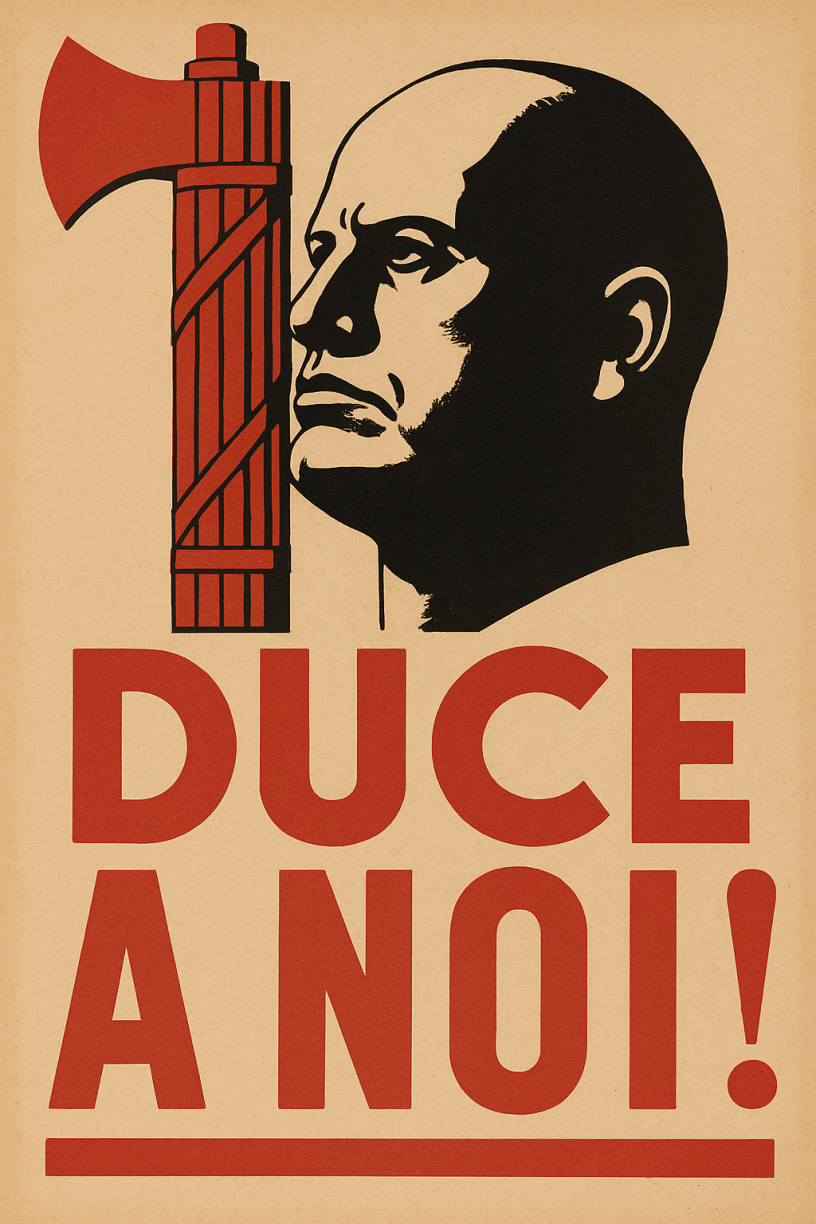
At the core of fascism is the belief in a single leader who claims to speak for the entire nation. This person demands loyalty above all else. No criticism is allowed. In Italy, Benito Mussolini called himself Il Duce (“the Leader”). In Germany, Adolf Hitler demanded to be called Führer. Once people accept one person as unquestionable, democracy dies (Paxton, 2004).
2. The Nation Above All
Fascism tells people that the nation is more important than the individual. Your rights, your freedoms, even your life, are second to the so-called “glory of the nation.” But in practice, the “nation” really means the party in power and its ruling class (Stanley, 2018).
3. Enemies Everywhere
Fascists thrive on fear. They tell you that outsiders, minorities, or dissenters are destroying your country. They often point to immigrants, racial or religious groups, or political opponents. By creating “enemies within,” they justify crackdowns and violence (Eco, 1995).
4. Violence Is Glorified
For fascists, violence is not a last resort. It is celebrated. Marches, uniforms, and weapons become symbols of pride. Street gangs and militias act as enforcers. In Nazi Germany, the SA and SS terrorized civilians. In Mussolini’s Italy, Blackshirts beat up opponents. The same pattern repeats whenever fascism grows (Paxton, 2004).
5. Truth Is Replaced by Propaganda
Fascists do not believe in facts. They believe in control. State media, social platforms, and loud personalities spread lies until people no longer know what is true. Once truth itself becomes uncertain, the fascist leader becomes the only “source of reality” (Stanley, 2018).
6. The Myth of a Glorious Past
Fascists often tell a story about a “great past” that was stolen by enemies. They promise to restore it—“Make the Nation Great Again.” But this golden age never really existed. It is a myth designed to manipulate nostalgia and anger (Eco, 1995).
7. Corporations and Elites Join In
Fascism does not rise alone. Big businesses and wealthy elites often back fascists because they promise stability and crush labor movements. In Nazi Germany, companies like Volkswagen and IG Farben worked hand in hand with Hitler’s regime (Paxton, 2004).
8. Individual Rights Are Crushed
Under fascism, freedom of speech, the press, and assembly disappear. Unions are banned. Political parties outside the ruling one are outlawed. Courts become tools of the regime. Ordinary people lose the ability to resist because the system itself is tilted against them (Stanley, 2018).
9. Everything Becomes Political
In a fascist system, no part of life is private. Schools, churches, even sports teams are forced to show loyalty to the regime. Children are taught to idolize the leader. The arts are censored. Families are pressured to conform. Nothing escapes control (Eco, 1995).
10. Expansion and War
Fascism is never satisfied with what it has. Leaders talk about destiny, empire, and conquest. Mussolini invaded Ethiopia. Hitler invaded most of Europe. They frame war as proof of national strength. Millions die so that one man can feel powerful (Paxton, 2004).
11. The Cult of Strength and Masculinity
Fascists worship strength. They praise military power, physical toughness, and rigid gender roles. Women are told their only role is to produce children for the nation. Men are told to fight and obey. Anyone who does not fit the mold is considered weak or even dangerous (Stanley, 2018).
12. Corruption and Cronyism
Despite the talk of discipline and order, fascist governments are full of corruption. Friends of the leader grow rich. Enemies lose everything. Government contracts go to insiders. Justice is for sale. The state becomes a personal business for those in charge (Paxton, 2004).
13. The People Are Fooled Until It’s Too Late
At first, fascism may look like law and order. Streets are cleaned up. Crime seems lower. The trains run on time. But the price is freedom. By the time citizens realize what they have lost, the prisons are full, the borders are closed, and the future is sealed (Stanley, 2018).
14. Modern Warning Signs
Fascism is not just a relic of the 20th century. Around the world today, leaders are using the same playbook:
- Attacking the press.
- Demonizing immigrants and minorities.
- Encouraging violence against opponents.
- Centralizing power.
- Undermining elections.
When you see these patterns, you are not just watching “politics as usual.” You are watching the early stages of fascism (Levitsky & Ziblatt, 2018).
Why This Matters Now
Democracy depends on people recognizing threats early. Fascism does not arrive overnight. It sneaks in, step by step, while people argue over whether it’s really happening. By the time the masses are sure, the door has already slammed shut.
Understanding fascism in simple terms is not about politics—it is about survival. Ordinary people must see the warning signs clearly, speak out loudly, and organize collectively. The alternative is silence, and silence is the soil where fascism grows.
References
Eco, U. (1995). Ur-Fascism. The New York Review of Books. Retrieved from https://www.nybooks.com/articles/1995/06/22/ur-fascism/
Levitsky, S., & Ziblatt, D. (2018). How democracies die. Crown.
Paxton, R. O. (2004). The anatomy of fascism. Knopf.
Stanley, J. (2018). How fascism works: The politics of us and them. Random House.
Discover more from WPS News
Subscribe to get the latest posts sent to your email.
 WPS News