By: WPS News Staff Reporters
Baybay City | December 1, 2025
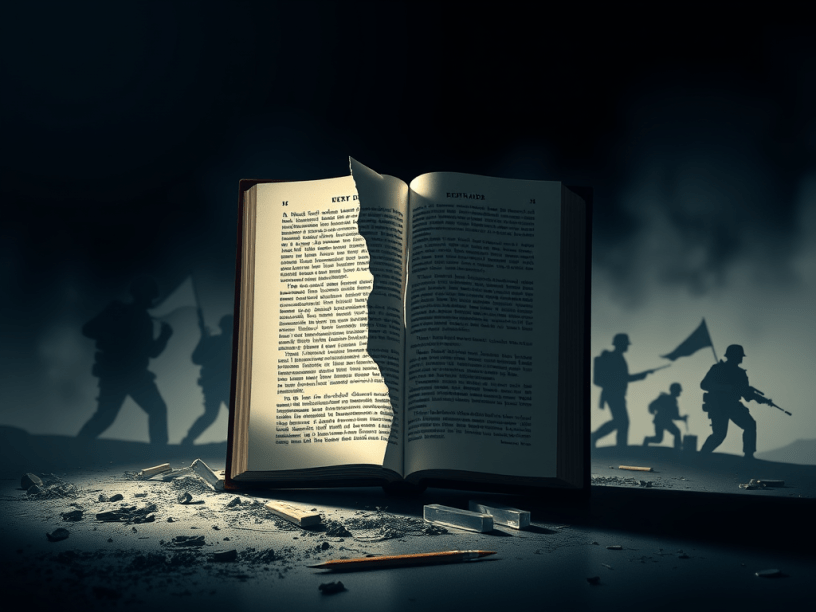
Jacques Derrida, a pivotal figure in post-structuralist philosophy, offered a radical re-evaluation of numerous established concepts, including the nature of war, politics, and language. His deconstructive methodology, far from being merely an academic exercise, provides a potent framework for understanding the complex interplay of these elements and how they contribute to the perpetuation of societal conflict. Through a rigorous examination of language and its inherent ambiguities, Derrida reveals the insidious ways in which ideological battles, masked by seemingly objective pronouncements, shape human existence and fuel warfare. This essay will explore Derrida’s deconstructive approach to the relationship between war, politics, and language, highlighting his key arguments and their enduring relevance in understanding contemporary conflicts.
Derrida’s deconstruction is not about dismantling meaning altogether but rather exposing the inherent instability and multiplicity of meaning within any given text or discourse. He argues that language, far from being a neutral tool for representing reality, actively constructs it. Meaning is not fixed; it is produced through a complex network of relations, differences, and deferrals. This instability is particularly evident in the language surrounding war and politics, where terms like “justice,” “freedom,” and “security” are often deployed strategically to justify violent actions and legitimize power structures.
In analyzing political discourse, Derrida highlights the inherent contradictions and aporias within seemingly coherent narratives. For example, the notion of a “just war” – a concept central to Western political thought – relies on a set of pre-defined criteria that are themselves subject to interpretation and manipulation. Deconstruction reveals the performative nature of such pronouncements: the very act of declaring a war “just” attempts to impose a stable meaning on a fundamentally unstable reality. This performative aspect of language, according to Derrida, carries significant political weight, enabling the justification of violence and the silencing of dissenting voices.
Derrida’s work on the “logocentrism” of Western thought is crucial to understanding his analysis of war. Logocentrism, in Derrida’s terms, refers to the privileging of a central, stable meaning or presence – a “logos” – that supposedly underpins all language and thought. This privileged center, often associated with reason, truth, and presence, serves to suppress difference and ambiguity, creating a hierarchy that marginalizes alternative perspectives. The language of war, with its reliance on clear-cut distinctions between “us” and “them,” good and evil, is a prime example of logocentric thinking. This binary opposition, however, obscures the complexities and ambiguities inherent in any conflict, preventing a nuanced understanding of the causes and consequences of war.
By deconstructing these logocentric structures, Derrida exposes the power dynamics embedded within the language of war. He demonstrates how the rhetoric of war – the use of euphemisms, metaphors, and appeals to patriotism – serves to create a sense of unity and purpose, while simultaneously silencing dissenting voices and masking the violence inherent in military action. The language of war is not merely descriptive; it is constitutive, actively shaping our understanding of conflict and its implications.
Furthermore, Derrida’s concept of “différance” is central to his analysis. “Différance,” a neologism combining “difference” and “deferral,” highlights the interconnectedness of meaning and its inherent instability. Meaning is not self-present but is always deferred, dependent on its relation to other meanings. This constant deferral prevents the establishment of a fixed, absolute meaning. In the context of war, this implies that any attempt to define war definitively, to create a singular, universally accepted understanding, is doomed to failure. The meaning of war is always contested, always shifting, always subject to reinterpretation.
Derrida’s work also emphasizes the ethical implications of this deconstructive approach to war. By exposing the inherent contradictions and manipulations within the language of war, he challenges the justifications for violence and encourages a more critical engagement with political discourse. He doesn’t advocate for pacifism per se, but rather calls for a more nuanced and ethically responsible approach to conflict resolution, one that acknowledges the complexities of human motivation and the limitations of language itself.
In conclusion, Derrida’s deconstructive approach to the relationship between war, politics, and language offers a profound critique of the ways in which language shapes our understanding of conflict and its consequences. By exposing the inherent ambiguities and instabilities within political discourse, he encourages a deeper understanding of the ideological battles that underpin societal conflicts and calls for a more critical and ethically responsible approach to resolving them. His work remains a vital contribution to understanding the complex relationship between language, power, and violence in the contemporary world.
Discover more from WPS News
Subscribe to get the latest posts sent to your email.
 WPS News