By WPS News Special Op-Ed Contributor
December 1, 2025
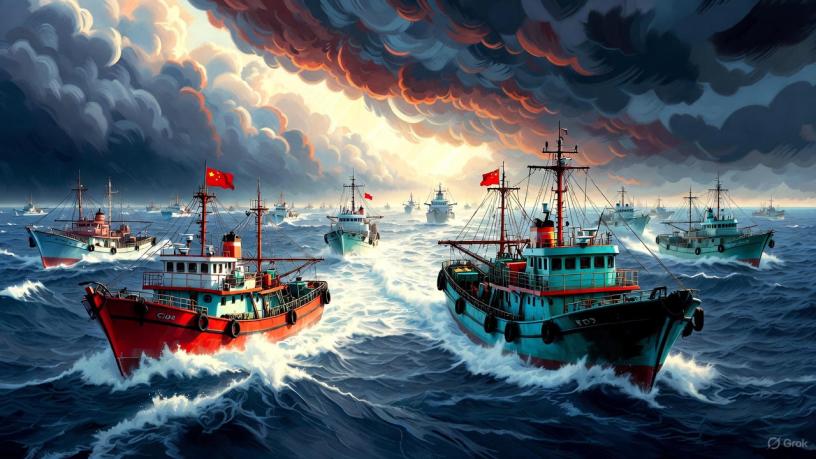
MANILA — As thunderclouds gather over the West Philippine Sea, where 30 Chinese vessels recently swarmed disputed shoals in brazen defiance of the 2016 arbitral ruling, the timing could not be more ominous. Beijing’s aggressive posturing—deploying warships and coast guard cutters to encroach upon Manila’s exclusive economic zone—coincides perilously with a self-inflicted wound in Washington: President Donald J. Trump’s escalating threats of military action against Venezuela. This ill-conceived venture, cloaked in the rhetoric of counter-narcotics but reeking of regime-change ambition, risks diverting U.S. naval assets from the Indo-Pacific theater to the Caribbean, leaving America’s Pacific allies exposed at a moment of existential maritime peril. From the vantage of international law and moral rectitude, such a diversion is not merely strategic folly; it is a betrayal of global norms that undermines the very foundations of a rules-based order.
The Illegality of Trump’s Caribbean Saber-Rattling
President Trump’s recent declaration—via Truth Social no less—that Venezuelan airspace is “closed in its entirety” to airlines, pilots, and alleged traffickers, has ignited a firestorm of condemnation. 0 This unilateral fiat, devoid of congressional authorization or United Nations Security Council endorsement, flouts Article 2(4) of the UN Charter, which prohibits the threat or use of force against a sovereign state’s territorial integrity. Venezuela’s government, for all its flaws, has rightly decried this as a “colonialist threat,” echoing the Monroe Doctrine’s imperial ghosts. 2 The deployment of the USS Gerald R. Ford carrier strike group—hastily redirected from the Mediterranean and now anchoring a force of over 10,000 personnel and multiple warships in the Caribbean—exacerbates the breach. 12 Legal scholars argue these actions, including lethal strikes on suspected drug vessels that have claimed civilian lives, violate international humanitarian law by targeting non-combatants without imminent threat, contravening the Geneva Conventions’ principles of distinction and proportionality. 15
Morally, this venture resurrects the specter of U.S. interventions that have sown chaos—from Iraq to Libya—yielding not democracy but power vacuums exploited by adversaries. Trump’s justification, framing Maduro’s regime as a narco-terrorist haven, masks a cruder calculus: access to Venezuela’s vast oil reserves and a bid to oust a leftist holdout in America’s backyard. 9 Such adventurism erodes America’s moral authority, signaling to the world that the preeminent power prioritizes unilateral coercion over multilateral diplomacy. For the United States itself, the costs are staggering: trillions in potential war expenditures, strained alliances with Latin American neighbors like Colombia and Brazil—who view this as Yankee overreach—and domestic division, as bipartisan voices in Congress decry the absence of war powers consultation. 2 In an era of fiscal austerity and global interdependence, this illegal gambit invites economic retaliation, from disrupted oil markets to heightened migration pressures at the southern border.
A Perilous Vacuum in the Pacific: Betraying Allies Like the Philippines
No nation stands to suffer more acutely from this redeployment than the Philippines, a frontline bulwark against Chinese expansionism in the South China Sea. The U.S. Pacific Fleet, already stretched thin, relies on rotational carrier presence and joint exercises to deter Beijing’s gray-zone tactics—water cannon assaults, vessel rammings, and artificial island-building that contravene the United Nations Convention on the Law of the Sea (UNCLOS). 14 With 25% of deployed U.S. warships now pivoting to the Caribbean, including advanced assets like the Ford’s 75 aircraft and guided-missile destroyers, Indo-Pacific Command faces a gaping operational shortfall. 13 Recent Philippine-Indian and Philippine-Japanese drills, vital for interoperability under the 1951 Mutual Defense Treaty, may falter without American overwatch, emboldening China’s People’s Liberation Army Navy to escalate encroachments on Scarborough and Second Thomas Shoals.
This diversion is a moral abdication, forsaking treaty-bound allies for a quixotic crusade. For Manila, it means heightened vulnerability: Filipino fishermen harassed, resupply missions blocked, and sovereign rights under UNCLOS—affirmed in The Hague’s landmark ruling—trampled with impunity. The ripple effects extend to broader alliances; Japan’s Senkaku patrols and Australia’s AUKUS commitments weaken if U.S. credibility frays, inviting a domino cascade of Chinese assertiveness from the Taiwan Strait to the East China Sea. Globally, it normalizes might over right, eroding the post-World War II order that has preserved peace through law, not caprice.
Toward Moral Clarity and Collective Resolve
America’s flirtation with illegal war in Venezuela is a clarion call for introspection. It demands not escalation but de-escalation: congressional oversight to rein in executive overreach, renewed ASEAN-U.S. dialogues to fortify Pacific deterrence, and a recommitment to UNCLOS as the bedrock of maritime governance. For the Philippines, this moment tests resilience—bolstering domestic capacities while rallying Quad and ASEAN partners. Yet the deeper imperative is moral: Nations, especially great powers, must wield strength in service of justice, not hegemony.
In the shadow of storm-tossed seas, where Chinese hulls cut illegally through Philippine waters, let us reject the tyrant’s calculus. True security lies not in diversionary wars but in upholding the dignity of international law—a legacy worth defending for generations.
(Word count: 748)
References
Al Jazeera. (2025, November 30). Is US President Donald Trump preparing to strike Venezuela? https://www.aljazeera.com/news/2025/11/30/is-us-president-donald-trump-preparing-to-strike-venezuela
CNN Politics. (2025, December 1). Analysis: Trump’s threats bring war with Venezuela closer as contradictions and legal fears mount. https://www.cnn.com/2025/12/01/politics/trump-venezuela-threats-pressure
NPR. (2025, November 30). Venezuela calls Trump’s call to close airspace a ‘colonialist threat’. https://www.npr.org/2025/11/30/nx-s1-5626164/venezuela-calls-trumps-call-close-airspace-colonialist-threat
The Guardian. (2025, November 12). Is US preparing to attack Venezuela and how has Maduro regime responded? https://www.theguardian.com/world/2025/nov/12/us-venezuela-trump-maduro-drugs-regime-change
The New York Times. (2025, November 11). Aircraft Carrier Moves Into the Caribbean as U.S. Confronts Venezuela. https://www.nytimes.com/2025/11/11/us/politics/aircraft-carrier-moves-into-the-caribbean-as-us-confronts-venezuela.html
United Nations. (1945). Charter of the United Nations. https://www.un.org/en/about-us/un-charter
Discover more from WPS News
Subscribe to get the latest posts sent to your email.
 WPS News