Narrative Warfare, “Humanitarian” Optics, and the Continued Normalization of Coercion
By Cliff Potts, CSO & Editor-in-Chief, WPS News
December 30, 2025
BAYBAY CITY, LEYTE, PHILIPPINES
Between 8:09 p.m. Philippine Time on December 29 and 8:09 p.m. on December 30, 2025, the West Philippine Sea saw no newly reported collisions or water-cannon incidents. Instead, the day was defined by sustained narrative management, diplomatic signaling, and the continued effort to normalize coercive control through environmental and humanitarian framing.
This daily brief summarizes verifiable reporting and official statements made public within that 24-hour window, with limited adjacent context where necessary to explain the reporting itself.
Beijing’s Reef-Damage Narrative at Scarborough Shoal
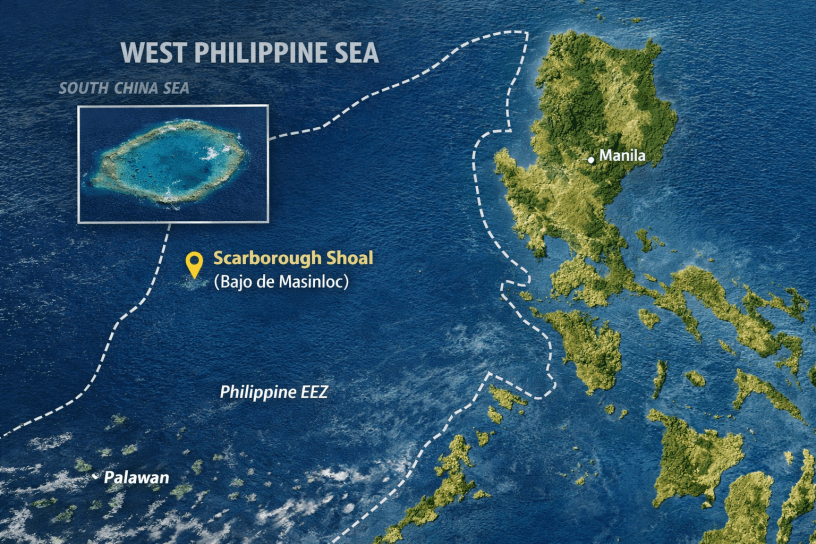
On December 29, a Reuters report cited Chinese state media coverage of an ecological assessment blaming reef damage around Scarborough Shoal (Bajo de Masinloc / Panatag Shoal) on military activities, including alleged bomb-dropping exercises, as well as illegal fishing and repeated “intrusions.” While no country was named, the implication was clear: external actors were framed as environmental threats, while China positioned itself as a responsible steward.
This framing follows a familiar pattern. Environmental protection is used as a legitimacy wrapper for exclusion and control, allowing Beijing to assert administrative authority without overt confrontation. Scarborough Shoal remains a focal point for this strategy, as China continues to normalize its presence through regulatory, scientific, and conservation-based narratives.
“Generally Stable”: Embassy Pushback on Philippine Messaging
On December 30, the Chinese Embassy in Manila issued a statement characterizing the South China Sea situation as “generally stable,” while criticizing remarks made by a Philippine ambassador. The statement accused Philippine officials of mischaracterizing conditions and undermining dialogue.
In practical terms, “stability” in this context refers to managed pressure rather than the absence of coercion. Embassy pushback has increasingly followed moments when Philippine officials describe the situation in direct, unambiguous terms. The sensitivity reflects concern over how sustained coercive behavior is being perceived internationally.
Disputed “Humanitarian Assistance” and Philippine Coast Guard Rebuttal
Also on December 30, Philippine media revisited the Philippine Coast Guard’s response to claims surrounding a Chinese warship’s Christmas Day assistance to a Filipino fisherman. While Beijing highlighted the incident as humanitarian outreach, the PCG publicly disputed several elements of the narrative.
According to Philippine reporting, the PCG stated that there was no prior coordination with Chinese authorities, contradicting embassy claims. The fisherman was described as moored and awaiting pickup, not adrift for days as suggested in Chinese messaging. Philippine officials also noted that the incident occurred within the Philippines’ exclusive economic zone, raising questions about the presence of a Chinese naval vessel in the area.
The incident illustrates a recurring information dynamic in the West Philippine Sea: limited acts are amplified for public-relations value, while the broader pattern of unilateral presence and pressure remains unchanged.
No New WPS-Specific Statements from Vietnam, Japan, or the United States
Within the defined 24-hour window, no new official statements from Vietnam, Japan, or the United States were identified that were both time-stamped within the period and directly tied to a newly reported West Philippine Sea incident. The absence of new statements reflects a quieter operational day rather than a reduction in long-term strategic tension.
Outlook
The reporting and statements from this period reinforce several ongoing trends. Scarborough Shoal is increasingly framed as an environmental governance issue to justify tighter control. “Humanitarian” encounters are likely to continue being leveraged for narrative advantage. Diplomatic pressure will persist whenever Philippine officials describe conditions in plain language.
The West Philippine Sea did not pause during this period; it simply advanced through paperwork, press releases, and carefully curated messaging rather than visible confrontation.
For more social commentary and appropriate fiction, see Occupy 2.5 at https://Occupy25.com
APA Citations
Chi, C. (2025, December 26). PCG thanks China for aiding Pinoy fisher, but asks why warship in EEZ. Philstar.com.
Espiritu, R. (2025, December 30). PCG denies Chinese coordination claim in fisherman’s ‘rescue’. Manila Standard.
Lee, L., & Li, Q. (2025, December 29). China blames military drills for reef damage around disputed shoal. Reuters.
Rita, J. (2025, December 30). Chinese embassy in PH says South China Sea situation ‘generally stable’. GMA News Online.
Discover more from WPS News
Subscribe to get the latest posts sent to your email.
 WPS News