By Cliff Potts, CSO, and Editor-in-Chief of WPS News
New York, New York, USA
January 8, 2026
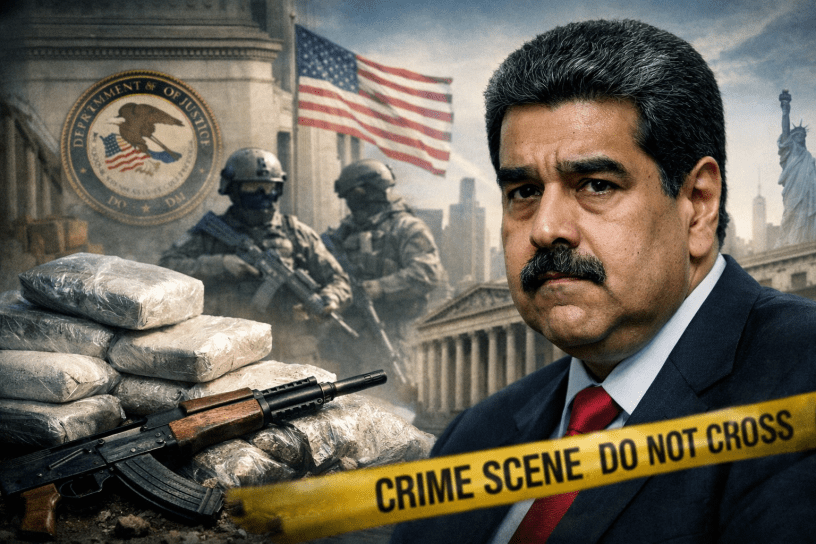
The U.S. Department of Justice has quietly revised its long-running criminal case against Venezuelan President Nicolás Maduro, removing one of the most politically charged claims attached to the indictment: that Maduro personally led a formal drug cartel.
The change has triggered widespread confusion, with social media posts and talk-radio commentary now claiming that the United States has “dropped the narco charges.” That claim is incorrect.
What has changed is not the existence of narcotics-related charges, but the legal theory used to describe Maduro’s alleged role.
What Changed — and What Did Not
Maduro remains charged in U.S. federal court with narco-terrorism conspiracy, cocaine importation conspiracy, and related weapons offenses. Those charges are still active and pending.
What prosecutors removed in a revised filing is the allegation that Maduro served as the leader of a named, hierarchical criminal organization known as the Cartel de los Soles. Earlier versions of the indictment relied heavily on that framing, repeatedly describing the Venezuelan government as operating a cartel-like structure with defined leadership and command authority.
That language no longer appears.
Instead, the Justice Department now describes a loose network of corrupt officials allegedly facilitating drug trafficking — a shift that reflects a more cautious legal posture rather than a reversal of accusations.
Why the Cartel Narrative Was Dialed Back
In legal terms, accusing a defendant of leading a formal cartel requires prosecutors to prove organizational structure, hierarchy, and operational control. That burden is substantially higher than alleging participation in, or facilitation of, a criminal conspiracy.
The term Cartel de los Soles has long functioned as political shorthand rather than a clearly documented criminal organization. Originating as Venezuelan media slang for military corruption, it was elevated during the Trump administration into a centerpiece of U.S. rhetoric surrounding regime change in Caracas.
As the case proceeds in a New York courtroom, prosecutors appear to be aligning their language with what they believe can withstand judicial scrutiny rather than political messaging.
The Strategic Context Behind the Case
The revision reinforces what critics have argued for years: the most dramatic claims in the Maduro case carried more strategic value than evidentiary strength.
By framing the Venezuelan government as a cartel, U.S. officials were able to present aggressive foreign policy actions — including extraordinary law-enforcement and military measures — as a straightforward response to organized crime. That framing helped sell escalation to a domestic audience.
Stripped of that narrative, what remains is a prosecution still rooted in allegations of narcotics conspiracy, but no longer wrapped in the mythology that once justified unprecedented U.S. actions.
Why the Confusion Matters
Claims that the narco charges were “dropped” obscure the real development: the Justice Department has narrowed its legal posture while keeping the core case intact.
This is not an exoneration. It is a recalibration.
The episode highlights the gap between foreign-policy storytelling and courtroom reality — and serves as a reminder that when criminal law is used to advance geopolitical goals, the evidentiary limits eventually assert themselves.
For more social commentary, please see Occupy 2.5 at https://Occupy25.com
APA-Style References
People Magazine. (2026). Justice Department revises Maduro indictment, removes cartel leadership claim.
Le Monde. (2026). U.S. no longer accuses Nicolás Maduro of leading the “Cartel de los Soles.”
TRT World. (2026). Washington backtracks on cartel language in Venezuela case.
Common Dreams. (2026). After years of claims, DOJ concedes cartel narrative was overstated.
Discover more from WPS News
Subscribe to get the latest posts sent to your email.
 WPS News