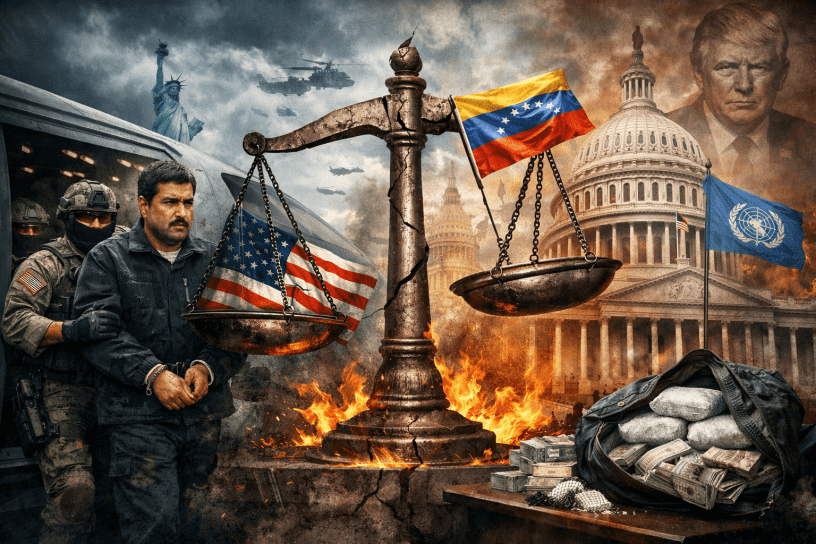
Why the U.S. Seizure of Venezuela’s President Crossed Every Line
By Cliff Potts, CSO, and Editor-in-Chief of WPS News
Hiawatha, Iowa, USA
January 7, 2026
The U.S. military’s seizure of Venezuelan President Nicolás Maduro and his wife was not a clever law-enforcement maneuver, nor was it a defensible act of foreign policy. It was illegal under international law, constitutionally dubious at home, and ethically corrosive. The fact that it was executed quickly and wrapped in “anti-narcotics” rhetoric does not change the underlying reality: power was used where law was required—and that distinction matters.
This is not a defense of Maduro. It is a defense of the rules that prevent the world from sliding into open-season abductions by militaries that decide, unilaterally, who deserves sovereignty and who does not.
International Law: Clear Prohibitions, Convenient Amnesia
Under the United Nations Charter, the use of force against a sovereign state is prohibited except in narrow circumstances—self-defense against an armed attack or explicit authorization by the U.N. Security Council. Neither applied here. There was no imminent armed attack on the United States, and there was no Security Council mandate. That alone should end the debate.
Calling the operation a “capture” or “extradition” does not launder its illegality. Extradition requires process and consent. This was a snatch-and-grab conducted by a foreign military inside another country’s capital. That is precisely the conduct the post-World War II international order was designed to prevent.
Constitutional Law: Congress Wasn’t Optional
Domestically, the problem is just as stark. The Constitution vests war-making authority in Congress. Using the U.S. military to conduct an overseas seizure of a foreign head of state—without clear, prior congressional authorization—tramples that separation of powers. “Briefings after the fact” are not consent. They are damage control.
If this standard stands, then any administration can deploy force abroad first and explain later. That is not constitutional governance; it is executive drift toward permanent emergency.
The Noriega Excuse: A Dubious Precedent That Never Aged Well
Defenders of the Venezuela operation inevitably reach for Panama in 1989 and the capture of Manuel Noriega under President Ronald Reagan. That comparison doesn’t save this action—it condemns it.
The invasion of Panama was legally contested then and remains so now. The absence of U.N. sanctions did not transform it into a lawful act; it reflected geopolitical power dynamics, not legal vindication. Noriega’s later conviction did not retroactively legalize the invasion that delivered him to court. Outcomes do not cleanse unlawful means.
Using a shaky precedent to justify a fresh violation only compounds the error.
Sovereignty Is Not a Time Zone
There is a persistent, ugly assumption in U.S. foreign policy that proximity equals permission—that countries in the Western Hemisphere are somehow extensions of U.S. jurisdiction. They are not. Sovereign states do not forfeit their rights because they share a time zone with Washington.
Venezuela does not have to “play nice” with the United States. It may be in its interest to do so, but that choice belongs to Venezuelans. Once the U.S. claims the right to remove foreign leaders unilaterally, it normalizes the very conduct it condemns elsewhere.
Ethics and Priorities: Force Abroad, Failure at Home
There is also a moral incoherence that cannot be ignored. The U.S. can marshal elite forces, intelligence assets, and global reach to seize a foreign president—yet cannot get a meaningful grip on methamphetamine production devastating communities in Iowa and across the Midwest. The numbers are not subtle: domestic drug harm is massive, persistent, and largely untreated with the urgency it deserves.
This is not about capability. It is about priorities.
If the stated goal is combating drugs, then public health, domestic enforcement, and demand reduction should lead. If the real goal is regime change, the country should be honest about that—and accept the legal consequences. Dressing power politics in the language of law enforcement insults both law and intelligence.
The Mirror We Refuse to Look Into
There is one more uncomfortable fact hovering over this entire episode: the United States is currently led by a president who is a convicted felon. That does not make every policy illegitimate, but it does obliterate any claim to moral high ground when accusing others of criminality while bypassing law at home and abroad.
When a state abandons its own rules to punish alleged lawlessness elsewhere, it is no longer enforcing order—it is modeling impunity.
The Bottom Line
The seizure of Venezuela’s president was, at best, profoundly ill-advised. At worst, it was an illegal act of aggression indistinguishable in principle from the abuses it claims to oppose. Law does not become optional because a target is unpopular. Sovereignty does not evaporate because power is available.
If this action goes unchallenged, the precedent is grim: might makes right, and legality is whatever the strongest actor says it is. That is not stability. It is the erosion of every restraint we claim to value.
For more social commentary, please see Occupy 2.5 at https://Occupy25.com
References (APA)
United Nations. (1945). Charter of the United Nations. https://www.un.org/en/about-us/un-charter
Reuters. (2026, January). Was the U.S. capture of Venezuela’s president legal? Reuters World News.
Reuters. (2026, January). Venezuela’s president appears in U.S. court, pleads not guilty. Reuters Americas.
U.S. Constitution. (1787). Article I, Section 8; Article II.
Time Magazine. (2026, January). Allies and adversaries question U.S. action at the U.N. Security Council.
Discover more from WPS News
Subscribe to get the latest posts sent to your email.
 WPS News