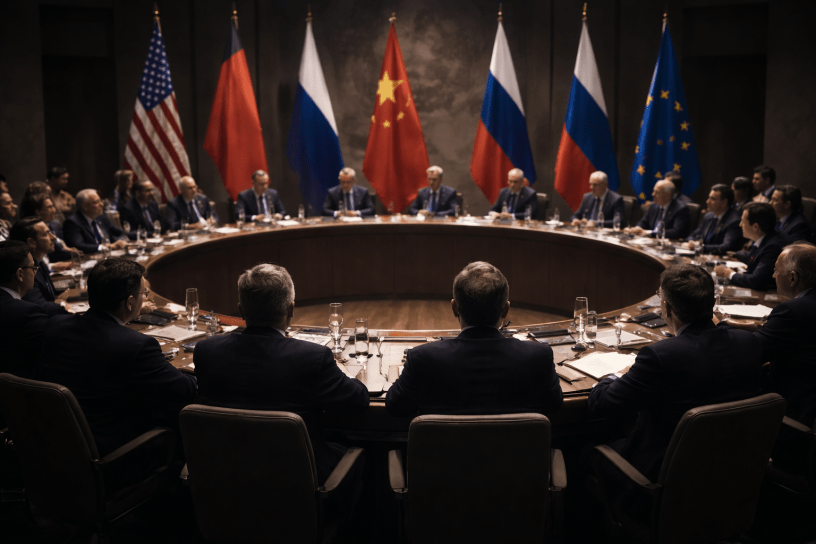
When Condemnation Exists—but Stops Short of Accountability
By Cliff Potts, CSO, and Editor-in-Chief of WPS News
Silence Is Not the Same as Approval—but It Can Have the Same Effect
In the aftermath of the U.S. action in Venezuela, several international actors—including European governments, China, and Russia—have issued statements condemning the use of force and invoking principles of sovereignty and international law.
This matters, and it must be acknowledged clearly:
Condemnation has occurred.
But acknowledging its existence does not end the inquiry. It begins it.
The critical question is not whether objections were voiced, but whether those objections impose any cost, constraint, or consequence on the behavior being condemned.
Not All Condemnation Is Equal
In international politics, condemnation operates on a spectrum.
At one end are rhetorical objections: public statements, expressions of concern, and references to international norms. These carry reputational weight but impose little immediate risk on the actor being criticized.
At the other end are procedural and material actions: emergency multilateral sessions, forced votes, legal filings, sanctions, or the withdrawal of cooperation. These actions create friction and alter incentives.
Most of the responses to the Venezuela operation remain firmly in the first category.
That distinction is not semantic. It is structural.
Europe: Normative Objection Without Collective Enforcement
European responses have emphasized legality, restraint, and concern for escalation. Individual governments have spoken more sharply than others, but no unified European action has followed that would materially constrain U.S. behavior.
There have been no coordinated sanctions, no alliance-level rupture, and no binding collective measures.
This is condemnation—but low-cost condemnation.
It signals discomfort without forcing resolution.
China and Russia: Strategic Condemnation, Not Solidarity
China and Russia have both issued statements emphasizing sovereignty, non-interference, and adherence to the UN Charter.
These objections are real, but they are also interest-driven.
Both states have strong incentives to oppose any precedent that normalizes cross-border seizure of political leadership. Their condemnations are less about Venezuela itself and more about defending a system in which their own sovereignty—and leadership security—is protected.
That does not invalidate the objections. It contextualizes them.
They represent strategic condemnation, not coalition-building.
Why This Still Functions Like Silence
Even when condemnation exists, its effect depends on whether it alters behavior.
To date:
- no enforcement mechanisms have been triggered,
- no legal proceedings have been initiated,
- no coordinated penalties have been imposed.
As a result, the acting power absorbs reputational criticism while continuing forward largely unhindered.
In practical terms, this creates the same outcome as silence: the normalization of precedent.
Complicity Does Not Require Agreement
Complicity in international systems is rarely explicit. It is usually procedural.
It appears as:
- statements without follow-up,
- concern without consequence,
- law without enforcement,
- and principle without cost.
No single actor owns the failure.
Collectively, the failure becomes durable.
Why This Moment Matters
This episode is not only about Venezuela. It is about whether international norms retain meaning when violated by powerful states.
If condemnation remains rhetorical while action remains unchecked, the lesson learned is simple: illegality is survivable.
And once that lesson is internalized, repetition becomes easier.
Editorial Condemnation
WPS News recognizes that condemnation of the U.S. action in Venezuela has occurred—but condemns the failure to translate objection into accountability.
International law does not erode because no one speaks.
It erodes because speaking is allowed to substitute for acting.
Norms survive only when states are willing to defend them at some cost. Until that threshold is crossed, condemnation—however sincere—functions as permission.
History will record not only what was said, but what was allowed to proceed.
APA Citations
United Nations. (1945). Charter of the United Nations.
United Nations General Assembly. (1974). Resolution 3314 (XXIX): Definition of Aggression.
Finnemore, M. (2003). The purpose of intervention: Changing beliefs about the use of force. Cornell University Press.
Discover more from WPS News
Subscribe to get the latest posts sent to your email.
 WPS News