By Cliff Potts, CSO, and Editor-in-Chief of WPS News
Dateline: CARACAS, Venezuela — January 9, 2026
State of Emergency and a Nationwide Hunt
In the chaotic aftermath of the United States’ military operation that captured Venezuelan President Nicolás Maduro early in January, the Venezuelan government has issued an emergency decree ordering police and security forces to locate, detain, and prosecute Venezuelan citizens alleged to have supported or promoted the U.S. action. The full text of the decree was published on January 5, 2026, formalizing a nationwide crackdown on anyone perceived as a domestic collaborator with the U.S. military intervention.
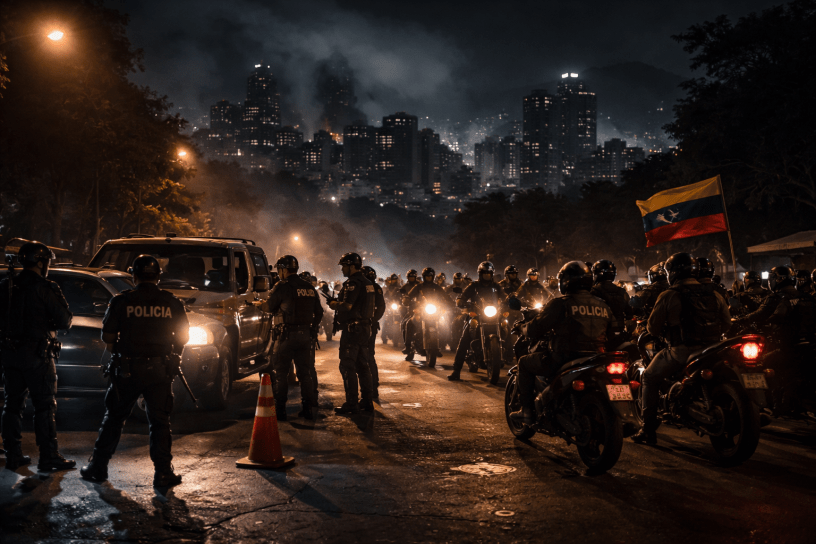
The decree’s language is deliberately broad — targeting not just alleged operational collaborators but also those accused of “support” or “promotion” of what Caracas describes as an armed attack against Venezuela. Local law enforcement agencies have been directed to pursue cases aggressively, with checkpoints and surveillance operations underway in major cities, particularly Caracas.
Public Reaction and Armed Enforcement
In the capital and other urban areas, the atmosphere has shifted quickly from shock to fear. Venezuelans report an uptick in street patrols by pro-government militias — known locally as “colectivos” — alongside official police forces carrying out searches for suspected supporters of the U.S. operation. Members of these armed groups have been stopping people on the streets, inspecting phones and vehicles for signs of “pro-U.S.” communication or affiliations.
Journalists and independent media workers are also being ensnared by the sweep. Dozens have been detained under accusations that their reporting or communications aided the U.S. mission — charges rights advocates say are dangerously vague and constitute political repression.
Government Narrative and Charges
The interim Venezuelan leadership — now under Delcy Rodríguez, who was sworn in after Maduro’s removal — frames the hunt as a necessary defense of national sovereignty. Caracas insists that anyone who collaborated with the U.S. should be held accountable for aiding what the government terms an act of foreign aggression.
Official statements portray the U.S. operation — which Venezuelan authorities and allies called an “illegal attack” — as a violation of international law and a blatant infringement on Venezuelan self-determination. Under that narrative, individuals accused of assisting the United States are being treated as having committed treason or comparable offenses under Venezuelan law.
Impact on Everyday Venezuelans
For many ordinary citizens, the decree has introduced a new level of uncertainty and peril. People seen in public celebrating or expressing support for the U.S. military action — even on social media — are being identified as potential suspects. Families face the real possibility of sudden arrests; activists and dissidents report going into hiding, fearing that any public stance could be construed as assistance to a foreign attack.
Human rights groups have expressed concern that the sweeping, poorly defined criteria for “support” create fertile ground for arbitrary arrests, intimidation, and suppression of dissent — particularly in a climate where formal due process is already constrained by the state of emergency.
Where Things Stand
As of January 5–7, 2026, the government’s crackdown continues to unfold. Police and allied militia groups are actively detaining individuals across Venezuelan cities, attempting to dismantle any internal networks they believe were involved in or sympathetic to the U.S. raid that captured Maduro. The evolving situation reflects not just a legal response but a broader struggle over control, legitimacy, and power — with ordinary Venezuelans caught in the crossfire.
For more social commentary, please see Occupy 2.5 at https://Occupy25.com
References (APA):
Reuters. (2026, January 5). Venezuela orders police to find, arrest anyone involved in supporting U.S. attack-decree. Reuters.
Jerusalem Post Staff. (2026, January 5). Venezuela orders nationwide arrests after US attack. The Jerusalem Post.
New York Post. (2026, January 6). Pro-Maduro motorcycle gang thugs hunting for Trump supporters in Caracas days after dictator’s capture: ‘Very tense’.
Washington Post. (2026, January 6). Fear grips Caracas as a new wave of repression is unleashed in Venezuela.
The Guardian. (2026, January 7). Armed militias deployed in Venezuela as regime attempts to impose authority.
Discover more from WPS News
Subscribe to get the latest posts sent to your email.
 WPS News