By Cliff Potts, CSO, and Editor-in-Chief of WPS News
Washington, D.C.
Introduction: When “It Can’t Happen Here” Stops Being True
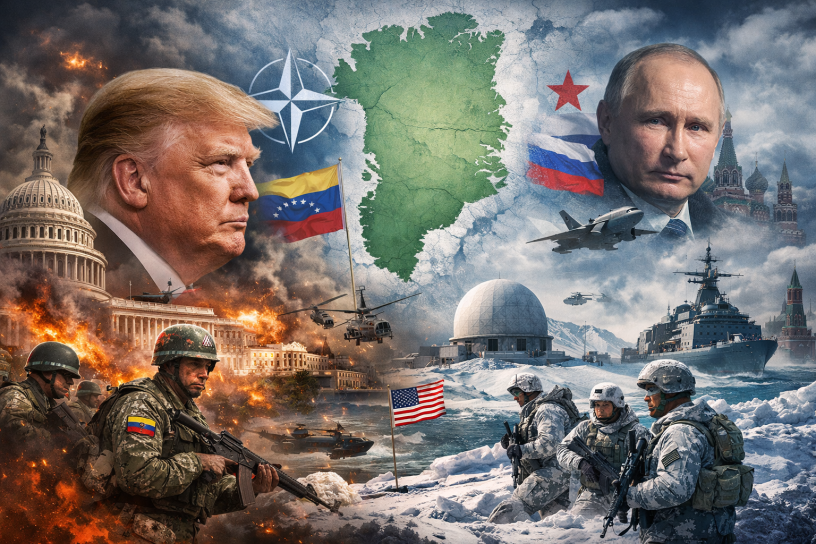
Washington, D.C. has always been capable of foolishness. That much is not new. What is new is how openly reckless ideas now circulate at the highest levels of power — and how often they escape serious consequence. In the span of weeks, the United States has moved from a bold, controversial military operation in Venezuela to renewed talk from President Donald Trump and his advisers about “acquiring” Greenland, including language that refuses to rule out military force.
Taken together, these events reveal something deeper than bad judgment. They reveal a governing culture that is increasingly comfortable testing limits simply because it has gotten away with doing so before. The danger is not that every threat will be carried out. The danger is that each unpunished escalation makes the next one easier to imagine — and harder to stop.
Venezuela: The Precedent That Changed the Room
The U.S. military operation in Venezuela marked a turning point. By openly intervening, capturing the country’s president, and framing the action as a decisive success, the Trump administration demonstrated that dramatic uses of force could be sold domestically as strength rather than destabilization. Legal questions, international criticism, and long-term consequences were brushed aside in favor of immediate political narrative.
That matters because precedent matters in Washington. Once an administration proves it can cross a line without serious internal or external punishment, the political cost-benefit calculation changes. What once sounded unthinkable begins to sound merely “bold.” That is the context in which Greenland has re-entered the conversation.
Greenland Returns — Louder and More Dangerous
Trump first floated the idea of acquiring Greenland in 2019, largely as a real-estate-style transaction. Denmark rejected it outright, and the idea was treated as a diplomatic embarrassment. What has changed is not Greenland’s status, but Washington’s tone.
In early 2026, White House officials confirmed that the administration is again considering a range of options for acquiring Greenland and that military force is “always an option.” This is no longer offhand musing. It is official rhetoric, delivered in a world already on edge.
Greenland is not a failed state. It is a self-governing territory of Denmark, a NATO ally. Even entertaining military seizure of allied territory represents a fundamental break with post–World War II norms. That such talk is happening at all signals how far the guardrails have already shifted.
Why Greenland Matters — and Why That’s the Problem
There are real strategic reasons Greenland attracts attention. The Arctic is opening due to climate change. Shipping routes, resource access, and military positioning are all evolving. Greenland hosts critical U.S. defense infrastructure and sits at a geographic crossroads between North America, Europe, and Russia.
But strategic interest does not justify imperial logic. Every great-power disaster in modern history begins with leaders convincing themselves that geography makes conquest reasonable. Greenland’s value is precisely why destabilizing it would have global consequences. The more important the territory, the higher the stakes — and the higher the cost of reckless action.
The Constitutional Wall Trump Would Hit
Despite presidential bravado, the U.S. system is not designed to support unilateral wars of choice against allies. The Constitution gives Congress the power to authorize war. A military seizure of Greenland without congressional approval would trigger immediate legal challenges, funding battles, and likely impeachment proceedings.
More importantly, the U.S. military itself is bound to follow lawful orders. An attack on allied territory without legal authorization would provoke resistance from within the chain of command. This resistance would not look like mutiny; it would look like paperwork, refusals, delays, and legal objections — the quiet mechanisms by which catastrophic orders die.
Trump’s frustration with “the generals” has always stemmed from this reality: the system is built to slow him down.
NATO: The Alliance That Would Break Before It Fought
Greenland’s status makes any military move uniquely dangerous. Denmark is a NATO member. An attack on Greenland is an attack on Denmark. Under NATO’s founding treaty, that obligates collective defense.
There is no clause exempting attacks carried out by the United States.
In practice, NATO would not launch a shooting war against American forces. Instead, the alliance would enter paralysis. Command structures would collapse, joint operations would freeze, intelligence sharing would stop, and Europe would begin preparing for a future in which the United States is no longer a reliable partner.
That outcome alone would mark the end of the post-1945 security order.
Russia’s Opportunity — Without Firing a Shot
If Washington shattered NATO unity through aggression, Russia would not rush troops to Greenland. It would not need to. Moscow’s strategy would be patient and opportunistic: political warfare, information campaigns, diplomatic isolation of the United States, and pressure on Europe’s eastern flank while NATO struggled to redefine itself.
The greatest gift Washington could hand Russia is proof that the U.S.-led rules-based order applies only when convenient. An American attack on Greenland would supply that proof in real time, on a global stage.
Why This Keeps Happening in Washington
This moment is not about Greenland alone. It is about a political culture that increasingly mistakes survival for success. Trump has learned that outrageous ideas can be floated, tested, and sometimes normalized without consequence. Each time that happens, the system adapts — not by strengthening norms, but by absorbing the shock.
The danger is cumulative. Washington does not collapse because of one bad decision. It collapses because enough bad decisions go unpunished that restraint starts to look optional.
What Actually Stops This
Trump is not restrained by persuasion or precedent. He is restrained by friction: law, process, institutions, allies, and time. The same bureaucracy that frustrates reform also prevents sudden catastrophe. Every step required to turn rhetoric into action introduces veto points staffed by people with careers, oaths, and legal obligations.
That friction has held before. It may hold again. But it only works if those institutions remain intact and taken seriously.
Conclusion: The Real Risk Is Not Greenland
The real risk is not that American troops will storm Greenland tomorrow. The real risk is that Washington has entered an era where such ideas can be discussed openly, seriously, and repeatedly by people in power. That alone signals decay.
Empires rarely fall because they are defeated in battle. They fall because they forget the difference between power and restraint. If Washington cannot remember that difference, Greenland will not be the last place this story points.
For more social commentary, please see Occupy 2.5 at https://Occupy25.com.
References (APA)
Associated Press. (2026). U.S. officials say military force “always an option” in Greenland talks.
Reuters. (2026). Trump advisers discuss options for acquiring Greenland.
The Guardian. (2026). European leaders push back on U.S. rhetoric over Greenland.
Washington Post. (2026). Trump’s Venezuela intervention reshapes U.S. foreign policy debate.
Al Jazeera. (2026). Greenland sovereignty and NATO tensions explained.
Discover more from WPS News
Subscribe to get the latest posts sent to your email.
 WPS News