By Cliff Potts, CSO, and Editor-in-Chief of WPS News
Minneapolis, Minnesota
January 10, 2026
Purpose and Scope
This article documents observable events, public statements, and prevailing political discourse as they are occurring. It is written in the form of a contemporaneous news record and is intended to preserve context, sequence, and institutional posture during a period of heightened political strain.
Statements and Actions by Public Officials
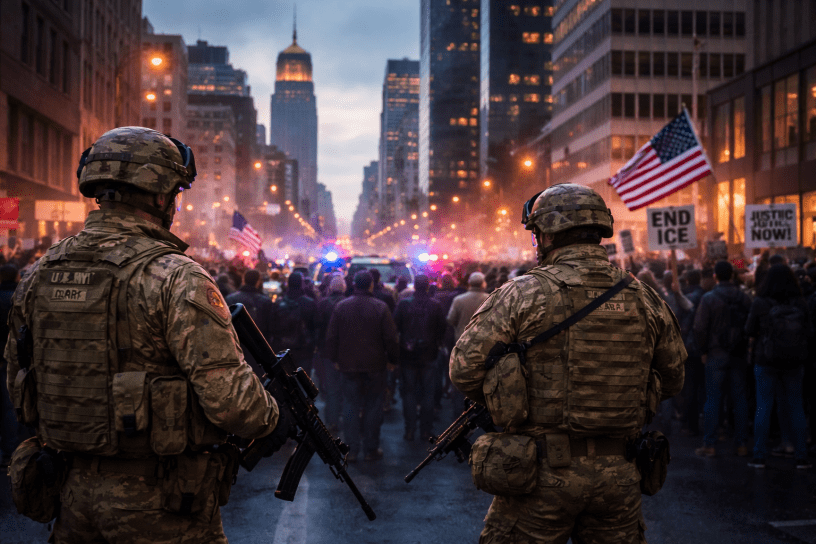
In early January 2026, senior municipal and state officials in the Upper Midwest issued public statements critical of federal immigration enforcement activity following civilian deaths. The mayors of Chicago and Minneapolis publicly condemned actions taken by Immigration and Customs Enforcement (ICE). Separately, Minnesota Governor Tim Walz announced the activation and readiness of the Minnesota National Guard for state-level public safety purposes while stating that additional federal intervention was neither requested nor required at that time.
These actions are notable because they represent a divergence in posture between state and federal authorities. They do not constitute defiance of law, secession, or armed confrontation. Rather, they reflect a state-level assertion of responsibility grounded in an assessment of local conditions and public safety needs.
Public Rhetoric and Social Media Discourse
At the same time, social media platforms such as TikTok and Facebook Reels have seen a marked increase in emotionally charged political speech. This includes expressions of anger, fear, grief, and helplessness, as well as rhetorical references to civil conflict. Testimony from multiple observers, including the author, indicates that such rhetoric is not isolated to a single individual and is broadly visible across platforms.
From a factual standpoint, it is essential to distinguish speech from action. Expressions of frustration or despair do not, by themselves, constitute violent conduct. However, the prevalence of such rhetoric functions as an indicator of public sentiment and perceived governmental legitimacy.
Legitimacy as a Political Indicator
Political science literature consistently identifies legitimacy as a central requirement for stable governance. Governments do not lose legitimacy solely through protest or dissent. Legitimacy erodes when a significant portion of the population begins to regard governing authority as unlawful, unaccountable, or hostile to public welfare.
The convergence of three factors—public condemnation by local officials, state-level assertions of autonomous public safety authority, and widespread public rhetoric questioning federal legitimacy—constitutes what can be described as legitimacy stress. This term denotes institutional strain rather than conflict itself.
Historical Context
Comparable periods in United States history, including the 1960s, demonstrate that early warning signals of institutional strain were frequently minimized until escalation forced reactive responses. Recording such signals contemporaneously provides a factual basis for later analysis and historical understanding.
Conclusion
Minnesota is not experiencing civil war, nor is armed conflict underway. What is observable at present is a measurable strain on perceived federal legitimacy, expressed through official statements and public discourse. Whether this strain resolves or deepens will depend on future actions by governing institutions. This article exists to document current conditions as they stand, without prediction or prescription.
Legal and Editorial Notice
This article is a work of journalistic documentation and analysis. It does not advocate violence, civil disorder, resistance to lawful authority, or any form of collective action. References to public rhetoric, including extreme or inflammatory language, are included solely for the purpose of accurately recording observable discourse. The author neither endorses nor encourages such language or any actions that might be inferred from it.
For more social commentary, please see Occupy 2.5 at https://Occupy25.com
References (APA Style)
Berman, S. (2019). Democracy and dictatorship in Europe. Oxford University Press.
Dahl, R. A. (1971). Polyarchy: Participation and opposition. Yale University Press.
Huntington, S. P. (1968). Political order in changing societies. Yale University Press.
Levitsky, S., & Ziblatt, D. (2018). How democracies die. Crown.
Minnesota Governor’s Office. (2026). Public statements regarding National Guard readiness.
U.S. Department of Homeland Security. (2025–2026). ICE enforcement policies and public communications.
Discover more from WPS News
Subscribe to get the latest posts sent to your email.
 WPS News