By Cliff Potts, CSO, and Editor-in-Chief of WPS News
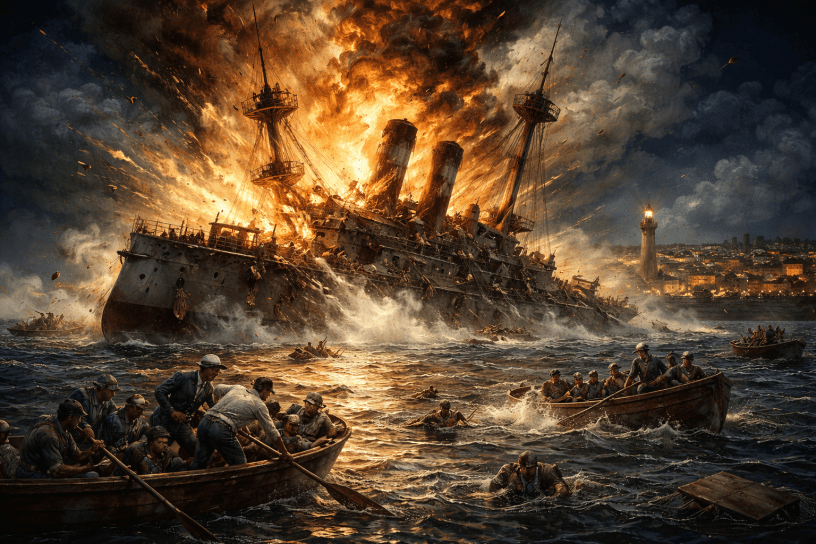
On the evening of February 15, 1898, a thunderclap tore through Havana Harbor. Within minutes, the United States Navy’s pride lay shattered, 266 sailors were dead, and a regional crisis accelerated into a global turning point. The ship was the USS Maine, and her destruction pushed the United States into the Spanish–American War—a short war with long consequences that reshaped American power across the Caribbean and the Pacific.
What the Maine Was—and Why She Mattered
Commissioned in 1895, Maine represented the U.S. Navy’s leap from a coastal defense force toward a modern steel fleet. She wasn’t a battleship in the later dreadnought sense, but for her moment she was cutting-edge: a steel hull, compartmentalized watertight bulkheads, electric lighting, and heavy armor around vital spaces. Her main battery—ten-inch guns mounted in armored turrets—gave her striking power unmatched by most American ships of the early 1890s. Just as important, Maine symbolized intent. The Navy was no longer content to patrol harbors; it aimed to project force.
That symbolism mattered in Cuba. By the late 1890s, Spanish rule there was collapsing under a brutal counterinsurgency. American commercial interests were exposed, and public sympathy—stoked daily in U.S. newspapers—ran hot. Washington sent Maine to Havana not to fight, but to be seen: a floating statement that American lives and property would be protected.
The Explosion in Havana Harbor
At 9:40 p.m., an explosion ripped through Maine’s forward magazines. The blast snapped the ship’s bow, ignited fires, and flooded compartments faster than crews could respond. She sank where she sat. Immediate rescue efforts saved some, but the toll was catastrophic.
What caused the explosion remains contested. A late-19th-century naval inquiry concluded an external mine had detonated the magazines. Decades later, metallurgical studies and re-examinations suggested an internal cause—likely spontaneous combustion in coal bunkers adjacent to ammunition. The honest historical answer is that certainty is elusive. What is certain is that the facts mattered less than the moment.
From Tragedy to War
In an era before radio and television, newspapers were the accelerant. Sensational headlines turned grief into fury and ambiguity into accusation. “Remember the Maine” became a rallying cry long before evidence could cool tempers. Political leaders faced an outraged public and a strategic opportunity. Within weeks, diplomacy collapsed. Congress declared war in April 1898.
The conflict was brief and decisive. American naval power—modern, fast, and increasingly professional—proved its worth. Spain’s fleets were destroyed in two theaters, cutting the legs out from under its empire.
The Spoils of a Short War
Victory delivered territory—and responsibility. In the Caribbean, the United States took control of Puerto Rico and established a dominant position over Cuba, which became formally independent but economically and militarily constrained. In the Pacific, the U.S. acquired the Philippines, transforming a continental republic into an overseas empire.
This expansion wasn’t cost-free. In the Philippines, the transition sparked a brutal counterinsurgency that lasted years and contradicted the war’s liberating rhetoric. The United States had won a war against Spain—but inherited Spain’s imperial problems.
Why the Maine Still Matters
The sinking of Maine sits at the intersection of technology, media, and power. A modern ship symbolized a modern nation; her destruction became a media event; the response forged a new role for the United States. The lesson isn’t simply that wars can begin on misinformation—though they can. It’s that symbols move faster than facts, and momentum can outrun caution.
Maine was advanced for her time because she embodied transition: from wood to steel, from harbor defense to blue-water ambition, from regional power to global actor. Her loss accelerated that transition. The United States emerged from 1898 with new territories, new reach, and a new identity—one still being debated today.
APA Citations
Blight, D. W. (2018). American oracle: The Civil War in the Civil War era and beyond. Harvard University Press.
Hoganson, K. L. (1998). Fighting for American manhood: How gender politics provoked the Spanish–American and Philippine–American wars. Yale University Press.
LaFeber, W. (1993). The new empire: An interpretation of American expansion, 1860–1898. Cornell University Press.
U.S. Navy Department. (1898). Report of the court of inquiry into the loss of the USS Maine. Government Printing Office.
Discover more from WPS News
Subscribe to get the latest posts sent to your email.
 WPS News