When an ally prepares defenses against another ally, something has gone deeply wrong
By Cliff Potts, CSO, and Editor-in-Chief of WPS News
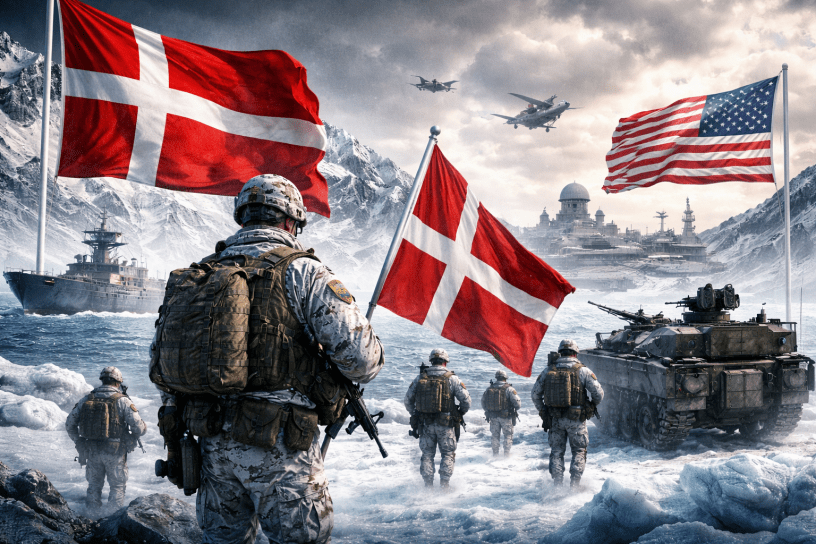
Denmark’s decision to increase its military presence in Greenland should alarm anyone who still believes NATO operates in a stable, predictable world. This is not a routine Arctic exercise. It is not a symbolic flag-planting mission. It is a sober, defensive response to a situation that should never have existed in the first place: a NATO member taking concrete steps to protect its sovereign territory from pressure originating with the United States.
That sentence alone should stop policymakers cold.
The immediate trigger is not speculation. It is public, documented rhetoric from President Donald Trump and figures around him asserting that U.S. control over Greenland is “necessary” for American security. These statements have not been treated as jokes in Copenhagen or Nuuk, because they are not jokes. When the president of the United States repeatedly questions the sovereignty of allied territory, allies are forced to plan for contingencies they once considered unthinkable.
Denmark has responded by doing exactly what a responsible state does under pressure: reinforcing its defenses. The Danish government has announced additional deployments of personnel and assets to Greenland, coordinated closely with NATO partners. Official statements frame the move in the language of readiness, Arctic security, and alliance cooperation—but the timing makes the underlying cause unmistakable. This is about deterrence, not theater.
Greenland is not an empty chessboard square. It is a semi-autonomous territory within the Kingdom of Denmark, with its own elected government and an explicit rejection of becoming part of the United States. Greenlanders have said this repeatedly, and Denmark has backed them unequivocally. What has changed is that Copenhagen now feels compelled to demonstrate, physically and visibly, that sovereignty will be defended even if pressure comes from across the Atlantic.
This is where the situation crosses from absurd into dangerous.
NATO was designed to deter external aggression, not to manage internal coercion. Yet here we are: European allies coordinating deployments not because Russia is massing forces in Greenland, and not because China is making territorial claims there, but because the political volatility of the United States has injected uncertainty into the alliance itself. Germany, Sweden, and other European partners are participating in Arctic deployments alongside Denmark—not to confront Washington, but to signal that alliance norms still matter even when one member strays.
It must be stated clearly: this is not the will of the American people. Polling consistently shows that a majority of Americans support NATO, respect allied sovereignty, and reject territorial adventurism. The problem is not “America.” The problem is a U.S. political system that has allowed a single individual to treat foreign policy as a personal negotiation and alliances as leverage.
Denmark’s troop movements are therefore not an escalation. They are a warning flare. They tell the world that European states are no longer willing to assume U.S. restraint as a given. They tell NATO that alliance survival now requires planning around American unpredictability. And they tell Washington something it desperately needs to hear: allies will not surrender sovereignty to soothe a president’s ego.
This moment will be studied for years—not as a clash between nations, but as a case study in how alliances adapt when their strongest member becomes their greatest liability.
References (APA)
Associated Press. (2026). Danish officials cite “fundamental disagreement” with U.S. over Greenland.
Breaking Defense. (2026). Denmark bolsters Greenland forces in close collaboration with NATO allies.
Reuters. (2026). Germany to send reconnaissance troops to Greenland amid allied coordination.
Pew Research Center. (2023). U.S. public support for NATO and allied defense commitments.
North Atlantic Treaty Organization. (1949). The North Atlantic Treaty.
Discover more from WPS News
Subscribe to get the latest posts sent to your email.
 WPS News