The American Civil War: Civic Life Series (Part 1 of 18)
By Cliff Potts, CSO, and Editor-in-Chief of WPS News
Baybay City, Leyte, Philippines
January 20, 2026
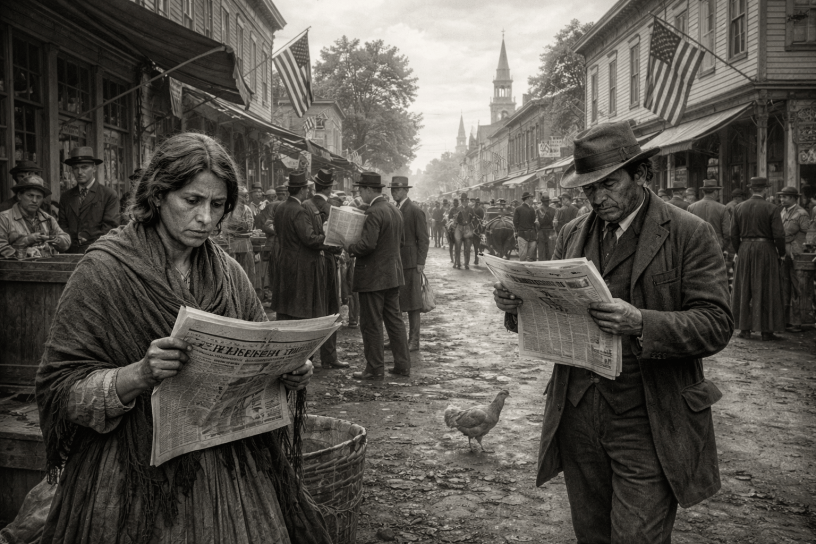
In the months before the American Civil War began in earnest, daily life did not look like a nation on the brink. Shops opened. Churches met. Newspapers argued. Families planned weddings and harvests. Most people believed the crisis would resolve itself, because most crises always had.
This belief—that things would somehow settle down—was not ignorance. It was experience.
For decades, political confrontations in the United States had followed a familiar pattern: heated rhetoric, sectional anger, compromise at the last moment. The Missouri Compromise. The Compromise of 1850. Each time, tempers flared and then cooled. Ordinary citizens learned a lesson from this rhythm: national disputes were loud but temporary. Life went on.
So when states began talking seriously about secession, many Americans treated it as posturing. Newspapers printed editorials predicting reconciliation. Clergy urged calm. Business owners assumed trade would resume once the politicians finished shouting. Even in the South, where secessionist fervor was strongest, many households expected a short disruption at most.
What people did not yet grasp was that legitimacy—the shared belief that the political system could still manage conflict—was already fracturing.
Normalcy as a Survival Strategy
For families, maintaining routine was not denial; it was survival. Panic offered no shelter. Bread still had to be baked. Children still needed schooling. Rent was still due. The safest emotional posture was to assume continuity.
Diaries from the late 1850s and early 1861 repeatedly reflect this tone. Writers noted alarming speeches and unsettling rumors, then pivoted immediately to domestic concerns: a sick child, a poor crop, a neighbor’s wedding. The implication was clear—politics might be dangerous, but daily life was not optional.
Normalcy also served a social purpose. To openly acknowledge that war was coming meant accepting responsibilities most people were unprepared for: choosing sides, preparing for loss, reimagining the future. Minimizing the threat allowed communities to remain intact a little longer.
The Illusion of Containment
Many Americans believed that even if violence occurred, it would be limited. There was talk of “a brief conflict,” “a single decisive action,” or “a show of force” that would restore order. The idea of prolonged, nationwide disruption felt implausible in a country that had never experienced industrial-scale internal war.
This illusion was reinforced by geography. In rural areas, distant political centers felt abstract. In towns far from state capitals, the arguments of elites seemed remote. People assumed that if trouble came, it would stay elsewhere.
They were wrong.
Economic Confidence Before Collapse
Merchants extended credit. Farmers planted as usual. Manufacturers accepted orders months in advance. The economy, like public sentiment, was built on the assumption of continuity.
This confidence delayed preparation. Stockpiles were not built. Contingencies were not planned. When disruptions came—first through uncertainty, then through mobilization—they hit households that had not braced for scarcity.
The lesson would be learned later, painfully: stability is not the same as resilience.
Social Fractures Beneath the Surface
Even as people insisted that the crisis would pass, signs of fracture were visible. Family conversations grew tense. Longtime friendships cooled. Church congregations split over doctrine and loyalty. Newspapers increasingly spoke past one another rather than to one another.
These were not yet explosions. They were hairline cracks.
Communities were still intact, but trust was thinning. And trust, once weakened, does not recover quickly.
The Cost of Being Wrong
When war finally arrived in full force, it felt sudden—not because it was unexpected, but because people had postponed believing it. The shock came not from the event itself, but from the realization that preparation had been deferred too long.
The cost of that delay would be paid in shortages, confusion, grief, and disorientation. The war did not simply interrupt life; it restructured it. And those who had assumed continuity found themselves scrambling to adapt.
Looking Back
In retrospect, the months before the Civil War read like a warning written in plain language and ignored. People were not foolish. They were human. They trusted precedent. They trusted institutions. They trusted that someone, somewhere, would prevent catastrophe.
This series begins here because this moment—the moment when everyone still thought it would blow over—is where civic breakdown quietly starts. Not with gunfire, but with the assumption that tomorrow will look like yesterday.
History shows that when that assumption fails, the consequences are not abstract. They arrive at the kitchen table, the market stall, the church pew, and the household ledger.
And by the time people realize normal life is not returning, it is already gone.
For more social commentary, please see Occupy 2.5 at https://Occupy25.com
McPherson, J. M. (1988). Battle cry of freedom: The Civil War era. Oxford University Press.
Faust, D. G. (2008). This republic of suffering: Death and the American Civil War. Alfred A. Knopf.
McCurry, S. (2010). Confederate reckoning: Power and politics in the Civil War South. Harvard University Press.
Blight, D. W. (2001). Race and reunion: The Civil War in American memory. Harvard University Press.
Mitchell, R. B. (2007). The vacated chair: The northern soldier leaves home. Oxford University Press.
Library of Congress. (n.d.). Civil War diaries and letters, 1859–1861. Manuscript Division. https://www.loc.gov/collections/civil-war
Library of Congress. (n.d.). Chronicling America: Historic American newspapers. https://chroniclingamerica.loc.gov
Discover more from WPS News
Subscribe to get the latest posts sent to your email.
 WPS News