By Cliff Potts, CSO, and Editor‑in‑Chief of WPS News
Baybay City, Leyte, Philippines — January 27, 2026
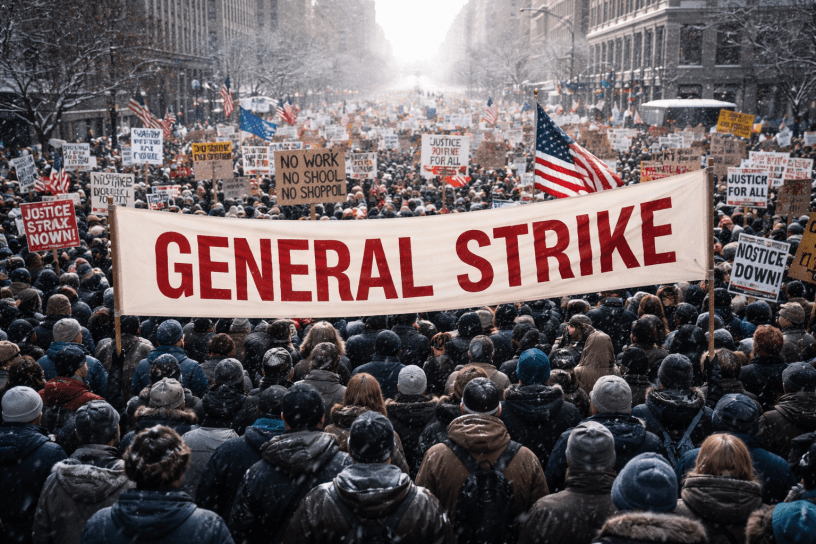
A loose but rapidly spreading coalition of activists is calling for a nationwide day of economic disruption on January 30, 2026, under the banner “ICE‑OUT.” The action is being framed as a one‑day general strike or national shutdown, urging participants to withhold labor, schooling, and consumer activity for 24 hours in protest of U.S. Immigration and Customs Enforcement (ICE) operations.
The call follows a week of sustained protests in Minnesota after federal immigration enforcement actions, including a fatal shooting involving federal agents. On January 23, Minnesota organizers coordinated a statewide “economic blackout,” encouraging residents to skip work, school, and shopping. That action drew thousands into the streets despite sub‑zero temperatures and prompted hundreds of local businesses to close in solidarity.
Organizers now appear to be attempting to scale that momentum beyond Minnesota.
What the January 30 action is
According to flyers, social‑media posts, and statements circulating online, the January 30 ICE‑OUT action is intended as a synchronized, one‑day national refusal. Participants are being asked to:
• Not go to work, if able • Keep children home from school, where possible • Avoid shopping or discretionary spending • Participate in rallies, walkouts, or public demonstrations
Unlike traditional labor strikes, the ICE‑OUT call is decentralized. There is no single national organizing body, no formal strike authorization from major labor federations, and no unified leadership structure. Instead, the action is being promoted by a patchwork of student groups, immigrant‑rights organizations, faith communities, and local activist networks that are amplifying the same date and message.
What the action is not
Despite the language of “shutdown” and “general strike,” there is currently no evidence that January 30 will result in a comprehensive national work stoppage. Major national unions have not formally endorsed the action, and organizers have not announced binding strike commitments across critical industries.
That distinction matters. Historically, nationwide general strikes require months of preparation, deep union coordination, and extensive legal and financial planning. None of those indicators are present at scale as of January 27.
What is unfolding instead is closer to a coordinated day of protest and economic disruption — an attempt to create visibility, solidarity, and pressure rather than a full halt to national operations.
Why the timing matters
The compressed timeline is striking. With fewer than 72 hours between widespread circulation of the national call and the proposed action date, organizers are relying heavily on rapid digital mobilization rather than institutional backing.
That approach carries risks. Short‑notice actions can struggle with turnout and clarity, and inconsistent messaging can dilute impact. At the same time, rapid escalation can also produce unpredictable results, particularly when public anger is already elevated.
Even limited participation across multiple cities could generate media attention and reinforce a broader narrative of resistance to federal immigration enforcement.
Goals and demands
While specific demands vary by group, ICE‑OUT messaging consistently emphasizes:
• Withdrawal or reduction of ICE operations in local communities • Accountability for federal agents involved in violent incidents • Opposition to expanded funding for immigration enforcement • Protection for immigrant communities and mixed‑status families
Many organizers frame the action not as a final demand, but as an opening move — a signal of capacity and intent rather than a standalone event.
What to expect on January 30
Based on available information, January 30 is likely to feature:
• Localized protests and rallies in select cities • Student walkouts and campus demonstrations • Voluntary business closures in solidarity • Online campaigns encouraging economic non‑participation
Participation levels will likely vary widely by region. Some areas may see visible disruption, while others may experience little direct impact.
A moment of testing
Whether January 30 becomes a footnote or a foundation will depend on participation, follow‑through, and what comes next. One‑day actions rarely succeed on their own. Their significance lies in whether they establish momentum, infrastructure, and shared purpose for sustained organizing.
For now, ICE‑OUT represents an attempt to translate regional outrage into national coordination — under severe time constraints and without centralized authority.
WPS News will continue to monitor developments as January 30 approaches and report on verified actions as they occur.
For more social commentary, please see Occupy 2.5 at https://Occupy25.com
Verification and reporting notes
Information in this report is based on publicly available statements, protest flyers, social media postings, and contemporaneous reporting from regional and national outlets as of January 27, 2026. Organizers are decentralized, and participation levels and locations may change rapidly. WPS News will update or correct this report if materially new, verified information emerges.
References
Associated Press. (2026, January 23). Thousands brave bitter cold to demand ICE leave Minneapolis.
The Guardian. (2026, January 23). Minnesotans strike in protest against ICE surge: “No work, no school, no shopping.”
Reuters. (2026, January 23). Minnesotans promise an economic strike to protest immigration enforcement.
Minnesota Reformer. (2026, January 22). ICE Out of Minnesota day is a general strike: What that means.
Discover more from WPS News
Subscribe to get the latest posts sent to your email.
 WPS News