By Cliff Potts, CSO, and Editor-in-Chief of WPS News
Reliability Was the Product
For years, Amazon didn’t just sell goods — it sold confidence. Packages arrived when promised. Tracking made sense. Customer service could actually fix things. That reliability became the brand. You didn’t think about Amazon; you trusted it.
That trust is eroding.
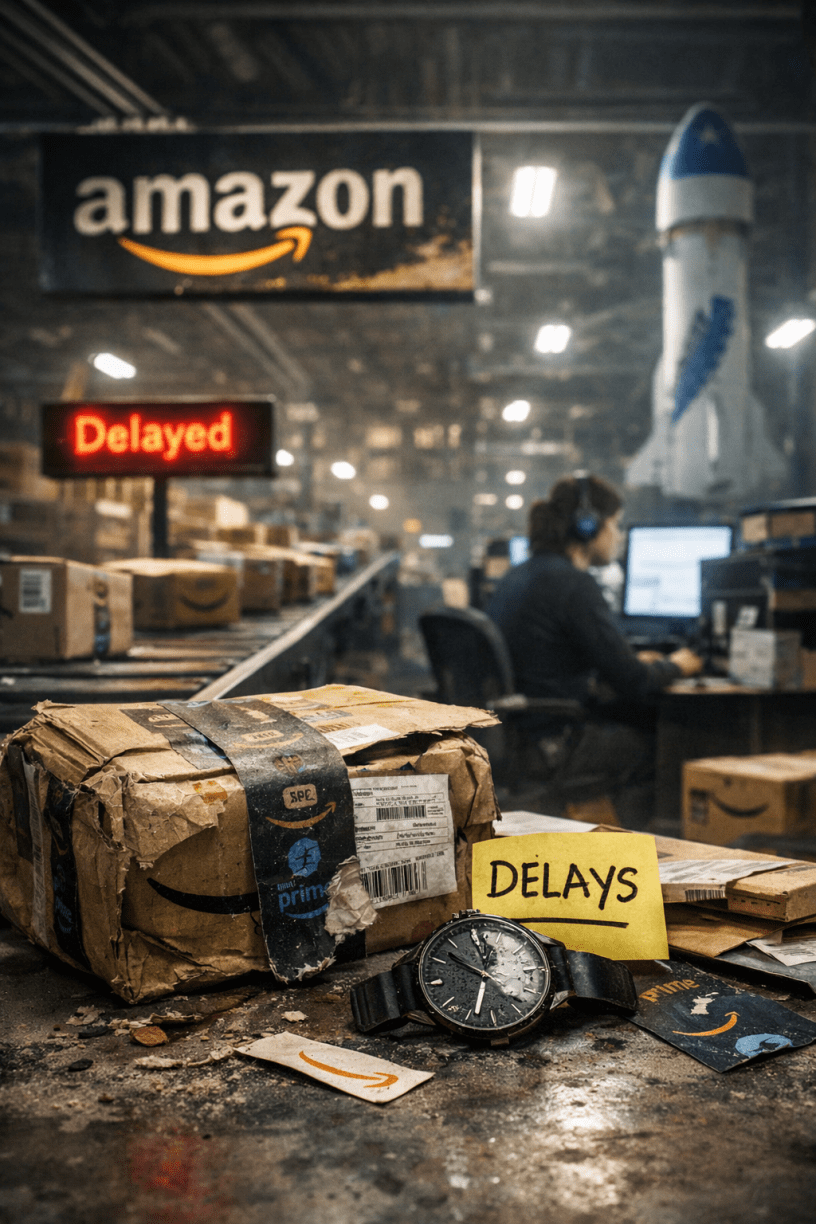
Not with a single catastrophic failure, but through a steady drip of small ones: missed delivery windows, vague tracking updates, packages that appear to wander for days, and customer service agents who apologize without resolving anything. These are not random mishaps. They are signals.
Decay Starts at the Top
Large systems rarely fail from the bottom up. They decay from the top down. When leadership focus drifts, discipline follows.
When Jeff Bezos stepped back from day-to-day control, Amazon lost its most important cultural force: obsession with execution. Bezos was fixated on logistics, customer trust, and operational detail. That fixation shaped Amazon’s internal culture for decades.
Today, that intensity is gone.
Amazon still moves an astonishing number of packages. But scale without obsession breeds fragility. Prime delivery promises quietly stretch. Tracking lags reality. Customer service has less authority and more scripts. Problems are routed, deferred, and closed — not solved.
Policy Over People
Amazon’s current operating model favors automation, cost control, and rigid policy enforcement. On paper, it looks efficient. In practice, it makes the system brittle.
Frontline workers have less discretion. Customer service representatives are constrained by rules they didn’t write. Delivery drivers are pushed harder with less margin for error. When something breaks — weather, staffing, software — the recovery is slower and colder than it used to be.
Customers feel this immediately. Sellers feel it in inconsistent fulfillment. Employees feel it in pressure without empowerment.
This is what institutional hollowing looks like.
The Distraction Effect
Leadership attention goes where leadership passion lives. Bezos’ public focus now centers on prestige projects and personal legacy building, most notably Blue Origin.
Ambition isn’t the issue. Displacement is.
When a founder disengages from the core business, the organization doesn’t collapse — it drifts. Metrics replace judgment. Scripts replace problem-solving. Accountability becomes abstract.
Amazon is drifting.
Why This Matters
Amazon’s real superpower was never speed. It was predictability. Customers trusted the system. They didn’t just expect fast delivery; they expected transparency and accountability.
Once that trust weakens, behavior changes. Customers hedge. Prime becomes optional. Frustration replaces loyalty. Trust, once spent, is brutally expensive to rebuild.
Amazon is not failing. But it is no longer excellent. And excellence does not survive without leadership that treats execution as sacred rather than assumed.
If Amazon wants to reverse this trend, the fix is neither flashy nor cheap: empowered customer service, honest delivery promises, accurate tracking, and leadership that re-centers operational discipline.
If not, the decay continues quietly — one late package, one scripted apology, one lost customer at a time — until the brand’s greatest asset finishes eroding.
For more social commentary, please see Occupy 2.5 at https://Occupy25.com
References (APA)
Bezos, J. (2016). Letter to shareholders. Amazon.com, Inc.
Amazon.com, Inc. (2023). Form 10-K: Annual report. U.S. Securities and Exchange Commission.
Kantor, J., & Streitfeld, D. (2021). Inside Amazon’s employment machine. The New York Times.
Stone, B. (2013). The everything store: Jeff Bezos and the age of Amazon. Little, Brown and Company.
Discover more from WPS News
Subscribe to get the latest posts sent to your email.
 WPS News