By Cliff Potts, CSO, and Editor-in-Chief of WPS News
Baybay City, Leyte, Philippines — January 28, 2026
Summary
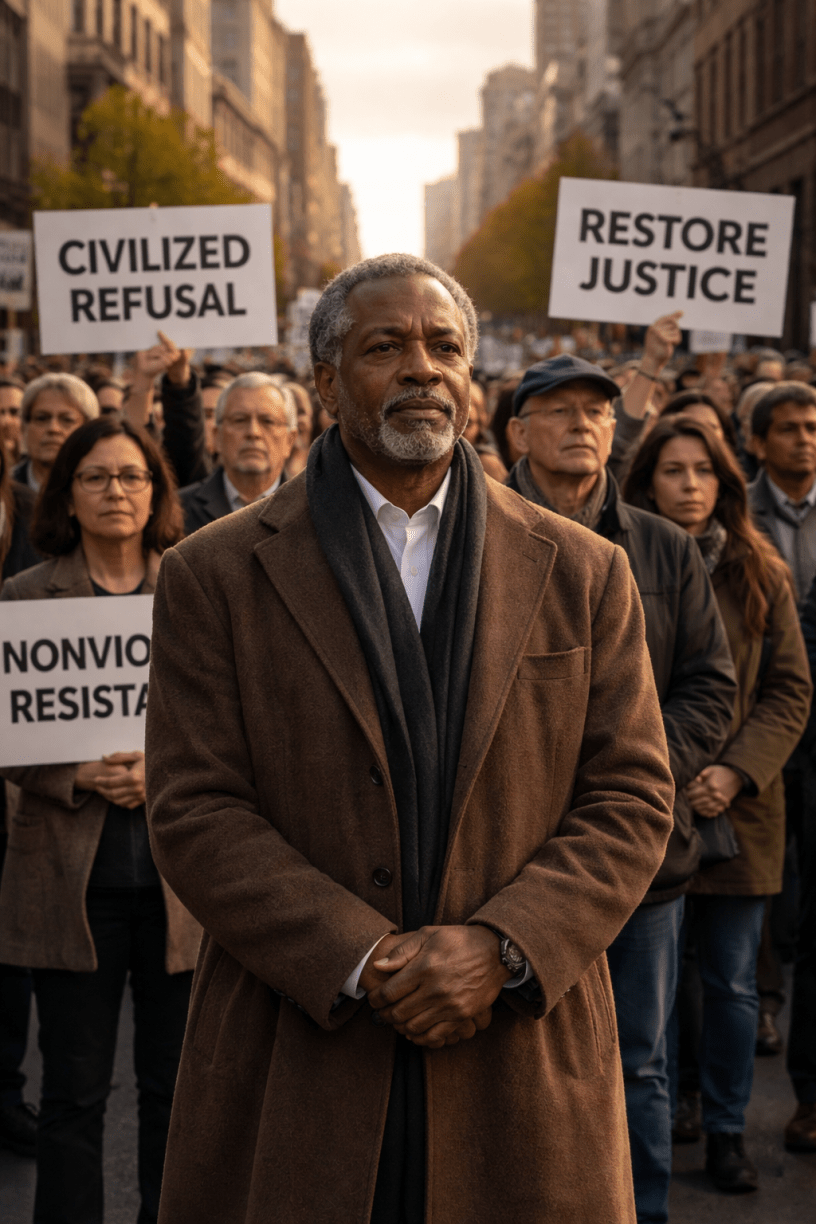
As federal enforcement tactics in the United States increasingly rely on extraordinary powers exercised without visible restraint, public fear has grown alongside public silence. History suggests that when authority becomes uncivilized, nonviolent withdrawal—not confrontation—offers a lawful, moral release valve. This essay examines the case for a disciplined, rolling refusal grounded in American civil-rights tradition.
The Problem Is Not Disorder—It Is Fear
The United States is experiencing a widening gap between authority and consent. Reports of armed federal agents operating with limited transparency, combined with incidents of lethal force and delayed accountability, have created an atmosphere of fear that extends beyond any single community.
Fear is not disorder. It is a signal that the social contract is under strain. When fear becomes routine, restraint by the public is not apathy—it is patience. But patience has limits.
Nonviolent Direct Action as Civic Discipline
The American tradition of nonviolent direct action does not begin with chaos. It begins with restraint. During the Montgomery Bus Boycott, communities did not riot; they withdrew cooperation. They created visible tension without violence, compelling institutions to confront injustice without providing justification for repression.
This approach remains relevant. Nonviolent withdrawal is not rebellion. It is discipline—an insistence that law be worthy of obedience.
When Extraordinary Powers Become Ordinary Tools
Extraordinary authorities, such as broad enforcement powers and emergency measures, are intended for rare circumstances. When such tools become routine, the risk is normalization: actions that would once have demanded immediate review become background conditions.
A government that tolerates lethal outcomes without prompt, transparent accountability undermines its own legitimacy. In such conditions, continued participation without protest becomes complicity by silence.
A Rolling Refusal, Not a Flash Protest
A single day of protest can be ignored. A rolling refusal cannot.
A rolling refusal is not a command but an invitation—one that recognizes unequal risk. Participation may include temporary work stoppages, reduced consumer spending, business closures, remote disengagement, or civic vigils. Each act is lawful. Each act is nonviolent. Together, they communicate a simple truth: consent is conditional.
This model avoids escalation. It deprives authoritarian responses of their preferred justification—disorder—while maintaining sustained, peaceful pressure.
A Release Valve, Not a Threat
Nonviolent withdrawal functions as a civic release valve. When pressure builds without an outlet, systems fail unpredictably. Calm, collective refusal allows societies to pause, reassess, and correct course before violence becomes thinkable.
This is not a call to overthrow institutions. It is a call to restore them by insisting that authority be exercised with restraint, transparency, and accountability.
Conclusion
A civilized society does not meet uncivilized authority with rage. It meets it with refusal. Quiet. Lawful. Sustained.
Nonviolent direct action is not disorder. It is order insisting on being restored.
For more social commentary, please see Occupy 2.5 at https://Occupy25.com
References
King, M. L., Jr. (1963). Letter from Birmingham Jail. American Friends Service Committee.
U.S. Commission on Civil Rights. (2023). Federal Law Enforcement Accountability and Oversight. Washington, DC.
Arendt, H. (1970). On Violence. Harcourt, Brace & World.
Discover more from WPS News
Subscribe to get the latest posts sent to your email.
 WPS News