By Cliff Potts, CSO, and Editor-in-Chief of WPS News
Baybay City, Leyte, Philippines — January 30, 2026
Reporting
In January 2026, three U.S. citizens were killed during encounters with federal law enforcement inside the United States. These deaths occurred during domestic enforcement operations, not during active combat, hostage rescues, or armed standoffs. In each case, federal authorities asserted that the individual posed a threat. In each case, publicly available evidence, medical findings, or eyewitness accounts raised substantial questions about those claims.
In the first case, Renée Good, a 37-year-old U.S. citizen, was shot multiple times by a federal immigration agent during an enforcement action. Federal statements initially claimed she used a vehicle in a threatening manner. The county medical examiner later ruled her death a homicide caused by multiple gunshot wounds. No independent finding established that Good posed an imminent threat to life at the time lethal force was used.
In the second case, Alex Pretti, a 37-year-old intensive care nurse, was killed during an immigration-related operation in Minneapolis. Federal officials claimed Pretti was armed and aggressive. Video footage and eyewitness testimony later showed him on the ground, unarmed, holding a cellphone, and attempting to assist others before being restrained and shot. A federal judge ordered the preservation of evidence after discrepancies emerged between official statements and recorded footage.
Pretti was legally armed under Minnesota law and possessed a valid permit to carry. Publicly available evidence indicates his firearm was not brandished and may have been removed during the encounter prior to shots being fired.
In a third incident earlier this year, another U.S. citizen died during federal custody following an enforcement encounter. As in the other cases, authorities cited non-compliance and perceived threat as justification. In all three incidents, national political figures publicly framed the victims as dangerous or guilty before independent investigations were completed.
All three deaths occurred in civilian settings and outside any judicial process.
Analysis: Innocence and Due Process
The United States is founded on a core legal principle that is neither symbolic nor optional: a person is innocent until proven guilty in a court of law.
That determination is made through evidence, procedure, and adjudication—often by a jury of peers. It is not made by an officer on the street. It is not made by a federal agency press release. It is not made by political leaders on television.
There is no constitutional authority that permits the execution of an unarmed civilian outside a courtroom.
Yet in each of these cases, lethal force was followed by a familiar narrative sequence: the dead were immediately portrayed as threats, their behavior was retroactively framed as justification, and the public was encouraged to accept death as a reasonable outcome of “non-compliance.”
This is not law. It is cultural conditioning.
Non-compliance is not guilt. Confusion is not aggression. Questioning authority is not a capital offense. In a constitutional system, law enforcement detains and investigates; it does not determine guilt or impose punishment. When lethal force is used absent an imminent threat to life, it constitutes extrajudicial killing, regardless of the language used to defend it.
The Weaponization of Rights
The killing of Alex Pretti exposes a deeper and more dangerous contradiction.
For decades, political movements in the United States have aggressively promoted the right to bear arms. Open and concealed carry have been framed as fundamental expressions of liberty and constitutional fidelity.
Pretti was exercising that right lawfully.
He complied with Minnesota law. He held a valid permit. He did not brandish his firearm. Public evidence shows he was holding a cellphone when lethal force was used.
Yet the mere fact that he was legally armed has been used retroactively to justify his killing.
This represents a profound inversion of constitutional logic. A protected right is transformed into evidence of guilt. Lawful gun ownership becomes proof of dangerousness. A constitutional guarantee becomes grounds for death.
If the presence of a legally carried firearm is sufficient to justify lethal force by the state, then the right to bear arms exists only in theory. In practice, it becomes conditional—revocable at the discretion of armed authorities.
That is not a right. It is a liability.
The same political forces that spent decades expanding gun rights now argue that those rights make civilians inherently threatening when confronted by federal agents. This contradiction reveals the underlying reality: rights are tolerated only when they do not inconvenience state power.
Media as an Instrument of Conditioning
Mass media has played a decisive role in sustaining this inversion.
In each incident, official claims asserting threat and guilt were broadcast widely before evidence was reviewed. Contradictory video, medical findings, and eyewitness accounts were treated as secondary. The presumption of innocence was replaced by a presumption of justification.
This is unconscionable in a constitutional society.
When media institutions repeat state narratives without verification, they do not inform the public; they condition it. They normalize violence, erase due process, and teach audiences that death is an acceptable administrative outcome.
This pattern is not new. The United States has struggled with state violence and narrative control since its founding—against Indigenous populations, enslaved people, labor organizers, civil rights activists, and political dissidents. What has changed is the speed and scale with which these justifications now circulate.
Historical Perspective
No functioning democracy treats the street as a courtroom.
Societies that allow armed agents to determine guilt through force abandon the rule of law in practice, even if it remains in their founding texts. History shows that once extrajudicial violence is accepted for some, it expands to others.
From an international perspective, the current U.S. approach diverges sharply from democratic norms. In most countries, police killings are rare, independently investigated, and politically restrained. Public officials do not declare victims guilty before evidence is reviewed. Media institutions do not routinely function as extensions of enforcement narratives.
The United States is moving away from these standards.
Conclusion
What is occurring in the United States in 2026 is not merely a series of tragic incidents. It is a systemic failure of constitutional discipline.
Innocence until proven guilty is not a slogan. It is a barrier against state violence. When that barrier collapses—through extrajudicial killing, weaponized rights, and media complicity—the rule of law becomes conditional.
There is no justification for executing an unarmed civilian outside a courtroom. None.
This must be stated plainly and preserved accurately, because civilizations that accept force as a substitute for justice do not remain constitutional for long.
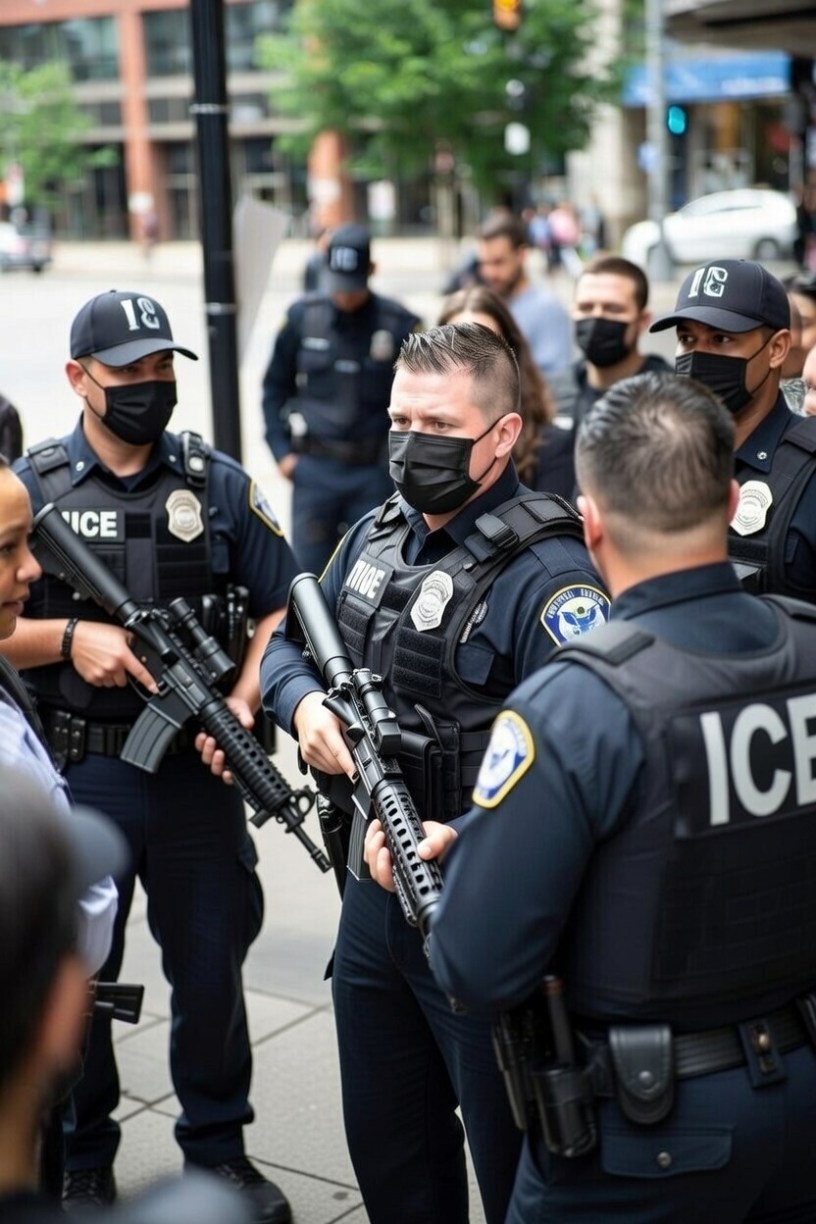
Featured Image is an AI generated genetically composite image of ICE agents.
References
American Civil Liberties Union. (2023). Police use of force in the United States. ACLU.
Amnesty International. (2023). Deadly force: Police use of lethal force in the United States. Amnesty International.
Associated Press. (2026, January). Federal judge orders preservation of evidence in Minneapolis Border Patrol shooting. Associated Press.
Hennepin County Medical Examiner. (2026). Autopsy report: Renée Good. Minneapolis, MN.
People Magazine. (2026, January). Medical examiner rules Renée Good’s death a homicide. People.
Reuters. (2026, January). Minnesota officials dispute federal account after Border Patrol killing of ICU nurse. Reuters.
U.S. Constitution, amend. V; amend. XIV.
United Nations Office on Drugs and Crime. (2020). Handbook on police accountability, oversight and integrity. United Nations.
Discover more from WPS News
Subscribe to get the latest posts sent to your email.
 WPS News