By Cliff Potts, CSO, and Editor-in-Chief of WPS News
Baybay City, Leyte, Philippines — January 31, 2026
As of this writing—late evening in the Philippines and approaching midday across much of the central United States—the situation surrounding recent immigration enforcement operations and the one-day “general strike” call in Minnesota is clearer than the online noise might suggest.
What We’re Seeing on the Ground
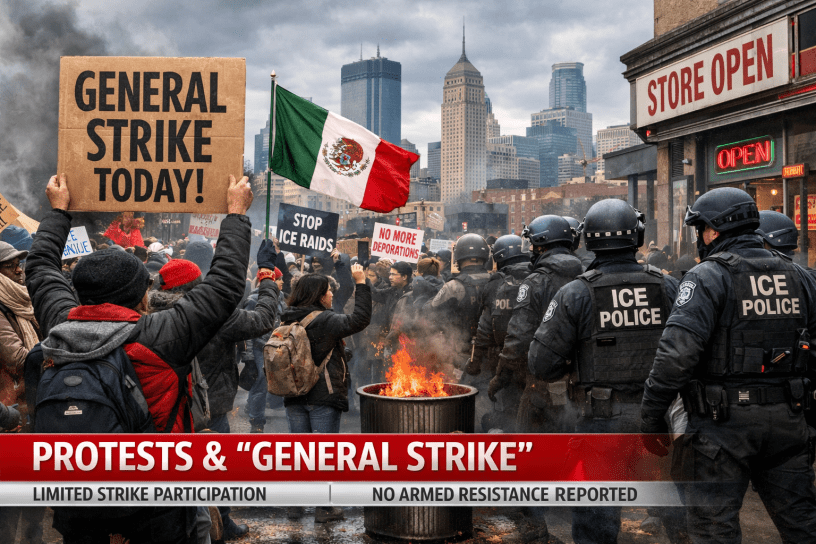
Public demonstrations opposing federal immigration enforcement have continued in Minnesota and other cities. Marches, rallies, and student walkouts are real and visible. They are drawing media coverage and, in some places, disrupting normal routines for part of the day.
What has not materialized is a broad, economy-wide shutdown. The one-day “general strike” call for today appears to be producing uneven participation. Some small businesses closed or encouraged workers to stay home; many others remained open. Schools and workplaces show mixed responses, with no coordinated action by major labor unions or statewide employers.
In practical terms, this looks less like a traditional general strike and more like a decentralized protest day—symbolic, loud, and politically pointed, but limited in economic impact.
No Evidence of Armed Civilian Resistance
Despite heavy online speculation, there are no credible, verified reports of organized armed resistance by civilians against federal law enforcement involved in immigration operations in Minnesota or Chicago. Reputable outlets and local reporting indicate tense encounters—verbal confrontations, blocked vehicles, and crowd pressure—but not coordinated or sustained armed actions.
This distinction matters. Armed resistance of the sort rumored online would trigger immediate federal alerts, emergency declarations, and wall-to-wall coverage. None of that is happening. What exists instead is civil unrest in the form of protest and dissent, not insurgency.
Chatter, Surveillance, and Reality
Activists are using mainstream platforms and encrypted messaging apps to share information and coordinate protests. Federal authorities have acknowledged monitoring some of this activity. That monitoring alone has fueled rumors that something larger or more violent is being suppressed. At present, available open-source reporting does not support that conclusion.
If anything, the gap between online rhetoric and observable events is widening. The anger is real. The organization is loose. The escalation many are predicting has not arrived.
Where This Leaves Things Today
As midday approaches in the U.S. heartland, the picture is one of sustained protest energy without a decisive tipping point. The one-day strike call did not freeze Minnesota’s economy. Demonstrations continue, but daily life largely goes on. And despite the intensity of online discourse, there is no verified sign of armed civilian resistance.
This is a moment worth watching—but also one that calls for restraint, accuracy, and clear separation between what people fear, what they hope for, and what is actually happening.
Excerpt:
As of midday in the central United States, protests over federal immigration enforcement continue, but the one-day “general strike” call in Minnesota has produced only limited participation, and there are no verified reports of organized armed civilian resistance.
References
Associated Press. (2026, January 30). Protesters call for nationwide strike against immigration enforcement policies.
Reuters. (2026, January 30). Nationwide protests and walkouts planned over immigration enforcement actions.
Star Tribune. (2026, January 30). Jan. 30 strike call sees mixed participation across Minnesota.
The Guardian. (2026, January 29). ICE-out protests and strike calls explained.
Discover more from WPS News
Subscribe to get the latest posts sent to your email.
 WPS News