Dateline: Chicago, IL — February 3, 2026
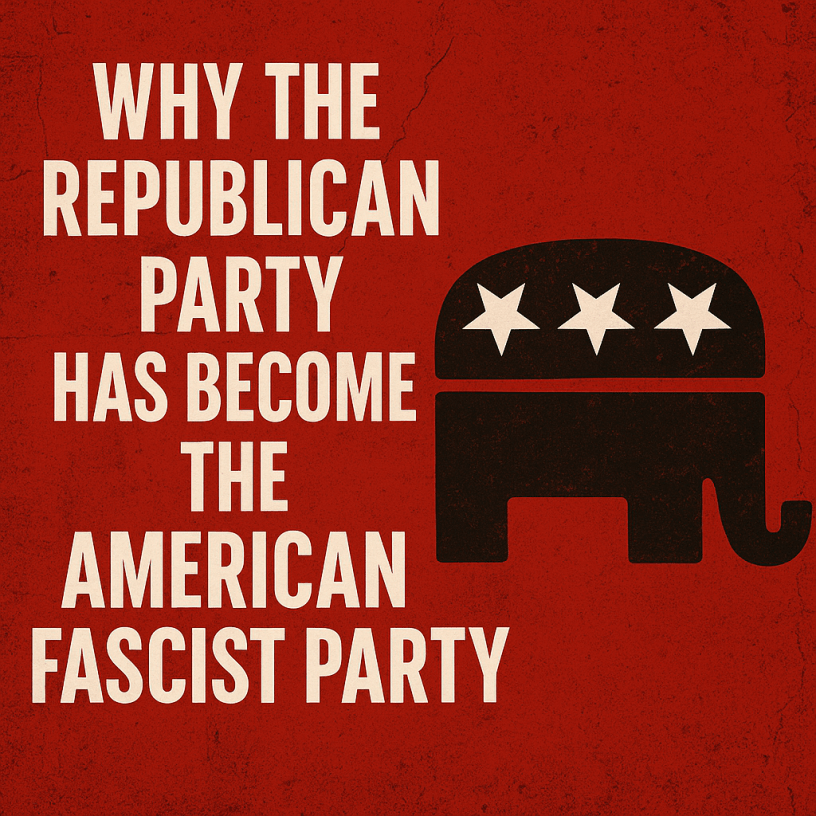
WPS News publishes the accompanying report, Why the Republican Party Has Become the American Fascist Party — A Historical and Evidentiary Analysis, with full awareness that the terminology used will provoke discomfort, disagreement, and criticism. That response is anticipated. It is not the purpose of this note to soften that impact, nor to amplify it through provocation.
This Editor’s Note exists to document why specific language was chosen, why the analysis is published on a recurring basis, and what responsibility a newsroom bears when political behavior aligns with historically documented patterns of democratic erosion.
On the Use of the Term “American Fascist Party”
The term “American Fascist Party” is used as a descriptive classification, not as a slur or partisan insult. Fascism has never been defined by self-identification. Historically, it is identified through behavior: the delegitimization of elections, suppression of political opposition, normalization of political violence, erosion of independent institutions, and the fusion of party loyalty with national identity.
When such behaviors are observable in the public record, precise language becomes a matter of professional responsibility rather than rhetorical choice.
On Timing and Periodic Publication
This analysis is published on a semiannual schedule, independent of elections, breaking news cycles, or singular events. Fascist movements historically consolidated power through gradual normalization rather than abrupt seizure. Episodic coverage often fails to capture this process.
Periodic publication allows readers to evaluate whether the patterns identified are intensifying, stabilizing, or receding. When no substantive revisions are required, that continuity itself becomes part of the historical record.
On What the Press Knew — and Chose Not to Say
By the early 1940s, credible information about Nazi extermination camps in Germany and occupied Poland had reached elements of the American press through refugee testimony, intelligence reporting, and foreign correspondence. Much of this information was minimized, cautiously framed, or relegated to secondary placement.
Historians have identified several contributing factors: disbelief at the scale of the crimes, fear of appearing propagandistic, institutional antisemitism within media organizations, and concern that emphasizing Jewish suffering would be perceived as partial or self-interested. The result was not ignorance, but hesitation.
This represents a documented institutional failure of clarity at a moment when clarity was essential.
Why That Failure Matters Now
The lesson of that period is not merely that atrocities can be hidden. It is that atrocities can be known and still avoided in public language because naming them feels politically risky or socially fraught.
In the modern era, debates surrounding Israel and Palestine demonstrate how accusations of bias or bad faith can be used to suppress clear description of political behavior. These pressures are real, but they do not absolve journalists of responsibility. Avoiding accurate terminology in order to sidestep controversy does not preserve neutrality; it preserves power.
Based on recurring historical patterns, WPS News assesses that pressures to soften language in the face of authoritarian behavior will increase rather than diminish. This makes precision more necessary, not less.
Archival Clarification
This Editor’s Note references historical failures of press coverage related to Nazi extermination policies. These references address institutional journalistic behavior, not Jewish identity, Jewish communities, or modern political positions regarding Israel or Palestine. No equivalence is implied between historical atrocity and contemporary geopolitical conflict. The purpose is to document how avoidance of accurate language has previously contributed to catastrophic delay.
On Editorial Responsibility
This publication does not assert that the United States is currently a fascist state. Competitive elections, independent journalism, and civil society remain active. These distinctions are acknowledged.
However, fascism has never begun with total control. It has always begun with patterns — visible in rhetoric, law, institutional pressure, and tolerated violence — long before democratic collapse. The responsibility of a newsroom is not to wait for the end state before documenting the process.
This Editor’s Note is intended for contemporary readers and for future ones seeking to understand how democratic erosion was assessed and recorded in real time.
A Note on Disagreement
Readers may reject the conclusions of the accompanying report. Such disagreement is legitimate. What is not legitimate is the dismissal of documented behavior solely through partisan identification or emotional reaction to terminology.
WPS News invites readers to engage the evidence, challenge the historical comparisons, and assess the analysis on its merits.
Closing Record
This Editor’s Note accompanies a report intended to function as a reference document, not a provocation. Its language is deliberate. Its timing is deliberate. Its purpose is historical documentation.
If, at a future date, the behaviors described no longer apply, this publication will revise its assessment accordingly. Until then, accuracy requires calling political movements what their actions demonstrate them to be.
Discover more from WPS News
Subscribe to get the latest posts sent to your email.
 WPS News