By Cliff Potts, CSO, and Editor-in-Chief of WPS News
Baybay City, Leyte, Philippines — February 3, 2026
The Problem: Interference Is Physical, Not Diplomatic
Maritime interference in the West Philippine Sea is carried out on the water, not in meeting rooms. Vessels are blocked, shadowed, or forced to slow down. Missions are delayed or cut short. Fuel is burned. Crews are worn down.
Diplomatic protests and formal statements document these actions, but they do not change what happens at sea in real time. They operate on a different timeline. By the time a protest note is issued, the interference has already achieved its immediate effect.
This gap between physical action and diplomatic response is central to how interference succeeds.
What Escort Operations Actually Do
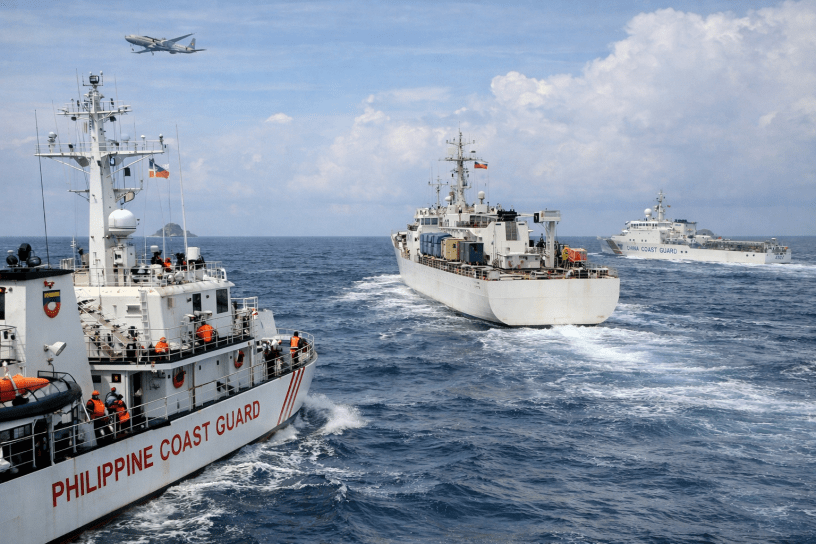
Escort operations place Philippine Coast Guard vessels alongside civilian, research, or resupply ships during routine activities. The purpose is not confrontation. The purpose is presence.
When a state vessel is present, several things change at once:
- Interference becomes a state-to-state interaction, not a private encounter.
- Actions are recorded by trained personnel using standardized procedures.
- The risk of unsafe maneuvering increases for the interfering vessel.
- Each incident becomes part of an official operational record.
Escort operations do not prevent all harassment. They change the conditions under which it occurs.
Why Escorts Alter the Cost Structure
Interference relies on being cheap and repeatable.
Without escorts, a single vessel can be blocked with minimal risk and little documentation. With escorts, the same action requires closer maneuvering near a government ship, greater visibility, and higher exposure.
This raises costs in measurable ways:
- Longer on-station time for interfering vessels
- Increased fuel use
- Higher risk of recorded unsafe behavior
- Greater likelihood of international attention
Over time, these added costs reduce the effectiveness of routine interference.
Escorts as Documentation Platforms
Escort vessels serve as mobile documentation units.
Standardized video, radar logs, GPS tracks, and radio recordings provide consistent evidence across multiple incidents. This allows patterns to be identified instead of treating each encounter as isolated.
Pattern documentation matters. It supports:
- Legal filings
- Insurance assessments
- Allied briefings
- Public reporting that relies on verifiable data
Escort operations turn harassment into evidence.
Why Escorts Do Not Escalate Conflict
Escort operations remain below military thresholds.
Coast guard vessels are law enforcement platforms. Their presence is normal in maritime operations worldwide. They do not signal offensive intent, and they do not require changes to rules of engagement.
The purpose is stability, not dominance. Escorts maintain routine activity rather than disrupt it.
This is why escort operations are widely accepted in contested maritime spaces and do not trigger automatic escalation.
Limits and Tradeoffs
Escort operations require resources.
They demand trained crews, maintenance, fuel, and coordination. Not every vessel can be escorted at all times. Poorly planned escorts can become predictable and easier to work around.
Escort operations must therefore be:
- Prioritized for high-value missions
- Rotated to avoid fixed patterns
- Integrated with broader patrol schedules
They are a tool, not a cure-all.
Why Escorts Matter More Than Protest Notes
Protest notes document violations after they occur. Escort operations shape behavior while it is happening.
This does not make diplomacy irrelevant. It places it in sequence. Documentation generated by escort operations strengthens diplomatic and legal efforts by grounding them in observed behavior.
In the West Philippine Sea, physical access is contested first. Diplomatic processes follow.
Bottom Line
Maritime interference succeeds when it remains low-risk, poorly documented, and inexpensive. Escort operations disrupt that balance by raising visibility and cost without escalation.
They do not stop every incident. They make interference harder to sustain over time. In an environment defined by persistence rather than crisis, that shift matters more than any single protest note.
For more social commentary, please see Occupy 2.5 at https://Occupy25.com
References (APA)
Bateman, S. (2017). Maritime security and law enforcement in the South China Sea. Contemporary Southeast Asia, 39(2), 221–245.
Erickson, A. S., & Kennedy, C. (2016). China’s maritime militia. Center for Naval Analyses.
Permanent Court of Arbitration. (2016). The South China Sea Arbitration (Philippines v. China).
United Nations. (1982). United Nations Convention on the Law of the Sea.
Discover more from WPS News
Subscribe to get the latest posts sent to your email.
 WPS News