By Cliff Potts, CSO
Editor-in-Chief, WPS News
Baybay City, Leyte, Philippines — February 6, 2026
Texas is not a slogan. It is not a flag waved hard enough to hide reality. It is a place with a long memory, a stubborn streak, and a habit of surviving things it probably shouldn’t. If we are going to talk honestly about where Texas is going, we have to start with who we actually are, not who we pretend to be when election season rolls around.
I am not interested in selling nostalgia. I am interested in telling the truth. Texas has always been built by working people, shaped by hard land, and governed unevenly at best. Sometimes wisely. Sometimes recklessly. Often somewhere in between. The story of Texas is not clean, and it is not simple. That is exactly why it matters.
Roots, Not Mythology
My own family history in Texas goes back the way many authentic Texas families do: down the Trace, through Louisiana, and into North Texas. They worked. They fought. They survived. Some were Confederate soldiers, and that history is owned, not celebrated. It is acknowledged because it is real, not because it is admirable. History does not need polishing. It needs honesty.
Texas has spent too much time arguing about symbols and too little time dealing with systems. We argue about flags, statues, and slogans while schools crumble, hospitals close, and infrastructure fails. That imbalance did not happen overnight, and it did not happen by accident. It happened because we stopped taking responsibility seriously and replaced it with performance.
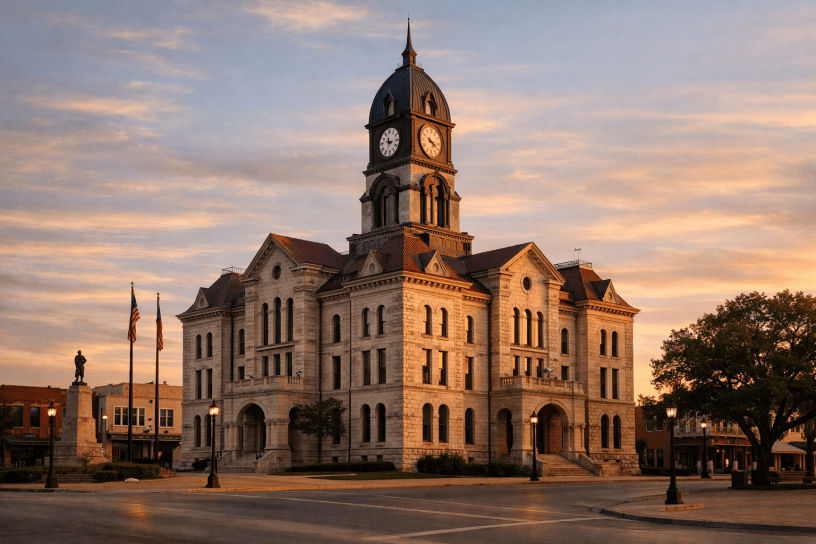
The featured image for this essay is the Parker County Courthouse in Weatherford, Texas. That choice is intentional. A courthouse is not a monument to glory. It is a reminder of obligation. Law, governance, and accountability live there. Or at least, they are supposed to.
Texas Is Bigger Than Its Politics
Texas is often described as “business friendly,” but that phrase hides a lot of damage. Friendly to whom? For many Texans, business friendliness has meant stagnant wages, rising housing costs, and the normalization of working two or three jobs just to stay afloat. That is not strength. That is exhaustion dressed up as pride.
At the same time, Texas has a deep, often overlooked strength: people. Texans are, by and large, adaptable, practical, and unusually capable of dealing with others face-to-face. Friendliness is not weakness. It is a skill. It allows people to negotiate, to cooperate, to build something together even when they disagree. In a global economy that increasingly depends on human interaction, that matters more than we admit.
But skills must be developed, not assumed. Texas has underinvested in education for decades, and the results show. High school dropout rates remain unacceptably high in major cities and rural districts alike. When young people leave school without the ability to read critically, work with numbers, or communicate across cultures, that failure follows them for life. It also follows the state.
What We Refuse to Face
Texas refuses to face several realities at once. Climate change is treated as a political opinion rather than a physical fact. Healthcare is treated as a privilege rather than infrastructure. Energy policy is treated as ideology rather than engineering.
The grid failures of recent years were not acts of God. They were acts of neglect. Decisions were made to prioritize profit over resilience, and Texans paid the price in frozen homes, lost lives, and economic damage. These were not unforeseeable events. They were predictable outcomes of policy choices.
Healthcare tells the same story. Rural hospitals close. Urban hospitals overflow. Mental health care is fragmented and underfunded. Texans die younger than they should because access to care depends too heavily on income and geography. A state that prides itself on independence should not accept dependency on luck as a healthcare strategy.
Neighbors, Not Enemies
Texas also sits at a border that is more relationship than line. For generations, Texans and Mexicans have worked together in agriculture, construction, trade, and industry. This is not a threat. It is a shared reality. Treating the border as a permanent emergency undermines economic stability and social trust on both sides.
A serious Texas prepares its people for that reality. That means bilingual education as a norm, not an exception. It means understanding that cultural competence is an economic asset. It means managing immigration with law, humanity, and common sense instead of fear-driven theatrics.
Institutions Matter
Courthouses, schools, hospitals, and utilities are not abstract ideas. They are the bones of a functioning society. When they weaken, everything built on them becomes fragile. Texas has coasted on reputation for too long, assuming that past success guarantees future stability. It does not.
Governing is not about identity performance. It is about maintaining systems that allow ordinary people to live stable lives. Roads that work. Power that stays on. Schools that educate. Laws that are enforced fairly. These are not glamorous achievements, but they are the ones that matter.
Why This Series Exists
This essay is the first in a long record, not a rally cry. Once a month, this series will examine Texas honestly: its history, its systems, its failures, and its possibilities. There will be criticism where it is earned and respect where it is due. Texas does not need flattery. It needs attention.
We cannot fix what we refuse to see. We cannot plan for a future we are afraid to discuss. And we cannot govern responsibly if we confuse noise with leadership.
Texas can be better. Not by pretending it is something it is not, but by taking responsibility for what it is and what it must become. That starts with telling the truth, calmly and consistently, and building from there.
This essay will be archived as part of the ongoing WPS News Monthly Brief Series available through Amazon.
References (APA)
Texas Education Agency. (2024). Secondary school completion and dropout rates by district.
U.S. Energy Information Administration. (2024). Texas electricity reliability and capacity reports.
Texas Department of State Health Services. (2024). Healthcare access and rural hospital data.
U.S. Census Bureau. (2024). American Community Survey: Texas demographic and labor data.
Public Utility Commission of Texas. (2024). Electric grid performance assessments.
Discover more from WPS News
Subscribe to get the latest posts sent to your email.
 WPS News