By Cliff Potts, CSO, and Editor-in-Chief of WPS News
North Liberty, Iowa
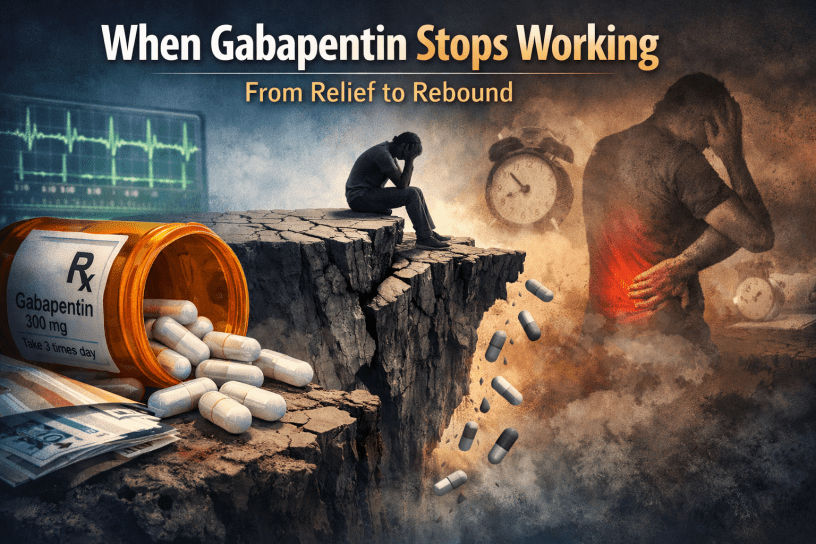
Gabapentin was never marketed as a miracle drug, but it has often been treated like one. Prescribed for nerve pain, off-label for anxiety, and routinely for sleep, it became a go-to solution when clinicians wanted something that wasn’t an opioid. For many patients, it worked—until it didn’t. And when gabapentin stops working, it doesn’t fade gently. It falls off a cliff.
Early Effectiveness: Why It Feels Like a Solution
In the beginning, gabapentin can feel like relief finally arriving. Neuropathic pain quiets down. Sleep comes easier. Anxiety dulls enough to function. For people who have been cycling through failed treatments, that early response can feel like proof that the system finally got something right.
Mechanistically, gabapentin alters calcium channel signaling in the nervous system. It doesn’t directly block pain signals the way opioids do, but it reduces neuronal excitability. Early on, the nervous system responds. The brain “listens.” Patients stabilize. Doctors see compliance and improvement. Everyone moves on.
That’s the honeymoon phase—and it can last months or even years.
Tolerance: The Slow Disappearance of Effect
Over time, many patients report a steady erosion of benefit. The same dose no longer manages pain. Sleep becomes fragmented again. Anxiety creeps back in. Clinicians respond predictably: raise the dose.
This is where the problem accelerates. Gabapentin tolerance isn’t dramatic; it’s insidious. The body adapts. Neural pathways recalibrate. What once dampened nerve activity becomes background noise. Eventually, increasing the dose produces diminishing returns—or none at all.
At a certain point, patients aren’t “responding poorly.” Their bodies are no longer responding at all.
When the Body Stops Recognizing the Drug
The most troubling reports come from long-term users who describe a total loss of effect. Not reduced benefit—zero. Pain returns full-force. Sleep aid vanishes. The medication may still be present in the bloodstream, but functionally, it’s invisible.
This isn’t psychological failure or noncompliance. It’s pharmacological adaptation. The nervous system has effectively learned to ignore the drug. And unlike short-acting medications, gabapentin tapering or cycling doesn’t reliably restore responsiveness.
Once that recognition is gone, it may be gone for good.
The Clinical Gap No One Owns
Here’s the uncomfortable truth: there is no clear long-term exit strategy for gabapentin failure. Patients are often left stranded between “keep taking it” and “stop and see what happens.” Withdrawal symptoms—insomnia, rebound pain, agitation—complicate discontinuation. Alternatives may carry greater risks or stigma.
Gabapentin was supposed to be safer. In many ways, it is. But safety without durability is not success. A drug that works until it doesn’t—and then doesn’t work at all—demands more honesty than it has received.
What This Means for Patients
Patients deserve upfront conversations about tolerance, long-term efficacy, and realistic outcomes. Gabapentin may be a bridge, not a destination. Treating it as a permanent solution sets people up for failure they’ll blame on themselves.
This isn’t an argument against gabapentin. It’s an argument against silence.
For more social commentary, please see Occupy 2.5 at https://Occupy25.com
This document is archived as part of the WPS News Monthly Brief Series.
References (APA)
Goodman, C. W., & Brett, A. S. (2017). Gabapentin and pregabalin for pain — Is increased prescribing a cause for concern? New England Journal of Medicine, 377(5), 411–414.
Mersfelder, T. L., & Nichols, W. H. (2016). Gabapentin: Abuse, dependence, and withdrawal. The Annals of Pharmacotherapy, 50(3), 229–233.
Smith, R. V., Havens, J. R., & Walsh, S. L. (2016). Gabapentin misuse, abuse, and diversion: A systematic review. Addiction, 111(7), 1160–1174.
Discover more from WPS News
Subscribe to get the latest posts sent to your email.
 WPS News