By Cliff Potts, CSO, and Editor-in-Chief of WPS News
Baybay City, Leyte, Philippines — February 16, 2026
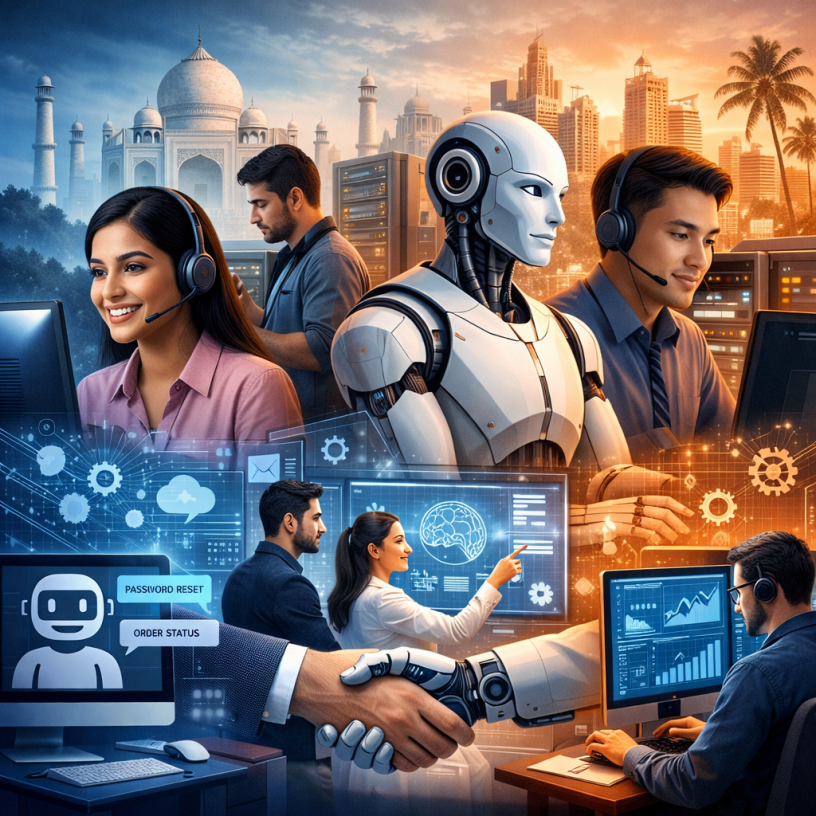
Artificial intelligence is increasingly used in customer service operations worldwide. In countries such as India and the Philippines, where business process outsourcing (BPO) employs millions, some observers claim AI has already replaced large numbers of workers.
Available evidence does not support the claim of total replacement. What is occurring is structural change.
Automation of Routine Tasks
AI systems are effective at handling repetitive, rules-based tasks. These include password resets, order tracking, balance inquiries, appointment confirmations, and scripted troubleshooting.
These interactions follow predictable decision paths. For companies, automation reduces cost and allows 24-hour service coverage. As a result, many entry-level, routine interactions are now handled by chatbots or voice systems before a human agent becomes involved.
This reduces the volume of low-complexity work. It does not eliminate the need for human agents entirely.
Continued Demand for Human Judgment
When customers escalate beyond automated systems, the remaining cases tend to be more complex. They involve billing disputes, policy interpretation, emotional frustration, fraud concerns, or multi-step technical issues.
These situations require:
- Judgment
- Emotional intelligence
- De-escalation skills
- Cross-system problem solving
- Cultural awareness
Industry reports from both India and the Philippines indicate that companies are shifting human agents toward higher-value interactions rather than removing them entirely. Human oversight remains necessary for sensitive or ambiguous cases.
Emerging AI-Related Roles
AI systems require ongoing supervision and refinement. This has led to new categories of employment within the service sector, including:
- AI trainers and data annotators
- Prompt engineers
- Quality assurance specialists for AI outputs
- Compliance and risk auditors
- AI workflow integration specialists
- Customer experience designers
These roles are increasingly visible in multinational service firms operating in Asia. In many cases, former customer service agents are being retrained to support AI-enhanced systems.
The Philippine and Indian Context
The Philippines remains one of the largest global BPO hubs, employing approximately 1.8 million workers. India’s IT and BPO sector employs several million more.
There is no verified data showing that AI has replaced these workforces in full. Instead, companies are investing in upskilling programs and hybrid models where AI handles first-level inquiries and human agents manage escalations.
The shift reflects technological restructuring rather than collapse.
Analysis
Claims of total job elimination oversimplify the situation. Automation typically targets repetitive tasks first. Historically, this pattern has occurred in manufacturing, banking, and logistics before spreading to service industries.
The current transition suggests a movement from task-based labor toward judgment-based labor. Human roles are narrowing but deepening in complexity.
There remains a consistent preference among consumers for human interaction in high-stakes situations. Surveys across multiple markets show customers are more satisfied when complex issues involve human representatives.
AI is expanding capacity. It is not removing the human element entirely.
Conclusion
AI is automating routine customer service work in India, the Philippines, and elsewhere. It is also generating new technical and supervisory roles.
The evidence indicates restructuring, not total replacement.
Human interaction remains central where trust, discretion, and emotional intelligence are required. The long-term outcome will depend on workforce adaptation, regulatory frameworks, and continued investment in skill development.
For more social commentary, please see Occupy 2.5 at https://Occupy25.com
References
Gartner. (2023–2025). AI and customer service automation forecasts.
Philippine IT-BPM Industry Reports. (2024–2025). Workforce statistics and AI integration updates.
National Association of Software and Service Companies (NASSCOM). (2024–2025). India IT-BPM sector analysis.
Discover more from WPS News
Subscribe to get the latest posts sent to your email.
 WPS News