By Cliff Potts, CSO, and Editor-in-Chief of WPS News
Baybay City, Leyte, Philippines — February 16, 2026
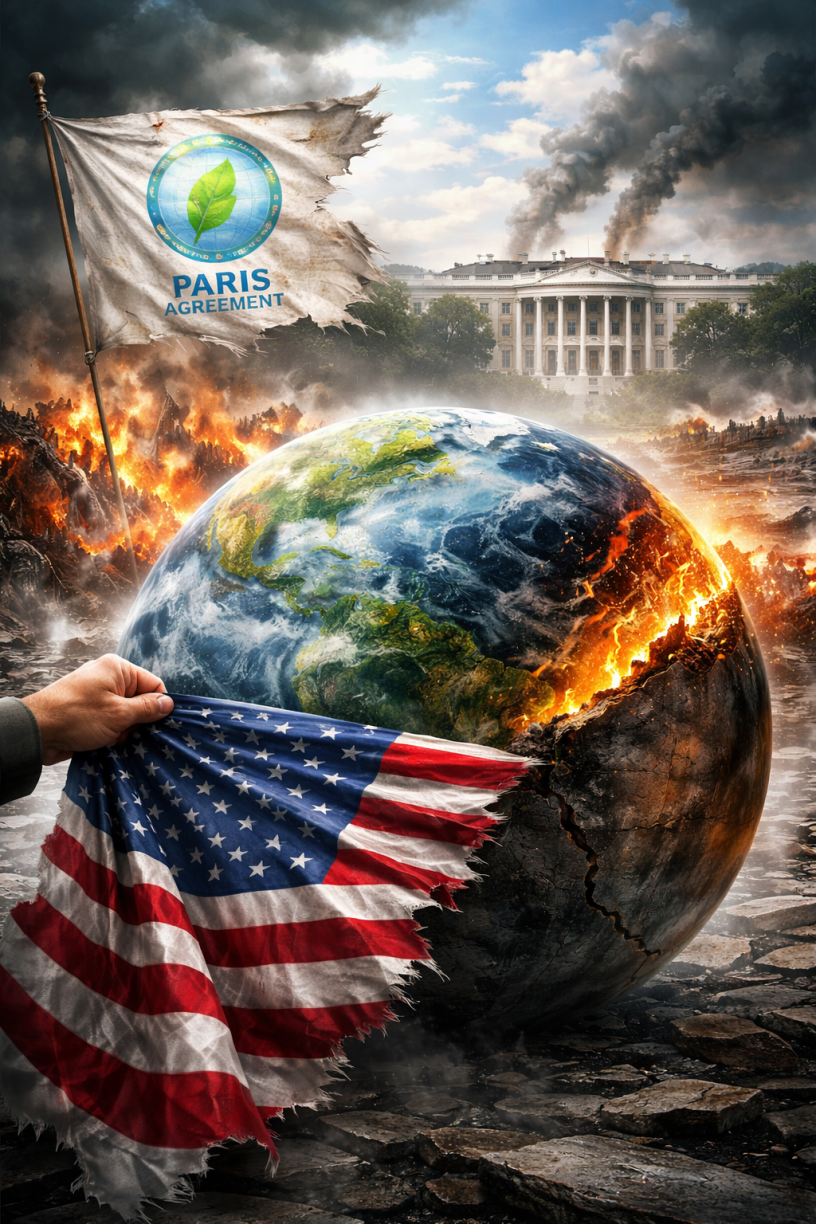
The United States has formally withdrawn from the Paris Climate Agreement for the second time, reversing its previous reentry and again stepping away from the world’s primary multilateral framework for addressing climate change. The decision, announced by the White House in January, removes the U.S. from coordinated global emissions targets, reporting mechanisms, and long-term climate finance commitments.
U.S. officials framed the withdrawal as a rejection of international constraints on domestic energy policy, arguing that climate action should be determined at the national level rather than through multilateral agreements. The administration also cited economic concerns, claiming the agreement places disproportionate burdens on U.S. industry while allowing other major emitters greater flexibility.
International reaction has been largely critical. European and Asian governments reiterated their commitment to the Paris framework, warning that repeated U.S. exits undermine predictability and trust in long-term climate cooperation. Climate scientists and policy analysts emphasized that the agreement’s effectiveness depends on sustained participation by major emitters, particularly developed economies with historical responsibility for greenhouse gas accumulation.
For the Philippines, the implications are indirect but consequential. The country is among the world’s most climate-vulnerable nations, facing intensified typhoons, sea-level rise, agricultural disruption, and infrastructure stress. While U.S. withdrawal does not end global climate action, it weakens collective momentum and reduces available financing and technical leadership for adaptation and mitigation efforts in developing countries.
Analysis
The second U.S. exit from the Paris Agreement reflects a broader retreat from multilateral problem-solving in favor of unilateral decision-making. Climate change, however, is a transnational risk that cannot be managed effectively through isolated national policies. Emissions reductions, climate finance, and technology transfer all rely on coordination, shared standards, and long-term commitments.
From a Philippines-first perspective, the concern is not symbolic diplomacy but material impact. Climate volatility already shapes food security, public health, and disaster response across Southeast Asia. Slower global action increases adaptation costs and shifts the burden onto countries least responsible for the crisis.
The long-term effect of repeated U.S. withdrawals is likely a fragmented climate governance landscape, with leadership shifting toward regional blocs and other major powers. While global climate action will continue, it will do so with greater uncertainty and reduced coherence—conditions that favor delay over decisive response.
References (APA)
Associated Press. (2026, January). United States exits Paris climate agreement again.
Reuters. (2026, January). Global leaders criticize renewed U.S. withdrawal from Paris accord.
United Nations Framework Convention on Climate Change. (2015). The Paris Agreement. https://unfccc.int/process-and-meetings/the-paris-agreement/the-paris-agreement
Discover more from WPS News
Subscribe to get the latest posts sent to your email.
 WPS News