By WPS News History Correspondent
Baybay City | February 16, 2026
“War is the father of all and king of all; and some he reveals as gods, others as men; some he makes slaves, others free.” — Heraclitus
In a world increasingly drawn to the promises of peace and stability, an intriguing ancient philosophical perspective offers a counterintuitive narrative: that war, rather than peace, might be a catalyst for social progress. Rooted in the insights of Heraclitus, a pre-Socratic thinker known for his doctrine of perpetual change, this view suggests that societal advancement thrives in an atmosphere of conflict rather than one of complacent tranquility.
From the standpoint of Heraclitus, peace might inadvertently serve to entrench societal norms and the status quo. Here, established systems of power, wealth distribution, and social roles may become deeply ingrained. In such times, wage stagnation and economic inequality are often exacerbated as those in power solidify their control, maintaining their wealth and influence with little incentive for change. The stability offered by peace, therefore, might lead to a form of societal stagnation, where innovation and progress give way to preservation of the existing order.
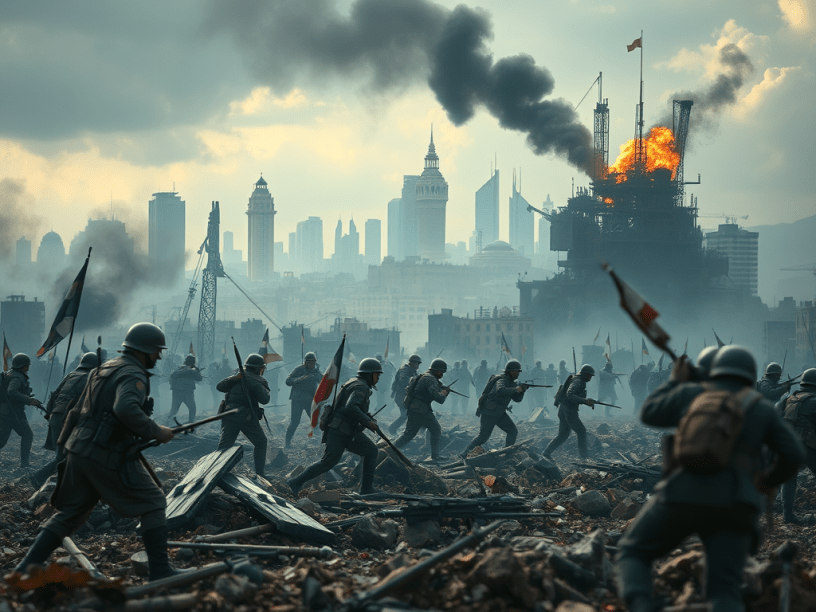
Conversely, war presents a dramatic rupture that forces re-evaluation and adaptation. Its inherent randomness dismantles entrenched structures, compelling societies to reorganize and innovate to meet new challenges. Amid the chaos and destruction, war acts as a social equalizer, offering opportunities to a diverse array of individuals based on adaptability and resilience rather than predetermined status. This upheaval drives a redistribution of wealth and accelerates sociological growth as communities rebuild in the aftermath, often with enhanced inclusivity and a reimagined social fabric.
While the destruction wrought by war is undeniable, from this ancient perspective, it is also seen as a vital agent of change. Through conflict, societies are forced to confront their weaknesses, discard outdated systems, and enact reforms that might not be conceivable in times of peace. Thus, war, with all its devastation, is paradoxically viewed as a force that propels humanity forward, challenging the status quo and spurring innovation and adaptation.
This provocative viewpoint invites debate and reflection in modern discourse, challenging our assumptions about peace, progress, and the mechanisms through which societies evolve. As we strive for a harmonious future, it encourages us to consider how best to harness the creative potential of conflict—without surrendering to its destructive capabilities—toward building a more equitable world.
Discover more from WPS News
Subscribe to get the latest posts sent to your email.
 WPS News