By Cliff Potts, CSO, and Editor-in-Chief of WPS News
Baybay City, Leyte, Philippines — February 18, 2026
Large portions of the United States experienced severe winter storms in late January and early February, bringing heavy snowfall, ice accumulation, power outages, and transportation disruptions across multiple regions. Meteorologists attributed the events to a combination of polar vortex dynamics and unusually warm ocean temperatures that increased atmospheric moisture and storm intensity.
The storms affected the Midwest, Northeast, and parts of the Southern United States, straining energy infrastructure and emergency response systems. Airports were forced to cancel thousands of flights, while local governments issued travel bans and emergency declarations. Utilities reported widespread outages as ice and wind damaged transmission lines.
Climate scientists cautioned that these events should not be viewed as isolated anomalies. Research indicates that warming Arctic temperatures can destabilize the polar vortex, allowing cold air to plunge farther south while warmer oceans amplify precipitation. The result is increased weather volatility, producing more intense storms rather than uniform warming.
For the Philippines and the broader Indo-Pacific, the U.S. experience is instructive. While winter storms are not a regional threat, climate-driven volatility manifests locally through stronger typhoons, flooding, heat stress, and agricultural disruption. The underlying dynamics—warmer oceans fueling more destructive weather systems—are shared across regions.
Analysis
Extreme winter storms underscore a persistent misunderstanding of climate change as a linear process. Climate change does not eliminate cold weather; it disrupts established patterns, increasing the frequency and severity of extremes. Infrastructure designed for historical conditions is increasingly misaligned with current risk.
From a Philippines-first perspective, the lesson is preparedness rather than comparison. Energy grids, transportation networks, and disaster response systems must be built for volatility, not averages. Events in the United States highlight how even advanced economies struggle when infrastructure investment lags behind climate reality.
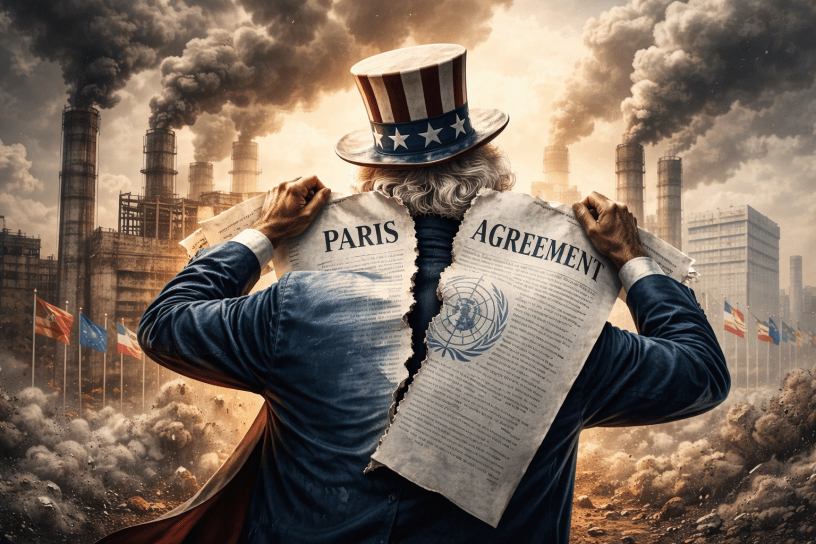
The broader concern is policy inconsistency. As major emitters retreat from coordinated climate frameworks, the burden of adaptation shifts disproportionately onto vulnerable countries. Without sustained global mitigation efforts, adaptation costs rise, and extreme events become more damaging and less predictable.
The long-term trajectory points toward normalized disruption. Weather volatility is no longer an exception but a defining feature of the climate system, demanding planning horizons that extend beyond political cycles and short-term economic calculations.
References (APA)
Associated Press. (2026, January). Severe winter storms disrupt travel and power across the United States.
Washington Post. (2026, January). How the polar vortex and warm oceans intensified major U.S. winter storms.
National Oceanic and Atmospheric Administration. (2025). Arctic warming and polar vortex behavior. https://www.noaa.gov
Discover more from WPS News
Subscribe to get the latest posts sent to your email.
 WPS News