By WPS News Staff Reporter
Elon Musk, the founder of SpaceX, Tesla, Neuralink, xAI, and The Boring Company, has consistently articulated an expansive and optimistic vision for humanity’s long-term future. His ideas center on making life multiplanetary, achieving sustainable energy at planetary and interplanetary scales, harnessing artificial intelligence to create radical abundance, and fundamentally redefining human purpose in a world where scarcity largely disappears. Through interviews, public talks such as his VivaTech 2024 appearance, podcasts, and posts on X, Musk describes a trajectory in which humanity expands beyond Earth, energy becomes effectively limitless, AI and robotics provide unprecedented productivity, and traditional economic constraints—particularly around labor and money—dissolve.
Becoming a Multiplanetary Species: The Mars Imperative
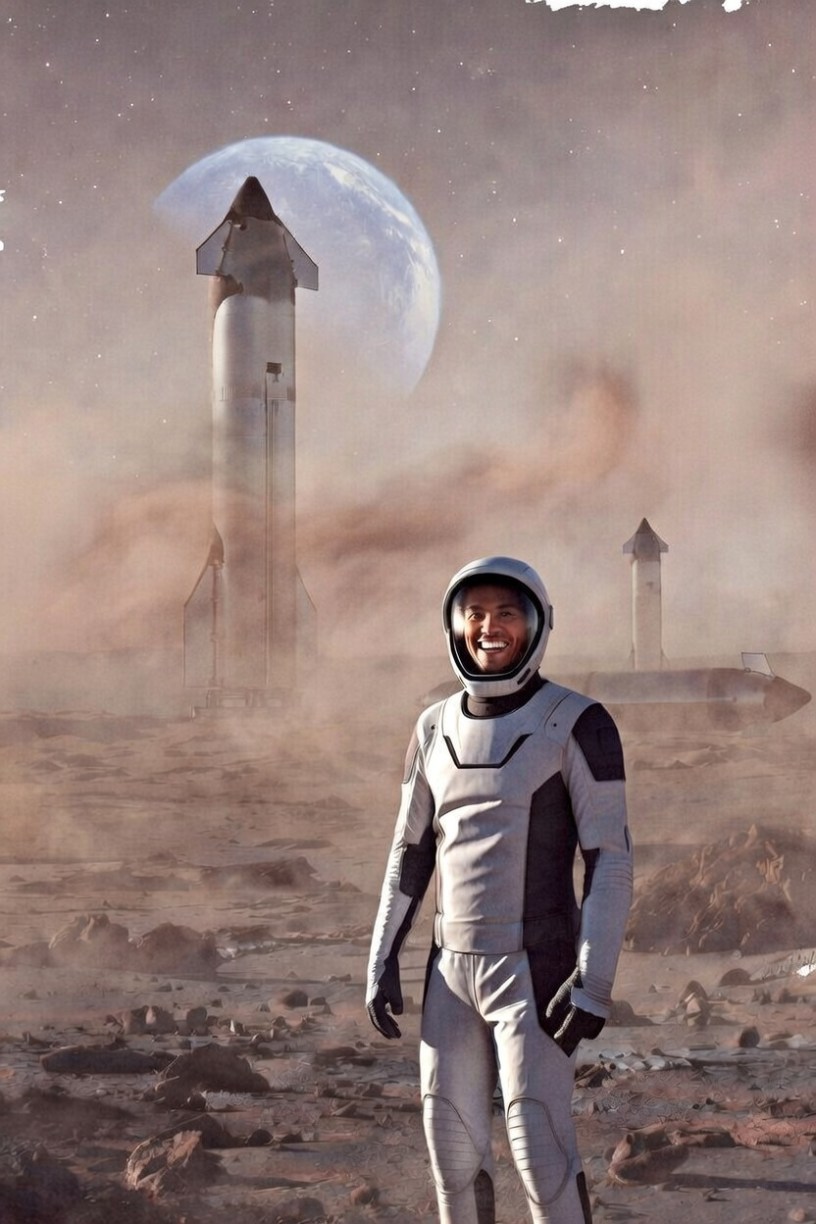
Central to Musk’s worldview is the necessity of making humanity a multiplanetary species to ensure the long-term survival of consciousness. He has described establishing a self-sustaining city on Mars as “the ultimate insurance policy for humanity’s survival.” Mars, in his view, is a challenging but ultimately habitable “fixer-upper” planet that can be terraformed over centuries.
Musk frequently points out that current Mars missions deliver roughly one ton of useful payload per billion dollars spent, rendering large-scale colonization economically impossible without dramatic cost reductions. SpaceX’s Starship is designed to achieve more than a thousandfold improvement in cost per ton to orbit and to Mars, potentially enabling a self-sustaining Martian city for around one trillion dollars spread over several decades—an amount he considers feasible without damaging Earth’s economy. “We need to secure the future of consciousness by being a multi-planet species,” Musk has stated. In the longer term, space-based solar power and industry could harness vastly more energy than is available on Earth’s surface alone.
Accelerating the Transition to Sustainable Energy
Alongside space exploration, Musk sees Tesla’s core mission as accelerating the world’s transition to sustainable energy through electric vehicles, solar generation, and large-scale battery storage. He views this shift as essential not only to avert climate-related catastrophe on Earth but also to support the enormous energy demands of advanced AI, robotics, and eventual interplanetary civilization.
AI and Robotics: The Path to Radical Abundance
Musk predicts that continued progress in artificial intelligence and humanoid robotics will usher in an “age of abundance” in which most goods and services become extremely inexpensive and widely available. He has described a future in which “there will be universal high income—not basic,” with AI and robots capable of producing “whatever stuff [people] want” at negligible marginal cost. Tesla’s Optimus project and potential space-based manufacturing are seen as key enablers of this outcome, dramatically increasing the total output of goods and services beyond current planetary limits.
Through xAI and its Grok model, Musk aims to build AI that seeks maximum truth and understanding of the universe, aligning advanced intelligence with human benefit rather than narrow commercial or ideological goals. He emphasizes the importance of human-AI symbiosis, warning that without augmentation, humans risk becoming comparatively insignificant in capability relative to rapidly advancing AI systems.
Neuralink and the Future of Human Augmentation
Neuralink’s long-term goal is to create high-bandwidth brain-machine interfaces that treat neurological disorders today and eventually provide enhanced cognitive abilities. Musk has argued that increasing the data rate between human brains and computers—from roughly 10 bits per second in spoken language to potentially terabits per second—will be essential for meaningful coexistence with superintelligent AI. Early applications focus on medical restoration, with future potential for direct thought-based control of devices and expanded human perception and reasoning.
Universal High Income and the End of Scarcity-Driven Work
Musk’s most provocative economic predictions concern a post-scarcity world. He has repeatedly stated that advanced AI and robotics could satisfy nearly all material human needs, leading to “universal high income” rather than a minimal basic income. In such a scenario, “there will be no shortage of goods or services,” and “everyone can have whatever goods & services they want.”
He envisions a future in which “probably none of us will have a job” in the traditional, necessity-driven sense. Instead, people will be free to pursue activities they find meaningful—scientific research, art, exploration, teaching, caregiving, or any form of creative or intellectual endeavor—purely because they choose to. “If you want to do a job that’s kinda like a hobby, you can do a job,” Musk has said.
Work Not Being Work, Money Not Being Money: Explaining the Shift
The phrase “work not being work” refers to the decoupling of labor from survival. In the current economy, most people work primarily to earn money for food, housing, healthcare, transportation, and other necessities within a system defined by scarcity. When AI and robotics reach the point of producing goods and services at near-zero marginal cost and in vast quantities, the requirement to labor for basic survival disappears. Work then transforms into voluntary activity pursued for personal fulfillment, social contribution, curiosity, challenge, or joy—much like how people today engage in hobbies, volunteer work, sports, or side projects without financial compulsion.
“Money not being money” follows from the same logic. Money exists primarily as a scarce medium of exchange, store of value, and incentive mechanism to allocate limited resources and motivate productive effort. In a world of genuine material abundance—where high-quality food, housing, medical care, education, transportation, and entertainment are sustainably available to all without rationing—money’s traditional role diminishes sharply. Musk has suggested that “if AI and robotics are big enough to satisfy all human needs, then money is no longer necessary” in the conventional sense. Its relevance “declines dramatically.” Currency might persist in limited forms—for prioritizing rare experiences, signaling status, or enabling niche markets—but it would no longer function as the central allocator of life’s essentials. Retirement planning, saving for scarcity-driven emergencies, and wage-based survival would become largely obsolete.
This is not presented as an automatic utopia. Musk cautions that achieving benign abundance requires careful alignment of AI toward truth-seeking, human well-being, and long-term flourishing. Risks include social disruption, loss of purpose, or misuse of technology, but he remains optimistic that the upside—vastly improved quality of life, expanded human potential, and protection of consciousness—outweighs the challenges.
Meaning, Risk, and the Long Arc
Musk acknowledges that abundance solves material problems but does not automatically solve questions of meaning. “It is less clear how we will find meaning in a world where work is optional,” he has noted. He advocates for a focus on expanding consciousness, maximizing positive experience, and pursuing curiosity and beauty across planets and millennia.
His overarching metric for success remains pragmatic: “how many useful things can I get done?” The vision combines technological ambition with philosophical reflection, urging humanity to build the tools and institutions needed to thrive in an era of extraordinary possibility.
(Word count: approximately 1,015)
References
Musk, E. [@elonmusk]. (2023, December 25). There will be universal high income, not basic, in a positive AI future. No scarcity, except that which we define to be scarce. In that scenario, everyone can have whatever goods & services they want. It is less clear how we will find meaning in a world where work is optional [Post]. X. https://x.com/elonmusk/status/1739495563043701011
Musk, E. [@elonmusk]. (2025, August 24). There will be universal high income (not merely basic income). Everyone will have the best medical care, food, home, transport and everything else. Sustainable abundance [Post]. X. https://x.com/elonmusk/status/1959723029531181380
Musk, E. [@elonmusk]. (2025, October 21). Working will be optional in the future. There will be universal high income [Post]. X. https://x.com/elonmusk/status/1980437382836154842
Musk, E. [@elonmusk]. (2025, November 16). Optimus will eliminate poverty and provide universal high income for all [Post]. X. https://x.com/elonmusk/status/1990056932888187086
Musk, E. [@elonmusk]. (2025, December 17). It is certainly a nice gesture of the Dells, but there will be no poverty in the future and so no need to save money. There will be universal high income [Post]. X. https://x.com/elonmusk/status/2001361571407368589
Musk, E. (2024a, May 23). VivaTech 2024 [Conference session]. Paris, France. https://www.youtube.com/watch?v=z2XRnJiyZQI
Musk, E. (2024b, August 2). Elon Musk: Neuralink and the future of humanity [Video podcast episode]. In Lex Fridman Podcast (No. 438). YouTube. https://www.youtube.com/watch?v=Kbk9BiPhm7o
Tesla. (n.d.). Tesla impact report 2021. https://www.tesla.com/ns_videos/2021-tesla-impact-report.pdf
Tesla. (n.d.). Tesla impact report 2020. https://www.tesla.com/ns_videos/2020-tesla-impact-report.pdf
Tesla. (n.d.). Tesla impact report 2019. https://www.tesla.com/ns_videos/tesla-impact-report-2019.pdf
Additional Notes for Endnotes
Discover more from WPS News
Subscribe to get the latest posts sent to your email.
 WPS News