Baybay City, Philippines – February 21, 2026
By WPS News Correspondence
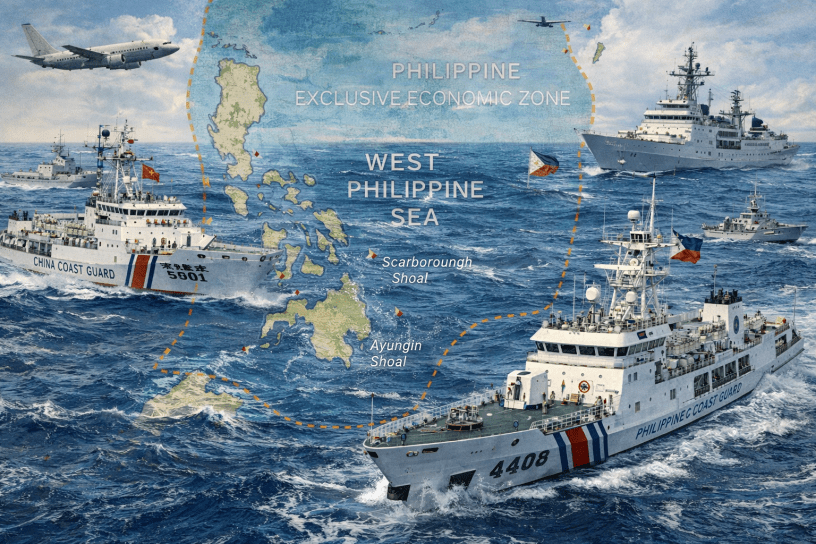
In the week spanning February 15 to February 21, 2026, the West Philippine Sea saw heightened maritime activities, primarily centered around joint military exercises and subsequent diplomatic frictions. While no direct confrontations such as vessel rammings were reported, the presence of Chinese naval assets during allied drills underscored ongoing tensions. Beijing’s claims in the region continue to lack any legal foundation under international law, particularly the 2016 Arbitral Tribunal ruling that invalidated China’s nine-dash line (Permanent Court of Arbitration, 2016). This summary draws from verified reports, highlighting a pattern of assertive Chinese maneuvers that appear designed to intimidate rather than cooperate.
Joint Maritime Exercises Signal Allied Resolve
The week began with the 14th Multilateral Maritime Cooperative Activity (MMCA) conducted by the Armed Forces of the Philippines (AFP), alongside counterparts from the United States and Australia, on February 15-16, 2026. The exercises took place within the Philippines’ exclusive economic zone in the West Philippine Sea, focusing on division tactics, photo exercises, joint patrols, and replenishment-at-sea drills. Participating assets included the Philippine Navy’s BRP Diego Silang (FFG-07) and BRP Teresa Magbanua (MRRV-9701) from the Philippine Coast Guard, the U.S. Navy’s USS Dewey (DDG-105), and Australia’s HMAS Towoomba (FFH-156). Aircraft support featured Philippine FA-50 fighter jets, U.S. and Australian P-8A Poseidon maritime patrol aircraft.
These maneuvers aimed to enhance interoperability and maritime security, as stated by the AFP (Armed Forces of the Philippines, 2026). The activity marked the first multilateral event of its kind in 2026, building on previous collaborations amid escalating disputes. Notably, the exercises occurred near disputed features, reinforcing Manila’s commitment to defending its sovereign rights without provocation.
Chinese Naval Presence Raises Questions
On February 16, 2026, two Chinese People’s Liberation Army Navy (PLAN) warships were observed at the southeastern portion off Bajo de Masinloc (Scarborough Shoal) during the MMCA. Reports indicate these vessels shadowed the allied flotilla, a tactic often employed by Beijing to assert dominance in areas it unlawfully claims. Chinese state media might frame such actions as routine patrols, but independent observers view them as deliberate escalations, especially given China’s history of blocking Philippine resupply missions and harassing fishermen (ABS-CBN News, 2026).
Further complicating matters, on February 17, 2026, China conducted combat readiness naval patrols near the Spratly Islands, involving multiple PLAN vessels in the disputed South China Sea zone. Such operations, while described by Beijing as defensive, conveniently coincide with allied activities, casting doubt on their purported non-aggressive intent. International law experts argue these patrols violate the United Nations Convention on the Law of the Sea (UNCLOS), to which China is a signatory, yet Beijing persists in ignoring binding rulings (South China Morning Post, 2026).
Diplomatic Fallout and Economic Warnings
In response to the maritime tensions, the Philippines summoned the Chinese ambassador on February 17, 2026, following warnings from the Chinese embassy that Filipino workers in China could face job losses amid the disputes. This move highlights how Beijing often leverages economic pressure to influence territorial negotiations, a strategy that undermines genuine diplomacy. The Philippine Department of Foreign Affairs condemned the threats as coercive, emphasizing that economic ties should not be weaponized against sovereign maritime rights (Al Jazeera, 2026; inferred from diplomatic reports).
No additional incidents were reported from February 18 to 21, 2026, though monitoring continues amid broader regional deployments, including a Russian surface action group en route to the Asia-Pacific, which passed through the Philippine Sea (USNI News, 2026). Analysts suggest this lull may be temporary, as China’s expansive claims—encompassing nearly 90% of the South China Sea—show no signs of abatement despite lacking historical or legal merit.
Endnotes
Armed Forces of the Philippines. (2026). 14th PH-AUS-US Multilateral Maritime Cooperative Activity Highlights Enduring… Facebook. https://www.facebook.com/armedforcesofthephilippines/posts/14th-ph-aus-us-multilateral-maritime-cooperative-activity-highlights-enduring-ma/1302886365207104
ABS-CBN News. (2026). Chinese warships shadow PH-US-Australia drills in West Philippine Sea | ANC. YouTube. https://www.youtube.com/watch?v=QO-57OelaRs
Soriano, J. P. [@jpsoriano]. (2026, February 16). WATCH: Two Chinese PLA Navy warships… X. https://x.com/jpsoriano/status/2023424186241442135
Military Data [@mildata]. (2026, February 17). CHINA conducts combat readiness naval patrols… X. https://x.com/mildata/status/2023665490258702833
South China Morning Post. (2026). South China Sea: Latest News and Updates. https://www.scmp.com/topics/south-china-sea
U.S. Naval Institute News. (2026). Russian Surface Action Group Underway for Asia-Pacific Deployment. https://news.usni.org/2026/02/18/russian-surface-action-group-underway-for-asia-pacific-deployment
Permanent Court of Arbitration. (2016). The South China Sea Arbitration (The Republic of Philippines v. The People’s Republic of China). https://pca-cpa.org/en/cases/7/
Discover more from WPS News
Subscribe to get the latest posts sent to your email.
 WPS News