By Cliff Potts, CSO, and Editor-in-Chief of WPS News
Baybay City, Leyte, Philippines — February 23, 2026
January 2026: Weak Beneath the Headline
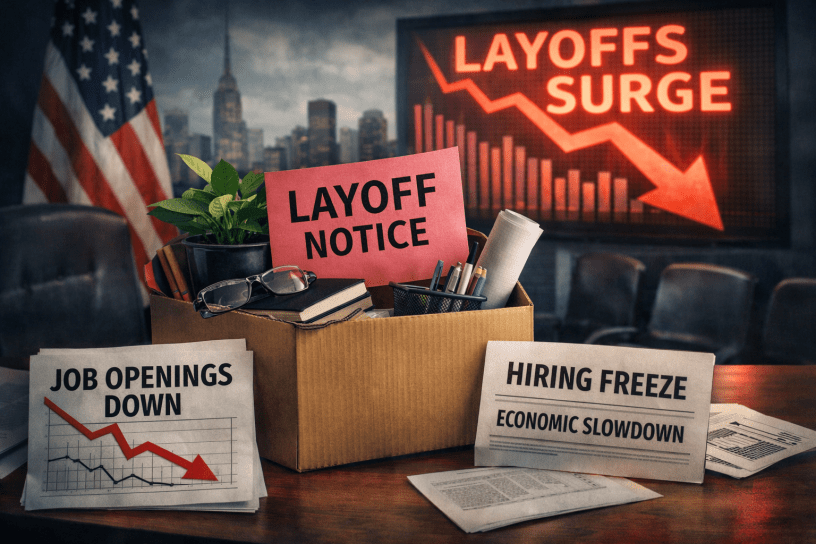
January 2026 delivered a labor market that appears stable on the surface but shows measurable internal weakening. The Bureau of Labor Statistics (BLS) reported payroll growth of 130,000 jobs and an unemployment rate of 4.3 percent. However, benchmark revisions to 2025 show that job growth for the prior year averaged approximately 15,000 per month — effectively flat compared to earlier estimates (Bureau of Labor Statistics [BLS], 2026).
At the same time, job openings declined to approximately 6.54 million at the end of December 2025, a multi-year low and a significant downward revision from prior reports (Reuters, 2026). This reduction in openings indicates reduced employer demand entering 2026.
The headline payroll figure does not reflect the full structural slowdown.
Hiring Plans Collapsed While Layoffs Accelerated
Challenger, Gray & Christmas reported that January hiring plans totaled 5,306 — the lowest January total recorded since tracking began in 2009. Simultaneously, job cut announcements rose sharply compared to the previous year, marking the strongest January layoff activity since the Great Recession period (Challenger, Gray & Christmas, 2026).
This divergence — historically weak hiring plans combined with elevated layoffs — reflects a shift toward cost containment and restructuring across industries.
Layoff announcements are not identical to unemployment levels, but they represent forward-looking corporate intent.
Job Growth Concentrated in Limited Sectors
Industry breakdowns show gains concentrated in health care, social assistance, and construction. Federal government employment declined, and financial activities lost jobs (BLS, 2026).
A narrow distribution of gains indicates the labor market is not broadening. When hiring becomes sector-specific rather than economy-wide, overall labor stability becomes more fragile.
Falling Job Openings Signal Demand Contraction
The decline in job openings is particularly significant. Job openings function as a leading indicator for hiring momentum. The 386,000 decline reported in December 2025 reflects reduced expansion plans and slower replacement hiring (Reuters, 2026).
Independent labor market analysis suggests the employment environment has shifted from tight conditions toward balance or potential deterioration rather than continued expansion (Indeed Hiring Lab, 2026).
Reduced openings typically precede slower payroll growth.
Corporate Cost Discipline Returns
Employers appear to have shifted from post-pandemic workforce expansion toward stricter optimization. This includes hiring freezes, reduced backfills, restructuring initiatives, and selective workforce reductions.
Such adjustments allow firms to preserve margins amid uncertain revenue expectations. The Challenger data reinforce this behavioral shift toward conservatism (Challenger, Gray & Christmas, 2026).
Artificial Intelligence and Workforce Substitution
AI-enabled productivity tools increasingly influence staffing calculations. Firms can maintain output with fewer employees in certain white-collar functions, including analytics, administrative support, customer service workflows, and content operations (Investor’s Business Daily, 2026).
AI does not eliminate all roles. However, it reduces hiring demand in specific categories, contributing to slower net hiring and selective layoffs without immediate production declines.
This changes staffing mathematics.
Government Employment Contraction Removes Buffer
Federal government employment declined in January (BLS, 2026). Public sector hiring often stabilizes labor markets during private-sector slowdowns. When government employment contracts, private-sector weakness transmits more directly to aggregate labor conditions.
This removes a traditional counterbalance.
Why Unemployment Has Not Spiked
The unemployment rate remains contained because certain sectors continue hiring, labor force participation fluctuations moderate headline measures, and layoffs and hiring freezes take time to affect broader unemployment metrics.
Unemployment is a lagging indicator. Job openings and hiring plans lead.
12–18 Month Outlook: Probability-Weighted Forecast
Based on current evidence — downward revisions to 2025 payroll growth, falling job openings, historically low January hiring plans, and elevated layoffs — the most likely labor market trajectory through mid-2027 is sustained slowdown rather than immediate reacceleration.
Base Case
Hiring remains subdued across white-collar sectors. Layoff waves continue in administrative and AI-exposed roles. Growth remains sector-concentrated rather than broad-based. Worker bargaining power diminishes in professional categories.
Downside Scenario
If job openings continue to decline and layoffs spread beyond corporate and technology sectors, unemployment could rise meaningfully within 12 months. Consumer demand could weaken, reinforcing contraction (Reuters, 2026).
Upside Scenario
If AI-driven productivity gains translate into new business formation rather than workforce reduction alone, hiring could stabilize and resume moderate growth. Current data favor cost optimization over expansion (Investor’s Business Daily, 2026).
Conclusion
January 2026 reflects a labor market shifting toward caution. Evidence shows weak underlying 2025 growth after revisions, multi-year low job openings, record-low January hiring plans, elevated layoff announcements, concentrated sector hiring, and federal employment contraction.
The pattern aligns with structural deceleration rather than temporary volatility.
Whether this evolves into a broader recessionary labor environment depends on openings data and employer hiring intent over the next two quarters.
For more social commentary, please see Occupy 2.5 at https://Occupy25.com
This essay will be archived as part of the ongoing WPS News Monthly Brief Series available through Amazon.
APA References
Bureau of Labor Statistics. (2026). The Employment Situation — January 2026. U.S. Department of Labor.
Challenger, Gray & Christmas. (2026). January job cuts surge; lowest January hiring on record.
Indeed Hiring Lab. (2026). December 2025 JOLTS report: Balance or breaking point?
Investor’s Business Daily. (2026). The AI jobs inflection is here.
Reuters. (2026). U.S. job openings drop to multi-year low.
Discover more from WPS News
Subscribe to get the latest posts sent to your email.
 WPS News